
















And the seventh day arrived... the first moment of truth. In one fell swoop, the longest stage of the Giro, the toughest stage faced so far in this edition and the first mountain-top finish: the Formia-Blockhaus leaves nothing out.
to follow the live coverage of the entire stage starting at 10:40 CLICK HERE
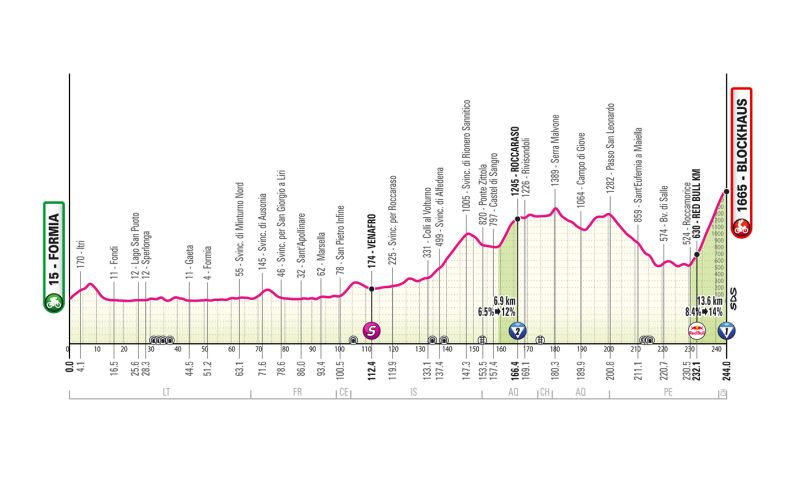
The mountain stage features 244 kilometers for a day that will approach seven hours of racing. The first part runs along the Lower Lazio coast through Sperlonga and Gaeta before touching Formia again and heading north. After Venafro - the intermediate sprint at km 112.4 - the road continues toward Rionero Sannitico and Castel di Sangro.
The first categorized climb is at Roccaraso after a 6.9 km climb at 6.4% average gradient, then comes the descent from Passo di San Leonardo before the long descent leading to Roccamorice where the final 13.6 km climb begins at 8.4% average gradient. The final ascent develops on narrow road with numerous hairpin turns. For almost 10 km the gradient stays above 9% with peaks up to 14%. Very brief downhill section 500 m from the finish and final straight uphill around 8%.
THE ROADS OF THE GIRO. To reach the first major climb of the Giro, you start from the sea. Formia, however, is much more than an appreciated seaside resort. Due to its position along the ancient Via Appia, its history is closely linked to Roman times. Among the most significant testimonies from that era are the Roman Cisternone of Castellone, a large underground structure from the 1st century B.C. articulated in naves and pillars, the Villa of Mamurra, a complex on the Gianola promontory articulated on multiple levels with thermal facilities, and the Mausoleum of Cicero. Of archaeological interest is also the Caposele area, with remains of a domus and spaces now dedicated to cultural activities, while in the Castellone district are the remains of the Roman amphitheater known as "Il Cancello".
Just after the start, a wide inland loop leads through territories where modern dairies produce the renowned buffalo mozzarella typical of these lands. Then you find the sea again at Sperlonga, where magnificent beaches and important Roman monuments - first among all the Villa of Tiberius - provide plenty of reasons for a stop. After passing Gaeta you leave the so-called "Riviera di Ulisse" and head decisively toward the Apennine ridges.
The brief Molise section of the race route allows you to discover the Roman city famous for its 33 churches and the Pandone Castle of Lombard origin.
Castel di Sangro preserves much of the ancient medieval layout, of which the Basilica of Santa Maria Assunta and the jewel fraction of Roccacinquemiglia perched on a rocky spur are admirable examples. Always balancing between past and present, this locality today known also for being an important production hub in the automotive sector, is also the cradle of Montepulciano d'Abruzzo, namely the red wine symbol of Abruzzo wine production.
Then comes the turn of Roccaraso (equipped with an equipped bike park, ideal for a few hours of fun on two wheels) and Rivisondoli, today established mountain resorts. A different atmosphere breathes at Sant'Eufemia a Maiella, where you walk along an open-air artistic path in which murals and other forms of painting enhance the environment, crafts and customs of the place and the Majella National Park. Worth seeing, among other things, the mother church of San Bartolomeo and the Church of Madonna delle Grazie. Caramanico Terme and Roccamorice invite further stops, but immediately after the final climb begins.
On the Blockhaus, in the Majella National Park, the legend of Eddy Merckx was born who on the occasion of the 1967 Giro d'Italia overwhelmed all his rivals conquering his first victory on a great mountain. Up there, on that plateau characterized by wide open spaces and a harsh natural environment devoid of permanent settlements, you breathe the history of cycling. And you enjoy the high altitude without mediation.



 1
1
 1
3
3
1
1
1
3
3
1
1

 Ritratti
 Oscar
Oscar Albi d'Oro


Se sei giá nostro utente esegui il login altrimenti registrati.