
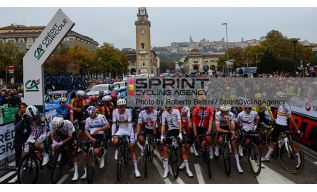
















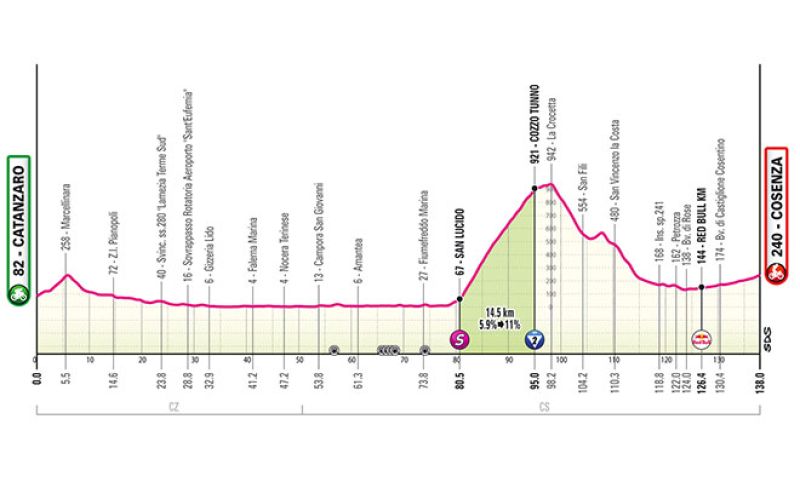
After the three-day Bulgarian stint, the Giro has returned to Italy and begins its journey down the Peninsula. It starts with the Catanzaro-Cosenza stage of 138 km, a short, fast stage, but with a long intermediate climb although not particularly demanding.
to follow the live coverage of the entire stage starting at 13:45 CLICK HERE
Departure from Catanzaro to reach Lamezia Terme without any altitude difficulties and from there continue along the Tyrrhenian coast (ss.18) always on wide road and slightly undulating terrain. After San Lucido (intermediate sprint at km 80.5) the Cozzo Tunno climb is tackled (connected at the summit to the Passo della Crocetta from Paola). A climb of almost 15 km, but without significant gradients: it's a category 2 with the summit at km 95. Followed by a long descent to the Crati plain where a slight uphill leads to the finish in Cosenza. The final 3 km are through the city with some curves in the central section always on wide roads. The race is always on a very slight uphill until the hump of the bridge over the Crati. Several wide curves follow that lead into the final straight. The finish line is 450 m long at 3.7% gradient.
THE ROADS OF THE GIRO. Catanzaro surprises. It does so, for example, in the Scolacium Archaeological Park, the city of Magna Graecia and later the Romans now immersed among olive groves and which you enter literally thanks to multimedia supports. Also of great importance is the Mediterranean Biodiversity Park, an area of about 60 hectares born from an urban redevelopment project that combines natural environment, contemporary art and scientific research. Here what catches the eye above all is the International Sculpture Park, with over 20 open-air installations created by world-renowned artists, including Tony Cragg, Dennis Oppenheim, Mimmo Paladino and Michelangelo Pistoletto.
Among the most representative places in the city is the San Giovanni monumental complex, built on an ancient Norman-Swabian structure and now a cultural center that integrates historic structures and exhibition spaces, including the Castle Galleries. Also important for the quality of the works collected is the MARCA (Catanzaro Art Museum).
Having left the Calabrian capital, the stage heads swiftly towards the Tyrrhenian Sea, which it reaches at Gizzeria Lido. From here the coast is climbed again by crossing renowned seaside resorts up to Amantea, a medieval village perched on a hill just above the shoreline. The old town, carved into the rock, is explored by walking through winding alleys to reach the church of San Bernardino da Siena (15th century). Worth visiting is the church of San Francesco d'Assisi from the 13th century, the towers of the Byzantine fortress and the Cathedral of San Biagio built on a previous Greek church. Back on the seashore, you continue until San Lucido where you turn inland to tackle the climb that leads to the 979-meter Passo Crocetta, the only notable difficulty of the day, which introduces the long flat stretch that leads to the finish.
Cosenza, often called the Athens of Italy for its important past preserves monumental masterpieces such as the Cathedral of Santa Maria Assunta of medieval origin and rebuilt in the 13th century and the Norman-Swabian Castle, while the Archaeological Museum of the Bretti and Enotri tells the story of the city with finds from the protohistoric, Hellenistic and Roman periods. Also worth seeing is the Carlo Bilotti Open-Air Museum set up in Corso Mazzini with sculptures by Dalí, Giorgio De Chirico, Mimmo Rotella and other internationally renowned artists. Technology enthusiasts will be amazed by the Interactive Museum of Computer Archaeology, an exhibition of historic computers (more than one hundred specimens) that describe the evolution of the computer through the decades. To conclude such an intense day you can relax in the greenery of Villa Vecchia, an urban garden of seventeenth-century origin recently renovated.

 3
3


 3
3


 2
2
1
1
2
2
2
2
1
1
2
2

 Ritratti
 Oscar
Oscar Albi d'Oro

