






















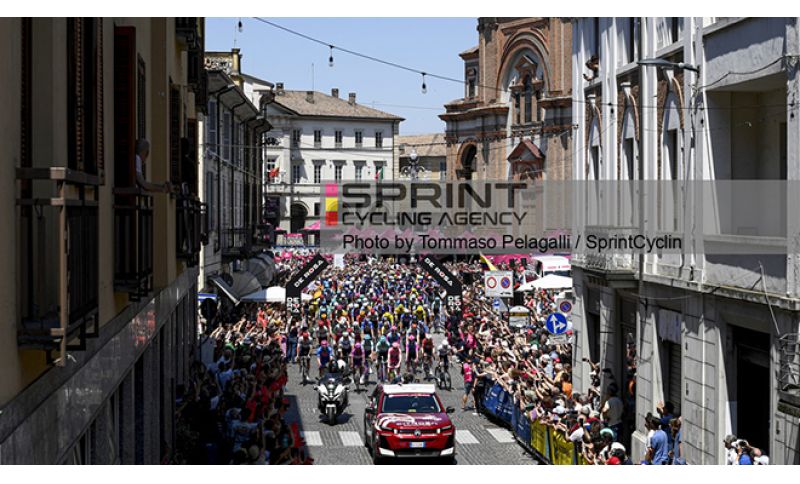
The final week of the Giro d'Italia opens with a scenario as fascinating as it is uncertain. Leading the general classification is Jonas Vingegaard, master of the race after two weeks in which he has shown he fears no opponents and tomorrow is ready to depart with the pink jersey on his shoulders. The Dane has managed every key moment of the race and now looks down on everyone, but the mountains awaiting the peloton leave any scenario wide open.
Behind him comes a surprise: young Portuguese rider Afonso Eulálio, second in the general classification 2'26" back and current leader of the young riders' classification. The Portuguese rider has been one of the great revelations of the race: brilliant on climbs, aggressive in the toughest stages and now a credible candidate for a place on the final podium in Rome.
Third place goes to Felix Gall, 2'50" behind the top. The Austrian has shown consistency and great endurance in the Alpine stages and aims to use the final week to put pressure on Vingegaard.
In the points classification, Paul Magnier leads, the absolute protagonist in sprints and active stages. Behind him are Jhonatan Narváez and Jonathan Milan, still in full battle for the cyclamen jersey.
Vingegaard also dominates the climbers' standings, confirming his superiority in high mountains. Behind him are Van der Lee and Giulio Ciccone, with the Abruzzese rider set to make his mark on the great Dolomite climbs.
Stage 16 from Bellinzona to Carì 113 km
The third week opens with a short but explosive stage: 113 kilometers from Bellinzona to Carì, in Switzerland, with almost 3,000 meters of elevation gain. A relentless day that could immediately ignite the battle for the pink jersey.
After a relatively calm start along the Ticino Valley, riders will face the climbs towards Torre and Leontica twice, before the final ascent to Carì: 11.2 kilometers at 8% average gradient, a severe and steady climb ideal for attacks from the big names in the classification.
Stage 17 – From Cassano d'Adda to Andalo: 202 kilometers of traps
The seventeenth stage offers a long ride of 202 kilometers towards Andalo, with over 3,200 meters of elevation gain. It's not an extreme Alpine stage, but the continuous succession of climbs and false flats could turn it into a grueling day.
The Passo dei Tre Termini and the Cocca de Lodrino will select the peloton, while the finale will be nervous and demanding. After a first passage through the Andalo finish line, riders will face a final circuit with the last 5.7 kilometers in slight but constant climbing. A perfect stage for finishers and general classification riders ready to capitalize on any crises.
Stage 18 – Towards Pieve di Soligo, but watch out for the Muro di Ca' del Poggio total 171 km
The eighteenth stage seems to favor sprinters, but the finale tells a different story. The 171 kilometers to Pieve di Soligo are made treacherous by the famous Muro di Ca' del Poggio, located just 10 kilometers from the finish.
The ramp measures just 1.1 kilometers, but with an average gradient of 12.3% it could split the peloton and eliminate the purest sprinters. It will be a day to interpret carefully, perfect for attackers and stage hunters.
Stage 19 – The Dolomites decide the Giro From Feltre to Alleghe (Piani di Pezzè) 151 km
The nineteenth stage is probably the queen stage of the entire race. Almost 5,000 meters of elevation gain among some of the most iconic Dolomite climbs: Passo Duran, Staulanza, Giau and Falzarego.
A deadly sequence that will culminate with the final ascent to Piani di Pezzè: 5 kilometers at 9.8% average after over six hours of racing. Here the Giro could definitively explode. If anyone wants to snatch the pink jersey from Vingegaard, they'll have to try on these mountains.
Stage 20 – From Gemona del Friuli to Piancavallo, the last chance 200 km
The penultimate stage represents the last real opportunity to overturn the general classification. After a more flowing first part, riders will climb Piancavallo twice.
The final climb measures 14.5 kilometers with an average gradient of 7.8%, but in the first half it often touches 10%. It will be a day of endurance and energy management, the last test before the final parade in Rome.
Stage 21 – Rome crowns the winner 131 km
As per recent tradition, the Giro will conclude in the splendid setting of Rome. After passing through the Ostia coast, the peloton will enter the final circuit of the Capital for eight flat laps.
Barring any shocking upsets, it will be the day of celebration for the general classification winner and the last chance for sprinters to leave their mark. But before reaching the Colosseum, the Giro will have to survive five stages that promise spectacle, attacks and legendary mountains.

 1
1


 1
1


 1
1
2
2
1
1
1
1
1
1
2
2
1
1
1
1

 Ritratti
 Oscar
Oscar Albi d'Oro

