















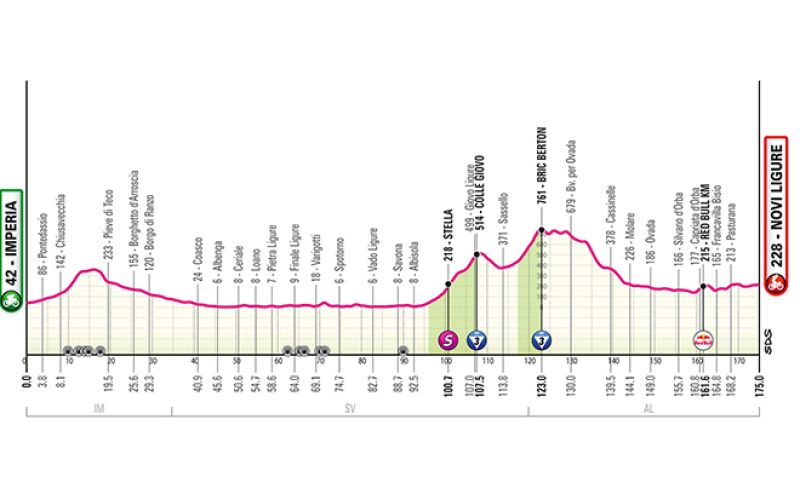
The 12th stage of the Giro d'Italia smells of Sanremo, which will take the peloton from Imperia to Novi Ligure for 175 km. After an initial passage through the Imperia hinterland up to Pieve di Teco, the stage follows the Via Aurelia from Albenga to Savona in the opposite direction to the Milano-Sanremo with some climbs.
to follow the race coverage starting from 13:05 CLICK HERE
Leaving Savona, riders reach the intermediate sprint at Stella (km 100.7) before climbing Colle Giovo and Bric Berton - both category 3 climbs with the mountain points located at km 107.5 and 123 respectively - which lead into the Po Valley where, with some short ups and downs, the route reaches Novi Ligure. In the final section, riders traverse some narrow roads before merging onto wide, straight roads. The last 3 kilometers are practically straight with some roundabouts that will be navigated with minimal deviations. The final turn comes 3000 m from the finish, which presumably could mark the return of the sprinters to the spotlight of the Giro.
THE ROADS OF THE GIRO. The stage start from Imperia allows you to discover a city that, while off the beaten path compared to the most frequented tourist circuits, knows how to seduce its visitors. It does so in its maritime quarters like Borgo Marina, Borgo Foce and Prino or in the Parasio district, a labyrinth of medieval alleyways, arches, small squares and panoramic views of the sea, as well as the Passeggiata degli Innamorati, a pedestrian path overlooking the coast. The city also offers an articulated cultural system, with a museum network that includes Villa Grock – Museum of the Clown, Villa Faravelli with the Museum of Contemporary Art and the Naval Museum, which tells the story of local maritime tradition.
The Ciclovia della Riviera dei Fiori passes through here, connecting Imperia to nearby coastal centers, but the riders will begin their day pedaling inland, passing through the charming medieval village of Pieve di Teco. They return to the seaside at Albenga, a surprising city of art. A brief journey through its past begins with the Church of Santa Maria in Fontibus with its remarkable Gothic portal. The Cathedral of San Michele, built on a previous place of worship from the early Christian era, preserves structures from the 11th century in the lower part of the façade and from the 12th century in the upper part, sides and apse. Right next to it stands the Baptistry (5th century) with its decagonal plan and considered the most important monument of Ligurian early Christian architecture. Not to be missed are at least two museums that tell distant stories: the Roman Naval Museum and Magical Transparencies, where glass artifacts from a nearby Necropolis are collected. In the large greenhouses visible along the roadside grow the flowers that have made this area a floriculture hub, appreciated worldwide for the variety of species cultivated and the care devoted to them.
Loano, Finale Ligure, Varigotti, Noli are the small towns that dot the coast and are destinations for tourists seeking relaxation year-round thanks to a truly mild climate. Just after Savona, ideally protected by the 16th-century Priamar fortress, riders bid farewell to the Ligurian Sea and head toward the heights that characterize the second part of the stage. Piedmont welcomes with the delightful Ovada, gateway to the so-called Lands of the Campionissimi.
Riders pedal on roads that are the cradle of legends of cycling such as Costante Girardengo and Fausto Coppi, to whom the Museum of the Campionissimi in Novi Ligure is also dedicated, which tells the evolution of the bicycle with extremely rare pieces and celebrates the greats of cycling. After the pilgrimage visit to the temple of cycling, you discover a beautiful, sporty but above all delicious town. The relationship between Novi Ligure and chocolate is an ancient marriage, always capable of delivering sweetness. And in the city, places to fill up with "fuel" for the next excursions truly do not lack.

 1
1


 1
1



 Ritratti
 Oscar
Oscar Albi d'Oro

