
















The trilogy of demanding stages that closes the first long week of the Giro d'Italia is completed on the roads of Emilia Romagna: the ninth stage will take the peloton from Cervia to Corno alle Scale for 184 kilometers.
to follow the live coverage of the entire stage starting from 12:35 CLICK HERE
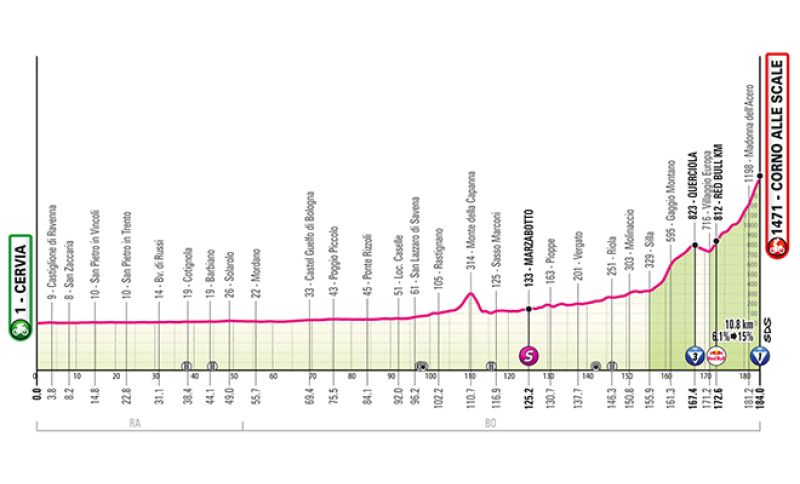
Today's stage is practically a single climb: the route is entirely flat from the start until Silla although after Sasso Marconi it begins to climb slightly along the Porrettana. The intermediate sprint is placed at Marzabotto after 125.2 km. At Silla begins the first categorized climb (which is effectively one with the final one from which it is separated by a very short descent). You pass through Gaggio Montano via the steepest access to reach Querceta (3rd category climb at km 167.4). Brief descent to Villaggio Europa (Lizzano in Belvedere) and then the final climb: 12 km all uphill on mountain road with numerous curves and some hairpin turns. In the last 3 km the gradient stays above 10% with peaks up to 15% before easing slightly.
THE ROADS OF THE GIRO. The beaches of Romagna are famous throughout the world, as is the quality of hospitality reserved for guests. This also happens in Cervia, naturally, the starting point of the ninth stage of the Giro. But there is much more here. The history of the place is closely linked to its salt pans - still active, by the way - and the wealth they generated. The historic center develops in the so-called Quadrilateral, an urban layout created at the end of the seventeenth century, which preserves symbolic buildings such as the Cathedral and the Town Hall. Testimony to the productive vocation are the Salt Warehouses, overlooking the canal port, next to the San Michele Tower, a defensive structure built to protect the city and salt reserves. The connection with the sea is evident in the Canal Port and the Borgomarina, an ancient fishermen's quarter.
The race continues through the Emilia-Romagna countryside. Perhaps it is no coincidence that in this region there are well-established agricultural machinery manufacturers whose products are exported worldwide. The next stop for fans is Bologna, barely touched by the Giro but absolutely fascinating for anyone who loves cycling: the climb leading to the Sanctuary of San Luca is a true monument of two-wheeled sport and is flanked by a portico that, with its over 600 arches, is the longest in the world. A stop in the Felsinean city inevitably leads to Piazza Maggiore and the presence of the Garisenda and Asinelli Towers, always present in every Bologna image.
The peloton ventures into the Reno valley passing through Pontecchio Marconi. It is curious that, in the era of radios that connect riders to team managers at every moment of the race, we pass through the village where the Nobel Prize winner for physics conducted his first experiments in wireless telegraphy. The Museum is dedicated to the work of Guglielmo Marconi and the history of telecommunications inside Villa Griffone, the family home of the Bolognese inventor.
At Marzabotto tribute is paid to the victims of one of the most horrific massacres of civilians that occurred during World War II, then the route heads toward the finish line passing among other things through Lizzano in Belvedere with an interesting Quartz Museum. Now almost in sight of the finish line, you pass next to the mystical Sanctuary of Madonna dell'Acero (16th century).
Corno alle Scale is the most important ski resort in the Bologna area, the place where Alberto Tomba laid the foundations of his extraordinary career. But even in this season the dense network of trails, the grandiose panoramas observed from the Apennine ridge, the vestiges of the Gothic Line and the suggestive Lake Scaffaiolo represent attractions to which one cannot and must not resist.

 1
1


 1
1



 Ritratti
 Oscar
Oscar Albi d'Oro

