





















The Giro d'Italia is full of pitfalls and also features stages where riders can pay – sometimes heavily – for the fatigue of the previous day. Today is one of those days: the Chieti-Fermo stage of 156 km is already a tough stage in its own right and comes the day after the grueling mountain stage that brought the peloton to the summit of the Blockhaus. So let's expect a thousand and more breakaway attempts and perhaps even gaps that could ultimately prove surprising.
to follow the live coverage of the entire stage starting at 13:15 CLICK HERE
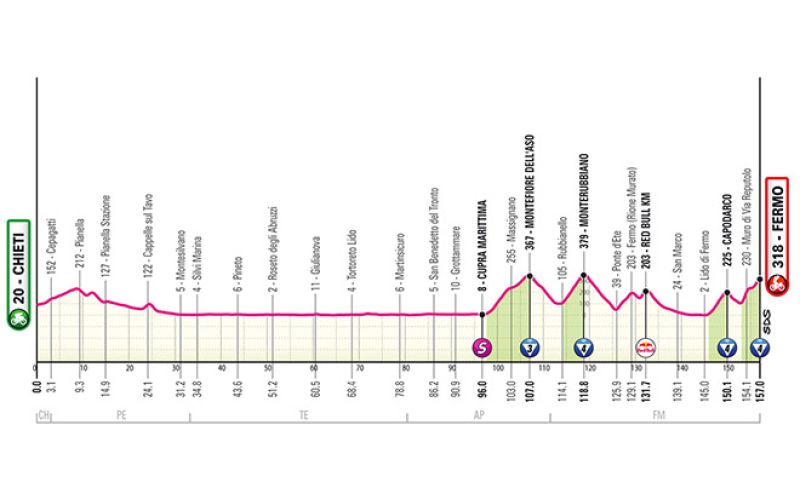
Like the previous ones, today's stage is also a mixed stage: first part along the Adriatic coast with flat terrain and substantially straight, wide roads, and second part in the Fermano hinterland with a succession of ups and downs and several "walls" to tackle especially in the final stretch.
After Cupra Marittima (intermediate sprint at km 96.3) the race heads inland and climbs the first categorized climb at Montefiore dell'Aso before the next one at Monterubbiano. This way you reach Fermo for the first time where you face the "wall" of via Cardarelli before reaching the ss.16 Adriatic road to tackle the Capodarco climb (categorized climb) and in rapid succession the Fermo-Reputolo climb with subsequent finish.
The final kilometers are all substantially uphill. After the Reputolo climb that leads into the town of Fermo (gradients up to 22%) you continue climbing through narrow city streets paved with porphyry also with steep gradients. Brief descent in the final 750 m and then climb to the finish on a ramp around 10%.
THE ROADS OF THE GIRO. The much-anticipated walls stage starts from Chieti where first of all due homage is paid to the Warrior of Capestrano, a stone and marble sculpture from the 6th century B.C. found in a necropolis of the ancient city of Aufinum: it is one of the most monumental and impressive works of Italic art: it depicts a warrior standing 2.10 meters tall! It is admired, with due respect, in the National Archaeological Museum of Abruzzo housed in the neoclassical Villa Frigerj before heading along Corso Marrucino, the main axis of the historic center characterized by prestigious buildings. Also worth seeing is the Cathedral of San Giustino, a jewel of Romanesque and Baroque architecture with its imposing bell tower, the six small naves of two bays each of the Crypt and the Baroque Chapel of the Arciconfraternita del Sacro Monte dei Morti, while silent witnesses of an ancient past are also the Roman Temples and the Amphitheater.
After a brief tour of the Teatino hinterland, the route finds the Adriatic coast at Montesilvano where the long climb up the coast begins, crossing renowned seaside resorts such as Silvi Marina, Roseto degli Abruzzi and Alba Adriatica. A mandatory stop at San Benedetto del Tronto, lively and entertaining, which also attracts with the particularly unique Sea Museum located in the port area. For size and variety of the exhibition proposal, the Museum is considered among the most complete of its kind. It is located in the Fish Market area and is divided into several locations, each dedicated to a specific aspect. You can thus visit the Antiquarium Truentinum, the Amphora Museum, the Augusto Capriotti Ichthyological Museum, the Museum of Maritime Civilization of the Marches.
The coast is followed further to Grottammare and Cupra Marittima, then back into the Marche hinterland, famous throughout the world also for the excellence of its footwear companies.
Here begins the feared – by riders – toboggan run between valleys and hills characterized first by the climbs that lead to Montefiore dell'Aso, to Monterubbiano and for the first time to Fermo. But it's not over. After one last descent towards the Adriatic you still have to tackle the wall of Capodarco and the climb, not easy, that brings you back to Fermo where the day's finish line is located.
A visit to the Roman Cisterns, dating back to the time of Augustus (1st century A.D.) and composed of thirty communicating rooms, is one of the mandatory stops when visiting the city. The heart of the city, however, is Piazza del Popolo, an elegant Renaissance space surrounded by arcades and overlooking historic buildings such as the Palazzo dei Priori and the Palazzo Apostolico. At the highest point of the city stands the Girfalco Park, a green area where the Cathedral of Fermo stands, a building rebuilt in the 13th century on older pre-existing structures and characterized by significant architectural stratification.



 1
1
 1
4
4
2
2
1
4
4
2
2

 Ritratti
 Oscar
Oscar Albi d'Oro


Se sei giá nostro utente esegui il login altrimenti registrati.