


















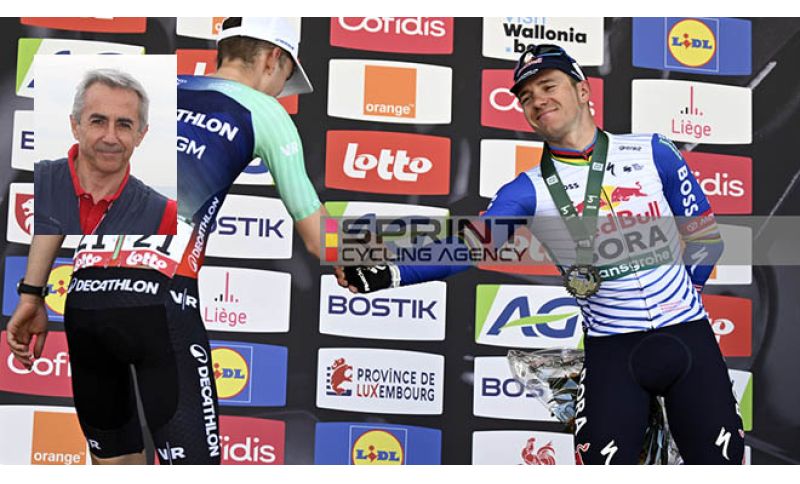
It seems clear to me: we're asking the wrong questions. The main one isn't "What and how much does Seixas lack to be Pogacar": from this perspective, the answer would be quite simple—the Frenchman lacks eight years of experience, or at least two or three if we're comparing him to the early days of the unstoppable Pogacar, plus a series of tests (the first at the next Tour) that must clarify above all his actual power as a three-week endurance rider. But this, as I said, is an almost childish question. The real question now is this: "What and how much does Evenepoel lack to be like Seixas". Yes, it's time to raise some questions about Remco's true stature. Talent is talent, no argument there. But how much talent? Not at Pogacar's level—we'd already figured that out some time ago. But as the seasons go on, it seems his stock continues to fall even compared to other riders. The Belgian new-generation talent, poached from football, is now 26 years old (full maturity in today's cycling) and is in his eighth season as a professional, if my count is right (since 2019). Some conclusions will have to be drawn. After this latest Liège, if I had to define him, I'd say this: unbeatable (or nearly so) in time trials, very beatable in grand tours, very beatable in the great classics, he becomes unbeatable again when certain riders aren't at the start, that is, the superleague of the peloton, without repeating the names of those three (road races) or those two (grand tours). Recent news: to the list of those who beat him we must add one more, the young kid from the superpower that doesn't know bidets, the phenomenal Seixas.
Let's be honest: they're really becoming a multitude. There's a whole crowd of people stronger than the phenomenon Evenepoel. So then: what kind of phenomenon is he? Are we still sure he's such a phenomenon? Reality speaks for itself: in fact, at 26 years old, Remco crowns himself the absolute number one of the second division of this cycling world, clearly, by far. However: when he enters the ruthless circle of the first division, he emerges diminished and humiliated. He's regularly the first among the beaten. Good, but always beaten.
Can that be enough? It's his business, his paymaster's business, his fans' business. The first among the beaten, however much praise he deserves, is still also the last among the phenomena. Perhaps he isn't even that. Or he is only when there are no other competitors in the race.

 35
35


 35
35


 2
2
1
1
2
2
1
1

 Ritratti
 Oscar
Oscar Albi d'Oro

