

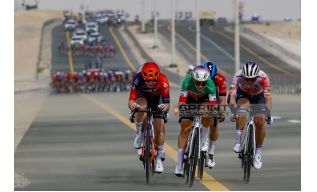













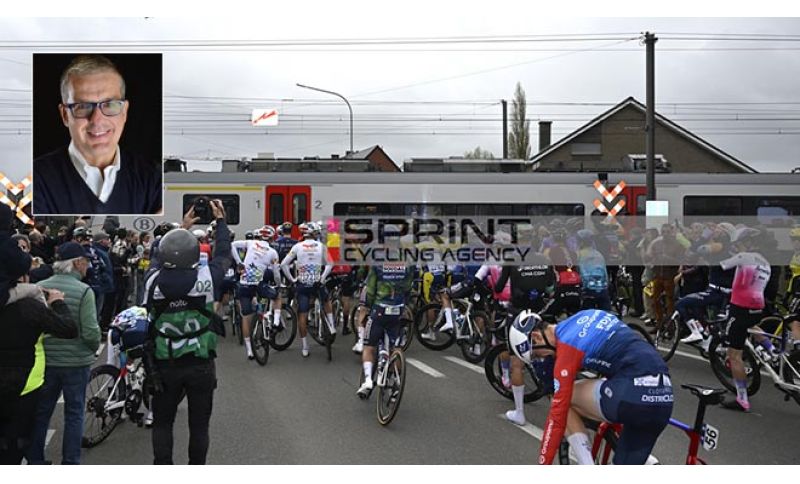
What's intriguing is the absence of video footage. A week has passed and it's hard to find a clear and sharp document showing what actually happened. Last Sunday, during the Eurosport broadcast, at the moment the race passed the level crossing, an advertisement was aired. When returning to the studio, Luca Gregorio (assisted on this occasion by commentators Riccardo Magrini and Moreno Moser) explains that something particular had happened in the race in the meantime, but the images don't show the moment when the breakaway riders pass the level crossing or even the immediate chasers, only Politt speaking with the race jury president, the Spaniard Vincent Tortajada Villarroya (commissioners Guy Dobbelaere, Belgium; Wilfred Haan, Netherlands; Laurent Bastien, France; Jurgen Deryckere, Belgium), rather animatedly. Up front, in the breakaway, a group of attackers. Behind, a small group of about fifty (54) riders with Pogacar and Evenepoel, who according to the authorities of the West Flanders court committed a serious infraction by passing a red light and are therefore subject to legal sanctions. For the jury, however, everything was fine. Is it possible that ordinary justice can intervene so forcefully in the "playing field" of a cycling race? Is it possible that riders who, until proven otherwise, are simply doing their job, are being targeted? Is it even possible that such things happen at the Tour of Flanders as they wouldn't at a local village race? Clearly not.
In this case, the victims are the riders, who as usual find themselves at the mercy of regulations and improvisation on the matter. The questions are the usual ones: did the organizers provide advance warning of the danger posed by the level crossing? Did they put in place all the necessary "actions" to help riders understand that danger was imminent? The organization is required to place directional arrows, panels indicating a narrowing, in short, to signal to the rider all the critical issues involved, but were they signaled on Sunday? I don't think so, in fact the riders, both during and after the race, clearly spoke of a lack of information. I repeat: we're talking about the Tour of Flanders, not a local trophy race.
The central point of this Belgian "mess" lies precisely here: was the level crossing supervised by organization personnel and race commissioners? In these cases, according to experts, the level crossing must be supervised by both. The organization is responsible for ensuring that its personnel supervise the area in front of the level crossing, ready to move to the center of the road with a red flag indicating the obligation not to proceed and thus decree a temporary halt to the race. The commissioners then have the task of observing the incident and the related behavior, to decide based on their powers (art. 2.3.035 of the UCI sporting regulations) whether to resume the race with a single restart (the so-called racing incident), but also to provide for staggered restarts preserving the gaps recorded between riders or groups of riders at the moment the race was halted. Up to the possibility of stopping the breakaway riders who didn't encounter the level crossing closure, because from what happened behind them, they gained an undue advantage. Not least, the extreme measure – that of disqualification – for those who crossed the level crossing despite the clear and signaled prohibition (art. 12.4.001 of the UCI regulations).
So, returning to the point: did the relay team warn the group of immediate chasers in time that an "obstacle" was imminent? The images don't exist (here's what television self-production is for…). At the crucial moment, an advertisement aired, which is the lifeblood of commerce for everyone – including us – but in this case, it's important to try to understand calmly what really happened, without interference from ordinary justice and without necessarily selling our soul to the devil. This is about safety, about riders and human capital: the history and credibility of our sport are at stake. It's not just a matter of station masters and trains running late.

 26
26


 26
26



 Ritratti
 Oscar
Oscar Albi d'Oro

