
















The greatness of Eddy Merckx, a unique figure in cycling history, also passed through Milan-San Remo and those seven victories that made him a legend. The Belgian turned professional in 1965, not even twenty years old, and on his shoulders he carried the amateur world champion jersey. His name is Edouard Louis Joseph Merckx, called Eddy. He started with football and boxing, then chose cycling: his idol is his fellow countryman Stan Ockers, the Belgian who appears in the most famous photo in cycling, that of the water bottle exchange between Coppi and Bartali at the 1952 Tour de France.
1966
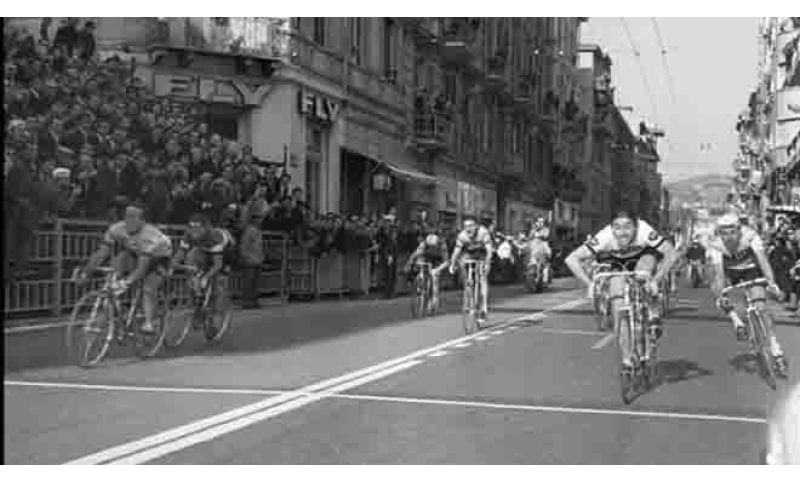
In 1966 Merckx goes to race in France with Peugeot and on March 20, 1966 (exactly 60 years ago today) he lines up at the start of Milan-San Remo, the Spring Classic, the race that is worth a career. The white jersey with black checks, race number 131. He is the youngest in the race, 20 years old, and has never raced such a long distance. Waiting for him are 288 kilometers with the Poggio at the finish but without the Cipressa, which will be added to the route in 1982. On Via Roma with a long sprint in his style, he beats Adriano Durante and Herman Van Springel. Merckx said: "They say I lack experience, but I always race to win. I have good legs." And years later, remembering that day, he explained: "I remember that San Remo perfectly, winning it at twenty years old was wonderful. The counterattack with Poulidor on Capo Berta, the chase of the fifteen escapees and then the battle on the Poggio and the very fast descent towards the sea. We were down to eleven. A few days earlier, at Paris-Nice, at the Auxerre finish I had been beaten by Durante and Dancelli, and now they were there with me at San Remo, I knew they were dangerous. When Van Springel attacked I knew how to wait, it was up to Durante to close on him, then I attacked decisively. I had chosen the left side of the road, Durante and Dancelli were on the right. The sprint at San Remo is always difficult, but I won."
From that day on, Merckx will race San Remo nine more times: seven triumphs in 10 starts, from 1966 to 1977. He surpasses Costante Girardengo, 6 successes, and sets the record of records in cycling, because no one has ever won such a high number of victories in a single Monument Classic. San Remo always remained in his heart, because "it is the first of the great classics, it has an extraordinary tradition. It is a ritual, a coveted finish line and everyone dreams of conquering it. It is the race that marked my life, it made me understand that cycling could become my life, and it made me known in Italy, my second home, I became popular with you. The one in 1966 was my first, great success. Something exceptional, in relation to my age, I had finished military service a month before. I remember there was so much public, along the road and at the finish."
1967
The second victory at San Remo comes right the following year, still in Peugeot colors: it is March 18 and this time Merckx prevails over three Italians: Gianni Motta, Franco Bitossi and Felice Gimondi. He also sets a new average speed record: 44.805 km/h. "Beating the best Italians of that time makes my victory more beautiful." This is the year in which Merckx conquers his first Giro d'Italia stage on the Blockhaus, the pink race that he will win five times: like only Binda and Coppi.
1969
On March 19 Merckx achieves the hat-trick, and it is the first San Remo in which he raises his arms on Via Roma all alone, not in a sprint. He is already "Italian" in jersey, racing for Faema. At 12" his fellow countryman Roger De Vlaeminck beats Marino Basso for second place. Eddy said: "It was the easiest race of my life. I was a spectator at the head of the group until the Poggio."
1971
On March 19 there is the four-timer at San Remo, in Molteni colors, as it will be for the next three victories in the Classicissima. With four triumphs, Merckx reaches Gino Bartali, it is the first step to enter legend. He arrives on Via Roma once again alone: Felice Gimondi is second at 30", third is Swedish Gosta Pettersson, who three months later will win the Giro d'Italia guided from the team car by Alfredo Martini. Thus Merckx: "I expected Gimondi's attack on the Poggio. I let him exhaust himself, I jumped him easily."
1972
On March 18 Merckx lines up at San Remo with the world champion jersey after his triumph at Mendrisio in the epic duel with Gimondi. He achieves his fifth San Remo victory, arriving on Via Roma with his right hand open to indicate the "5", but this is the victory of fear. He attacks on the Poggio and triumphs once again alone with 9" over Gianni Motta and Marino Basso. Eddy recounts: "I had fallen at Paris-Nice, I suffered a lot. I attacked because I was afraid."
1975
This year's San Remo inaugurates the duel between giants: Merckx, still in the rainbow jersey after his victory at the 1974 Montreal World Championship, against a young rising star, Francesco Moser. It is March 19. The Trentino frightens Merckx with a dive down from the Poggio in his style, which puts the Fleming on the ropes, and then loses in the sprint to Eddy on Via Roma: third is Frenchman Sibille. With his sixth triumph, Merckx reaches Costante Girardengo, the only one with six victories in the Classicissima. Thus the Cannibal: "Great attack by Moser on the descent, and I came back at the last moment. Then in the sprint I had no problems." But in July, at Charleroi, that Italian inflicts a sensational and unexpected defeat on Merckx in the opening time trial of the Tour de France right in Belgium, at Charleroi, and steals the first yellow jersey that had already been prepared with Eddy's sponsor. That defeat by Moser, even today, Merckx remembers as the most bitter of his career.
1976
It is March 20 when Eddy Merckx, who is 30 years old, enters the legend of San Remo. Seven triumphs, like no one ever. Still in Molteni colors, he beats in a two-man sprint Belgian Jean Luc Vandenbroucke (who will later be disqualified for testing positive), third Miro Panizza at 28". On the finish line, Eddy shakes his right fist: "It was my answer to the critics. Everyone was saying that Merckx is finished, Merckx is no more. And I proved that I was not yet sportingly dead, even though I had physical problems after the accident and fractures at the 1975 Tour. I tried to do the impossible to drop De Vlaeminck, Maertens, Sercu... because in a sprint I would risk being defeated. And I was sure of winning only when I raised my arm on Via Roma."

 1
1


 1
1


 1
1
1
1
1
1
1
1

 Ritratti
 Oscar
Oscar Albi d'Oro

