
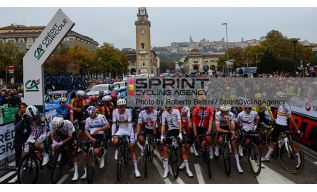
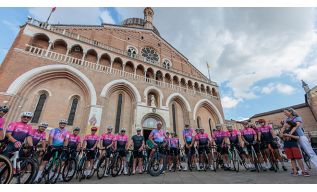

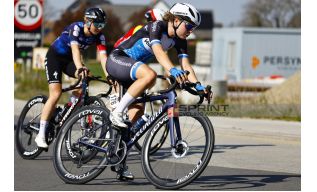
















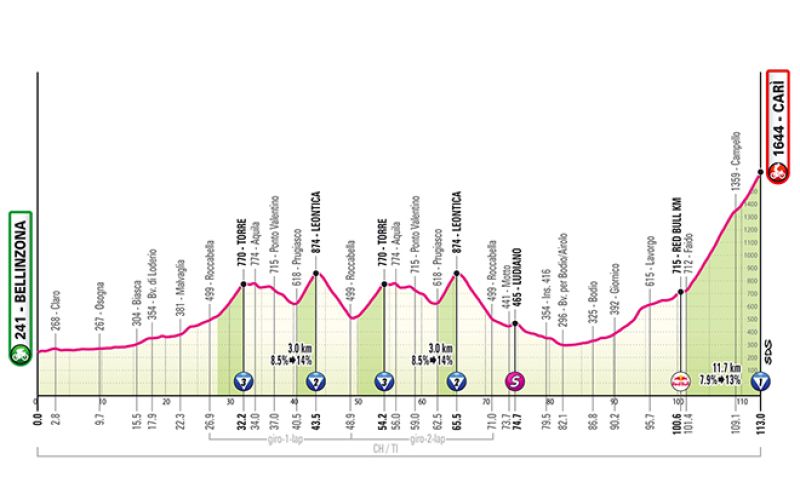
After the third and final rest day, the Giro d'Italia restarts... from Switzerland. The entire sixteenth stage is set in Ticino with departure from Bellinzona and finish at Carì after 113 km and 3,100 meters of elevation gain.
To follow the live coverage of the entire stage starting from 1:45 PM CLICK HERE
A Swiss stage, a mountain stage: after an initial slight climb, riders enter a 22 km circuit to be repeated twice, characterized by two climbs in succession, with the second, Leontica, being challenging. It's a second-category climb that will be tackled first at km 43 and then at km 65. The Torre climb is third category with the categorized point at km 32 and 54. After leaving the circuit, riders reach the intermediate sprint at Ludiano and then enter the San Gottardo valley with a constant climb to Faido where the final ascent begins of 12 km with an average gradient of 7.9% and maximum slopes of 13% within the final kilometer.
THE ROADS OF THE GIRO. This edition's stage entirely in Swiss territory is short, but the uphill finish will expose the big names. The frenzy of racing, however, won't concern the spectators who can already immerse themselves in the magnificent atmosphere of Bellinzona before the start. The view is indeed dominated by one of the most important fortified systems in the Alpine arc: the Fortress, a UNESCO World Heritage site, composed of Castel Grande, Montebello and Sasso Corbaro. These three medieval castles, connected by defensive walls, tell the strategic history of the city and offer spectacular panoramas over the Ticino valley. And that's not all.
In the historic center stands the Collegiate Church of Saints Peter and Stephen, an example of Renaissance architecture with stone facade and richly decorated interiors, while among Bellinzona's cultural attractions stands Villa dei Cedri, an art museum housed in a nineteenth-century residence immersed in a historic park.
The silent Blenio Valley fascinates with its ancient and well-preserved villages such as Lottigna and L'Aquila and with its Romanesque churches, among which stand out those of Negrentino and Ponto Valentino. The second part of the stage instead climbs the Leventina Valley, which in the Middle Ages was one of the main transit zones for those who needed to cross the Alps through the Gotthard Pass for any reason.
Among the many villages encountered along the route, Giornico deserves at least a stop, characterized by stone houses, cobbled streets and two impressive arched bridges over the Ticino. In the Casa Stanga, recognizable by its facade on which you can admire over 50 coats of arms painted in the sixteenth century by travelers of high rank who stopped in the village, you'll find the Leventina Museum where precious and very interesting treasures from the valley are preserved. From a monumental point of view, the Romanesque church of San Nicolao stands out with very well-preserved medieval frescoes.
At Faido the road steepens, the finish at Carì is 12 kilometers further up, at 1,664 meters elevation. A mountain environment that offers numerous opportunities for relaxation and entertainment. Among the most immersive experiences stands out the Carì Experience route, an educational trail that crosses the forest with informative and sensory stations offering a conscious approach to nature. In the surrounding area you'll find the imposing Piumogna Waterfall and the Piottino Gorges, a suggestive natural passage carved by the Ticino river along the ancient Gotthard route. Getting bored while waiting for the riders is truly impossible.

 2
2


 2
2


 2
2
1
1
2
2
2
2
1
1
2
2


 Ritratti
 Oscar
Oscar Albi d'Oro

