















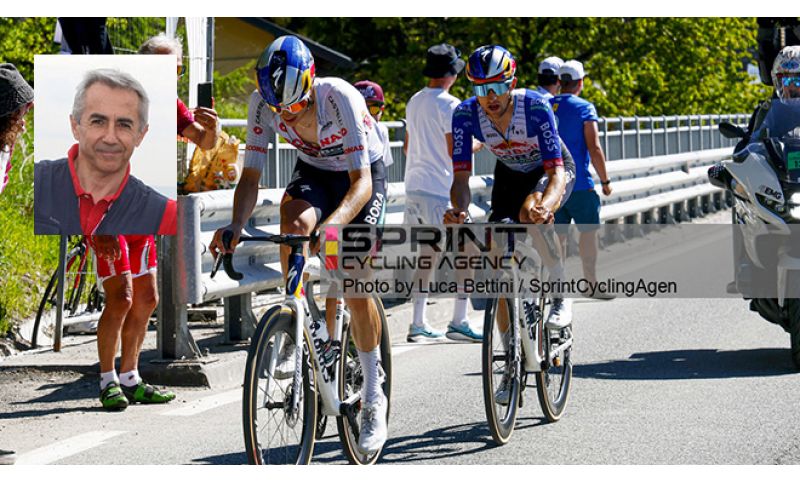
He is not Pogacar and he is not even Vingegaard. I find it unfair to expect him to become one (at almost 23 years old, those two had already changed the world). But Pellizzari is Pellizzari, he is all we have, he is the hope and the reality, he is the only Italian who hypothetically, ideally, potentially could say important things in the grand tours (there are those who already place his friend Piganzoli next to him, but honestly it seems a bit premature to me).
We won't even bother to recap the previous episodes too verbosely: Pellizzari served his apprenticeship with the Reverberi family (may heaven always bless our Reggio Emilia academy), he earned his upgrade (God, how well I speak) to the top-team (God, how I speak again), where he began his true master class (God, how...) in leadership (God...), first as Roglic's assistant, now finally as a true leader.
We know how it's been going: between excessive risks (the time on Blockhaus when he tried to be Vinge) and nasty viruses, his Giro was heading into total disaster, within a millimeter of a humiliating withdrawal. Then the unexpected happened: from the iron logic of the scientists who now govern the big teams out popped a fossil, considered lost in the mists of antiquity, character. That is to say that factor which no master class and no methodologist, nor even the best mental coach (God, how...), will ever be able to create and cultivate, not even by corrupting with monstrous doses of Giga the most shameless of Artificial Intelligences.
By pulling out his character, which only mom and Mother Nature have granted him, Pellizzari is managing to swim upstream against the current of failure like a salmon. The clear signal: the resistance and reaction on Pila. Nothing historic, but a real signal. The beginning of a new beginning. Now, a week to get back to his place, where we had placed him with such fervor, starving as we are, on the podium of our future dreams. It would take – it will take – one great stage among the three mountain stages, it would take – it will take – to always stay with the best, at least until Vinge decides to stay there, then with the others, remembering that it's one thing to be inferior to a phenomenon, another – much more depressing – is not to hold your own against Gall, Arensman, Bernal.
Giulio is a dear boy, he has more of a boomer profile than a tattooed punk-like type, but above all he shows clear attitudes of a true racer on the bike. How much, he'll have to prove it in the next couple of seasons.
But there's a but: he needs to be helped to understand it and to understand himself. He needs to be protected. And here I switch to polemic mode: it doesn't seem to me that Red Bull Bora has done everything for the best on his behalf so far. I'm referring directly, without beating around the bush, to Hindley's proximity: presented as a kind of expert tutor, to help him in the decisive moments of the stage, but above all to be there for him psychologically even in difficult moments. So far, none of this has been seen.
In his honest candor, Pellizzari says that Hindley is like a brother. Hindley obviously confirms. The team itself speaks of two captains, to close a pincer around Vingegaard (we saw how that worked out). What we all saw, not being exactly naive, is that Hindley didn't miss an opportunity to put a few seconds between himself and the boy, always with the same scheme, with a final little attack more propaganda than substance.
Let's be clear: Hindley can't be sacrificed to Pellizzari, if Hindley is strong enough to drop everyone and dominate the Giro, he has every right. But something different is happening here: Hindley doesn't have the strength to dominate anything, I'm not talking about Vinge, but not even Gall. If all he can manage is to attack three hundred meters from the finish line to gain 7 seconds, then I'd call it something else: it's dirty play. The only result of these little attacks, now a ritual in Hindley's Giro, is to show that he is better than Pellizzari. This on a hierarchy level. But on a psychological level, of simple human relations, the effect is heavier: certainly, they don't encourage the young guy, if anything they mortify him. And it's precisely here that the team should step in, stopping the dirty game, imposing logic and respect. Without naming names, there's also another way to demonstrate what I mean: Caruso. And I'll say no more.
The moral? There's a feeling that these German-style managements – money, science, organization, schematicism, planning, rigidity – are showing some limits. Obviously I'm also talking about Lidl, also German-run. Who knows: the Germans invented cycling in the '90s, with Ullrich and Telekom (Altig was an emigrant in Italy), certainly they don't have in their DNA and mindset a culture built over centuries, like Spain, France, Italy. And who's to say that in certain situations where heart, elasticity, imagination, even improvisation are needed, they don't quickly go down. Who's to say that when a high dose of humanity is needed, see the growth crisis of an Italian boy, these limits don't jump right out. It's a hypothesis, not a scientific truth: clearly, the Germans will have a hard time understanding. For the occasion, a simple formula still comes in handy, never surpassed: Italy-Germany 4-3. They'll definitely understand this one. No hard feelings, just joking. But not really.

 17
17


 17
17


 2
2
1
1
2
2
2
2
1
1
2
2

 Ritratti
 Oscar
Oscar Albi d'Oro

