






















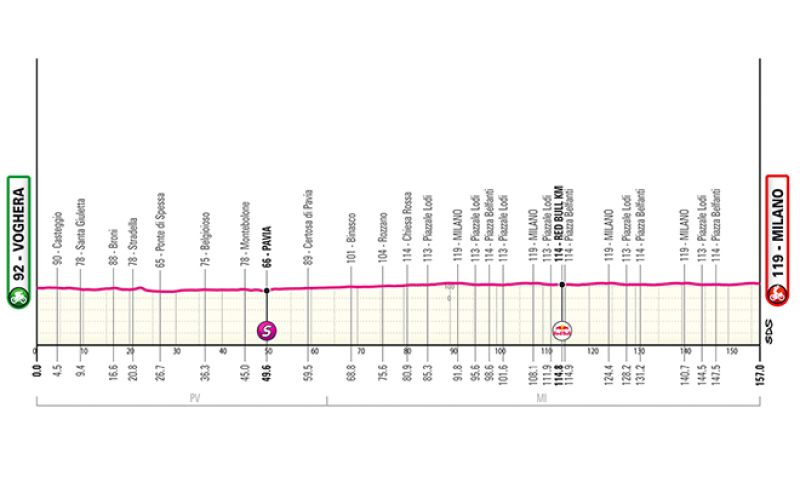
A completely flat stage for the Giro d'Italia's return to Milan after 5 years. Stage number 15 starts from Voghera and concludes in the heart of the Lombard capital, which in 1909 gave birth to this beautiful adventure that is the Giro d'Italia.
to follow the live coverage of the entire stage starting at 13:40 CLICK HERE
As we said, the stage is completely flat: departure from Voghera to Pavia on wide and straight roads. After Pavia to Milan, it retraces the historic Sanremo route, entering the final circuit of 16.3 km after the Chiesa Rossa, to be repeated 4 times. The 16.3 km circuit develops along wide avenues with few curves, the last one approximately 2 km from the finish on Corso Venezia.
THE ROADS OF THE GIRO. In Milan there will be spectacle and, probably, a festival of sprinters. But, however brief, the road leading to the Lombard capital offers numerous points of interest. Voghera's rich historical heritage includes first and foremost the Visconti Castle, built in 1372 and featuring frescoes attributed to Bramantino. In the heart of the city stands the Cathedral of San Lorenzo, begun in the seventeenth century, which houses within it a Serassi organ from 1833 and the so-called Cathedral Treasures: gold brocades, precious furnishings and miniatures. Style and beauty have never ceased to be a characteristic feature of Voghera: Valentino Garavani, the designer who recently passed away and to whom the elegant Teatro Sociale was dedicated, was born here, for example.
The stage initially follows the ancient Via Postumia, which winds through the extreme edges of the Oltrepò Pavese, cradle of highly prized wines and where it is lovely to discover villages and castles with long histories. A mandatory stop in Stradella, whose important past is first witnessed by the soaring Civic Tower. But a visit to the town is not complete without stopping at the Accordion Museum, which tells the story of the instrument's evolution from 1876, when the first workshop in Italy was opened here, to today.
Pavia, a little-known treasure chest of art, would require an entire day to be discovered. The must-see stops are at the Cathedral topped by the third largest dome in Italy, the Basilica of San Michele Maggiore where numerous coronations have taken place over the centuries, including that of Frederick I known as Barbarossa, and the Basilica of San Teodoro (11th century) with its wonderful sixteenth-century frescoes.
Just outside the city, the monumental complex of the Certosa of Pavia demands maximum attention, built between the 14th and 15th centuries and enlarged several times, representing one of the most grandiose religious sites in Lombardy.
The final carousel along the streets and avenues of Milan will be at full speed. Like everything that happens in the city, after all. To discover some lesser-known places in the capital of Fashion and Design, you can explore some museums that more than others celebrate ingenuity, technique and innovation.
Starting with the ADI Design Museum, inaugurated in 2021, which houses the historic collection of the Compasso d'oro and important temporary exhibitions. The MUDEC - Museum of Cultures also offers important exhibitions that accompany a permanent collection rich in pieces that tell millennia of creativity from peoples of five continents. Located in the Triennale Palace, a stone's throw from the Sforza Castle, is the Museum of Italian Design which houses a collection of approximately 1,600 pieces particularly representative of Italian design from 1946 to 1981. Nearby you immerse yourself in the world of creativity in what was the studio of Achille Castiglioni, one of the fathers of design in Italy. Also not to be missed is a visit to the Gae Aulenti Archive, located in the house designed and inhabited by the same starchitect on Via Fiori Oscuri, which houses drawings, models, design objects and contemporary artworks acquired over the years.



 2
2
 2
1
1
2
2
2
1
1
2
2


 Ritratti
 Oscar
Oscar Albi d'Oro


Se sei giá nostro utente esegui il login altrimenti registrati.