


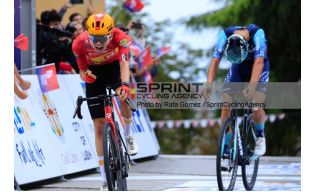
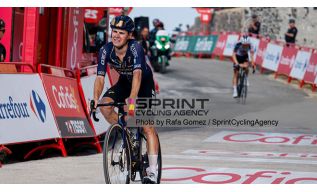

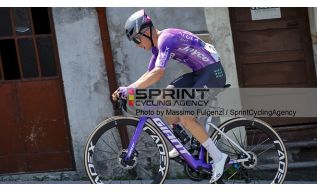
















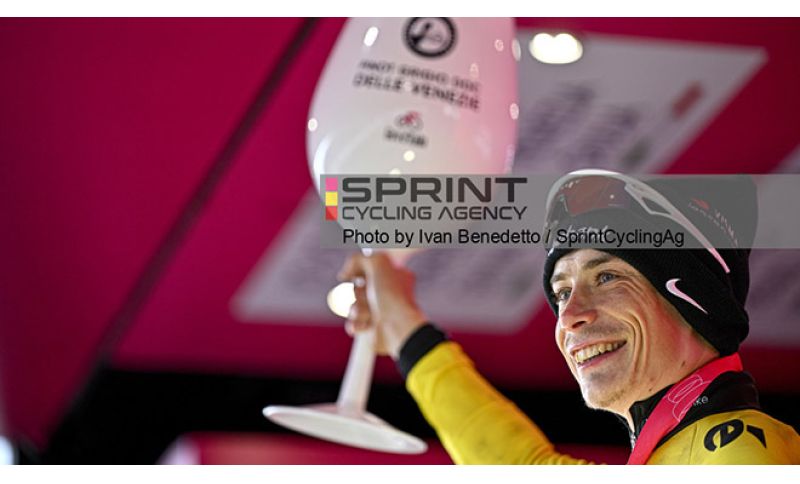
In modern cycling there are victories that are measured by the stopwatch, by the gap inflicted on opponents, by the weight of the general classification. And then there are victories that enter a broader dimension, almost archival, because they modify a rider's position within the statistical memory of this sport. The victory of Jonas Vingegaard at the Giro d'Italia belongs to this second category. It is not merely a stage conquered: it is the completion of a trajectory.
With this success, in fact, Vingegaard becomes the 115th rider in history to have won at least one stage in each of the three Grand Tours, namely the Giro d'Italia, Tour de France, and Vuelta a España. This is a very significant indicator, because it measures not only the absolute quality of the rider, but also his ability to be competitive in different technical, tactical, and environmental contexts. The Giro requires adaptation, resistance to changes in pace, and the ability to read often nervous stages; the Tour represents the pinnacle of media and competitive pressure; the Vuelta, by its structure and position in the calendar, often rewards riders capable of managing fatigue, heat, severe climbs, and tactically less linear racing. Entering this group means, therefore, surpassing a threshold of competitive completeness. It is not enough to be strong in one race or in one phase of a career: one must demonstrate repeatability, performance longevity, and adaptability. The data becomes even more significant when considering that, among these 115 riders, twenty are currently still professionals. Vingegaard thus enters a historic elite, but does so as a fully active athlete, with further room to increase his statistical footprint.
The victory also represents the 49th professional win for the Dane, who thus reaches Diego Ulissi among active riders. This is an interesting figure because it places Vingegaard in a particular zone of contemporary cycling statistics. We are not facing a rider built on the volume of victories, as happens with sprinters or some specialists in one-day races; we are before an athlete who concentrates his successes in events with high competitive density. In other words, the absolute number of victories must be read together with their average quality. In Vingegaard's case, the specific weight of successes is very high, because many victories come in WorldTour contexts, in decisive stages, or in general classification races.
The one achieved at the Giro is also the seventh seasonal victory, the first after the success in the general classification of the Volta a Catalunya, achieved 47 days earlier. This time interval is useful for reading the dynamics of condition. It does not indicate a true competitive interruption, but rather a phase of calendar management and form reconstruction toward a higher objective. In contemporary cycling, especially for Grand Tour riders, the season can no longer be evaluated solely in terms of weekly continuity of victories. What matters much more is the ability to place the performance peak at strategic moments. From this point of view, Vingegaard's return to victory signals a reactivation of performance at the moment when the race enters its most selective phase.
The national data adds another level of interpretation. Vingegaard becomes the thirteenth Dane to win a stage at the Giro d'Italia, bringing Denmark's total stage wins in the pink race to twenty. This is not an enormous number, but precisely for this reason it is significant: Denmark does not belong to the dominant historical tradition of the Giro, like Italy, Belgium, France, Spain, or the Netherlands, but has built over time a qualified presence, often linked to riders capable of emerging on hard, technical, or altimetrically selective days. Even more specific is the data relating to mountain finishes. Vingegaard is only the third Dane to win a Giro stage with a mountain finish, after John Carlsen at Gran Sasso in 1989 and Chris Anker Sørensen at Terminillo in 2010. The geographical coincidence is suggestive: all three of these finishes are located in the Apennines.
Statistics, in this case, seem to transform into sports geography. The Apennines, often less celebrated than the Alps or the Dolomites, confirm themselves as decisive terrain for writing significant pages of Danish presence at the Giro. It is not merely a curiosity: the Apennine climbs, for their technical characteristics, irregular gradients, and tactical placement in stages, can produce genuine selection, especially when the race arrives already worn down by days of accumulation.
The victory also weighs in the history of Team Visma - Lease a Bike, which reaches its seventeenth stage win at the Giro d'Italia considering all its previous corporate incarnations. The data confirms the team's transformation into a structure capable of winning not only with sprinters or classics riders, but also with general classification leaders. The previous year the team had won three stages, with Wout Van Aert at Siena and Olav Kooij at Viadana and Rome. Vingegaard's victory is placed on a different level, because it does not represent merely a partial success, but an affirmation of sporting leadership in a highly selective stage. Behind him, Felix Gall's second place has a non-negligible statistical value. For the Austrian, this is the fourth stage podium in a Grand Tour, following the series achieved at the 2023 Tour de France: victory at Courchevel, second place at Le Markstein, and third place at Laruns. Gall thus confirms a precise characteristic of his profile: he is a rider who emerges when the race increases in intensity, especially on days when progressive fatigue weighs more than mere explosiveness. The Giro podium reinforces the idea of a reliable athlete in high-ranking mountain stages.
Jai Hindley also adds a new piece to his particular relationship with the Giro d'Italia. The placement represents his seventh stage podium in the pink race, the first since the third place obtained at Aprica in 2022. Hindley remains moreover the only rider in recent Giro history to have finished in the top three at Blockhaus twice, where he had won in 2022. This is data that says much about his relationship with certain climbs: some riders are not merely mountain specialists in a generic sense, but develop particular technical compatibility with specific ascents, for gradient, duration of effort, and the tactical manner in which the decisive kilometers are approached.
Finally, the jersey or leadership in the King of the Mountains classification adds a symbolic element. Vingegaard is only the second Dane to lead the climbers' classification at the Giro d'Italia, after Jesper Worre in 1986, who wore it in the first three stages. This data too must be interpreted with caution, because the mountains classification can be influenced by point distribution and course design. However, in Vingegaard's case, it is not a chance occurrence: it is consistent with the profile of a rider who has built his competitive identity on the ability to produce differences on climbs.
The statistical summary of the day is therefore clear. Vingegaard did not simply win a stage: he completed the triptych of the Grand Tours, reached 49 professional victories, brought Denmark back to a mountain finish at the Giro, and strengthened the historical weight of Visma - Lease a Bike in the pink race. It is a victory that unites chronicle and archive, immediate result and historical depth. In cycling, statistics never explain everything. They do not tell of the wind, the fatigue, the tension of the group, the exact moment when a race breaks apart. But when read correctly, they allow us to understand why some victories are worth more than others. That of Jonas Vingegaard belongs to this category: not merely a line in the race results, but a new chapter in the historical map of the Grand Tours.

 6
6


 6
6


 5
5
6
6
3
3
1
1
5
5
6
6
3
3
1
1

 Ritratti
 Oscar
Oscar Albi d'Oro

