

















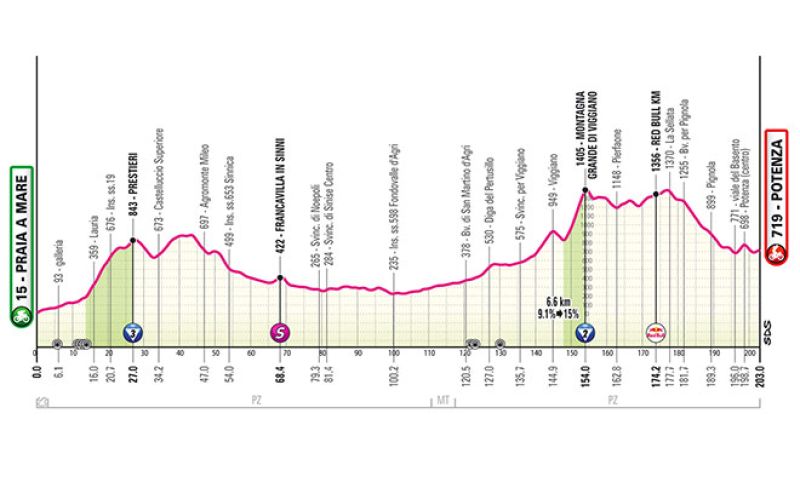
The fifth stage of the Giro d'Italia hides many pitfalls that the numbers help us discover: from Praia a Mare to Potenza there are 203 kilometers to cover with 4,100 meters of elevation gain.
to follow the live coverage of the entire stage starting at 12:10 CLICK HERE
It is a very eventful stage entirely in the inland areas between Calabria and Basilicata. At the start, you climb into the Pollino Park with the Prestieri climb (over 12 km long, but without significant gradients). The route then follows the Sinni valley in predominantly downhill terrain with several counter-slopes especially in populated areas. After Francavilla in Sinni (intermediate sprint at km 68.4) the stage moves into the Agri River Valley to reach Viggiano where you face the hardest climb of the first stages of the Giro, the Montagna Grande di Viggiano (6.6 km, max 15%, second category, categorized climb at km 157), which leads into the Pierfaone ski resort area with an undulating road before the descent to Potenza. The final kilometers are characterized first by a climb into the center of Potenza and then by the descent leading to the last kilometer, all in slight uphill (approximately 2-5%).
THE ROADS OF THE GIRO. The beautiful dilemmas. When you arrive in Praia a Mare, the starting point of the fifth stage of the Giro, you don't quite know what your stay's agenda will be. There are many and very different reasons that compel the visitor to extend their stay in this town overlooking the Tyrrhenian Sea along the so-called Riviera dei Cedri (Citrus Riviera). The fragrances of the prized citrus fruit mingle with those of the sea, which here has more to offer than usual: right in front of the town, in fact, you can admire the Island of Dino rich in sea caves easily accessible by canoe or pedalo. The most famous is the Blue Grotto, so called for the intense color of its waters and with walls decorated by ancient marine fossils.
Back on the mainland, you notice the bulk of the Fiuzzi Tower, 15 meters high that has defended the town from sea raids since the 16th century. Also worth seeing is the Sanctuary of Madonna della Grotta located inside three rocky cavities illuminated by beams of natural light that create effects of rare suggestiveness.
Behind Praia a Mare stretches the territory of the Pollino National Park which today's stage crosses for several kilometers. In a succession of ups and downs, wild landscapes and villages of ancient origins – among these Lauria, Castelluccio Inferiore and Superiore, Latronico – you venture deep into the territory of the Appennino Lucano-Val d'Agri-Lagonegrese National Park.
While waiting for the riders to pass, it's worth stopping on the shores of Lake Pertusillo and, just beyond, making a brief detour to visit the archaeological park of Grumentum with the remains of the oldest Roman city in Basilicata. Then comes the moment of the climbs that lead to the Montagna Grande di Viggiano and La Sellata, the latter surrounded by extensive coniferous forests. Then here's Pignola, called "The town of a hundred portals" by virtue of the numerous decorations on the entrances of the historic center buildings.
Finally, here's Potenza, fascinating for its rich historical and artistic heritage that develops among historical testimonies, religious architectures and contemporary works. At the highest point of the city stands the Cathedral of San Gerardo, the main place of worship, which combines Romanesque and neoclassical elements and houses important works of art. In the historic center stands the Church of San Francesco, among the oldest buildings, characterized by a late-Gothic portal and important internal artistic testimonies.
Also worth seeing is the National Archaeological Museum "Dinu Adamesteanu", at Palazzo Loffredo, which tells the story of ancient Lucania from prehistory to the Roman age. The end-of-day toast is made by sipping a glass of Aglianico DOCG in Piazza Mario Pagano, recently renovated under the supervision of starchitect Gae Aulenti. Because Potenza is always capable of keeping pace with the times.

 3
3


 3
3


 2
2
1
1
2
2
2
2
1
1
2
2

 Ritratti
 Oscar
Oscar Albi d'Oro

