
















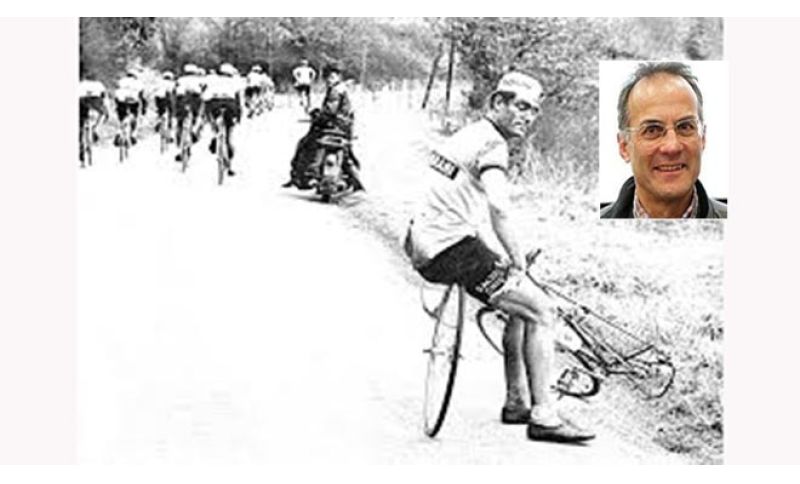
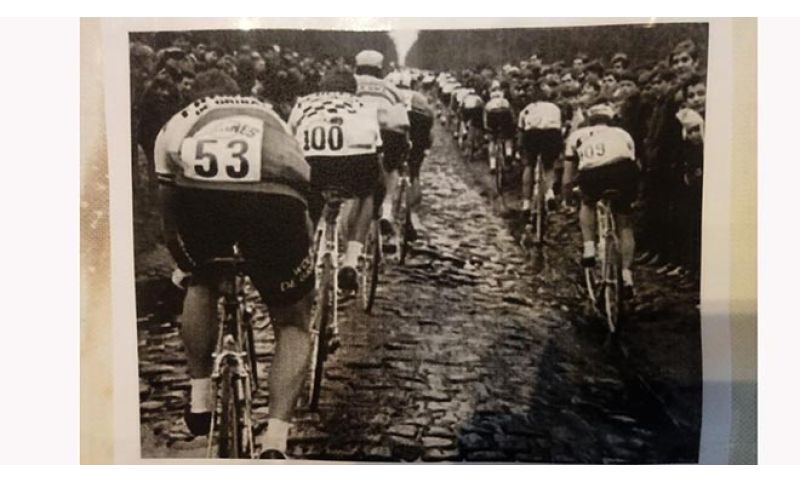
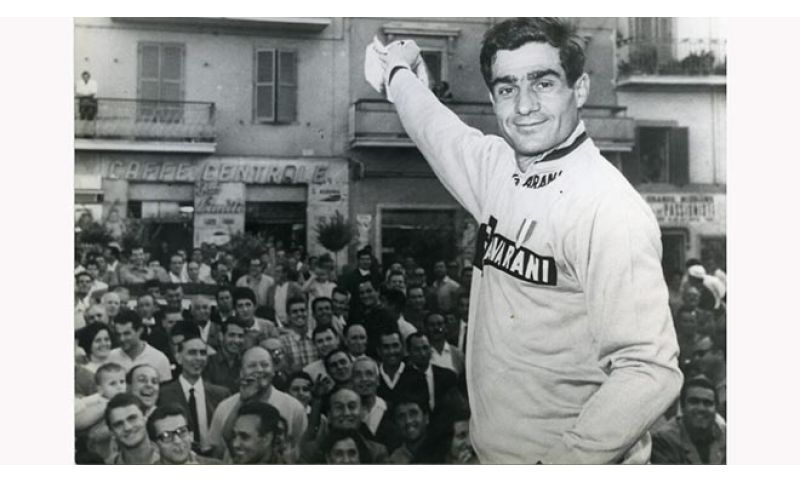
Sunday, April 7, 1968, 262 kilometers, 136 starters, ready to go. The Paris-Roubaix. On the bright side, the weather. On the dark side, everything else. On the horrific side—from here on, take the figures with a grain of salt—around the one hundred twentieth kilometer, Dino Zandegù from Rubano in Padua, almost 28 years old, wearing the Salvarani jersey, number 110, at his second (and last) "hell of the north" (the first one ending in a hospital), having safely passed through the Arenberg forest (in one of the photos, he's the second-to-last in the line on the right shoulder, with Poggiali at his wheel), feels the wheel wobble. Flat, punctured. Until the wheel comes off, and so does his morale. Dino gets off his bike, puts his feet at the same level as the wheel and his morale, that is, on the ground, removes the wheel—it's the rear one—holds the bike with his left hand, sits on the rim and waits for a proper wheel.
The day before had been heated with fierce controversies. The organizers discovered that many stretches of cobblestones had been asphalted by well-meaning but shortsighted local administrations, perhaps offended that their roads had been shown on television with stones and potholes. With no time to rage but only to remedy the situation, the organizers worked hard to find other paths, trails, and country roads that wouldn't distort the sense of history and the spirit of the race. The search proved fortunate for the organizers, somewhat less so for certain riders like Zandegù himself who hoped to get away with it: 56.6 kilometers of agricultural roads built with granite cubes, cemented with livestock manure and mining dust.
Zandegù endures his roadside drama with cycling philosophy. "Several support vehicles stop—he recalls, with a truth that this time doesn't seem to reach 90 percent—and try to help me, but each time hope vanishes before imprecision, inadequacy, and imperfection. In short, it's as if my wheel, or my hub, or my derailleur, probably my destiny, don't match those provided by the organizers' standards. So much so that I can't find the right wheel." Meanwhile, time passes relentlessly and, Zandegù adds, "up front Merckx and Gimondi, Stablinski and Poulidor, Janssen and Reybrouck aren't waiting for anyone, those with strong legs and pumped tires attack, those with flat tires and low morale grab the tram or hop on the broom wagon." But not him, he stoically persists: "The first team car, the one with Luciano Pezzi, follows Felice, the other team car, the second one, follows the group. I decide to wait for it. When it finally arrives, to ease the tension I ask 'where were you, at the bar?', while the mechanic proceeds to change the tire. Ready and go. I emerge, recover, climb back, catch my breath when I manage to rejoin the stragglers. But it's tough, because between one tire and another I'll have lost a good quarter hour."
When the race heats up, Zandegù is half dead: "And about forty kilometers from the finish, having confirmed the absolute impossibility of catching the best riders, for realism and practicality, also for a sense of measure and decency, I abandon." It turns out that, "taking advantage also of my absence, Merckx conquers Roubaix for the first time" (here Zandegù doesn't miss a hint of self-irony), the only one to resist the Cannibal's wheel is Van Springel, then three other Belgians, Godefroot, Sels and Van Schil, then Poulidor who "though eternally second this time finishes sixth." The first Italian is Gimondi, twentieth, at 8'03", followed by Durante, twenty-seventh, at 16'54", then three other Salvarani riders, Poggiali and De Pra thirty-fourth and thirty-fifth at 21'33", and Guerra forty-second and third-to-last at 40'57".
Zandegù is left with that spiritual disappointment, that non-alcoholic bitterness, that competitive regret, which however could magically transform into a sweet dream: "Alongside the old Paris-Roubaix, create the new Paris-Ruban". In homage to his Bethlehem in Padua: Rubano, in French Ruban. "And if there's a need to find some paths and dirt roads, the organizers can count on me." So much so that "French, Italian, and Paduan, the language is what it is, but you always say pavé".

 1
1


 1
1


 1
1
1
1
1
1
1
1
1
1
1
1

 Ritratti
 Oscar
Oscar Albi d'Oro

