














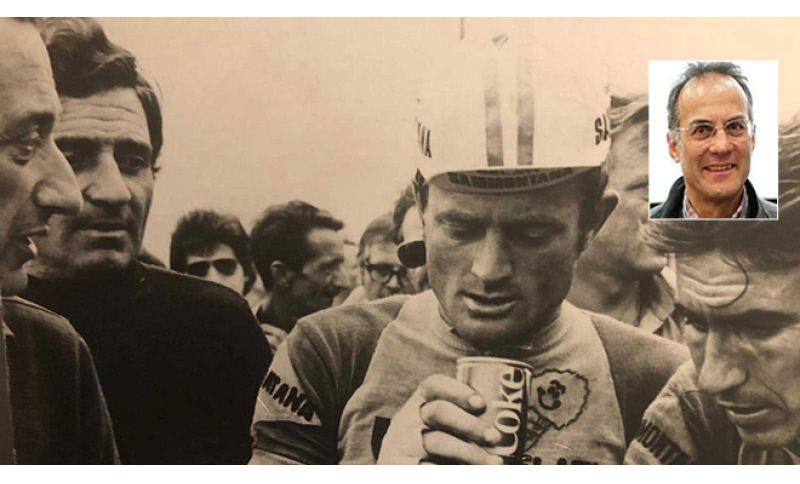
Football, not cycling. He loved to play football, and who knows what he would have given to become a skilled, famous footballer. Instead his friends rode bikes, some of them raced, and everyone asked him to try, telling him he had the talent, the gift, the inspiration. So he let himself be tempted. It was a stroke of luck. Because Fabrizio Fabbri would participate in nine Giros d'Italia and win three stages. And other races. And he would wear the blue jersey in six World Championships.
Today, at 7 p.m., the Gino Bartali Cycling Museum at Ponte a Ema remembers Fabrizio Fabbri: Marco Pasquini will lead the event, family members (his wife Loretta, sons Francesco and Fabio) will share their stories, and witnesses from that era will evoke races and riders, episodes and curiosities. Fabbri began racing in 1965, was a professional from 1970 to 1979, then served as a sports director (10 years at Mapei!) until 2013. A man of cycling in the most authentic Tuscan tradition, the one that runs from Gino Bartali to Alfredo Martini (who held him in great respect and friendship) and Franco Ballerini, the tradition of the Golden Lily award and the Tandem Trophy, of San Baronto and the "Bermuda Triangle" that included Mastromarco, Cantagallo and Quarrata.
A Bartali devotee, encouraged by his father and sisters but discouraged by his mother, Fabrizio proved himself immediately by winning the Tuscan amateur championship: and Tuscany was the Flanders of Italian cycling, every village a team, every hamlet a race, every rider an almost-champion. He chose to be a domestique ("I wasn't capable of commanding, asking and demanding, I preferred to obey") of those defined as "luxury" domestiques, not for how they were treated, but for how they treated their captains—he served everyone from Bitossi to Gimondi and Moser. A dozen victories, and among these, besides the three at the Giro d'Italia, also a stage at the Tour of Switzerland, two classics like the Giro dell'Appennino and the Tre Valli Varesine, and the overall at the Tour of Puglia. Yet the victories that brought him the most joy were two editions of the Grand Prize for Industry and Commerce in Prato, "because they were won—he always repeated this—among my people, on my roads, in my land". Born in Ferruccia di Agliana, he eventually made his home in Quarrata (he died seven years ago, at age 70), Fabbri was an eternal village boy.
Shy, modest, reserved. If he could have, Fabrizio would have made himself invisible. He deflected praise and compliments to his riders. Faced with recognition, he would almost become intimidated: the Filotex Prize, a Golden Helm, the recent naming of a street after him in Agliana. At most he shared them with all the staff members. Yet he was always available: he was the guardian angel of his riders, they confided in him, unburdened themselves, trusted him; he answered journalists, helped them, went out of his way; and he participated in celebrations, gatherings, meetings. He was there. And he will be there this time too. In words, in testimonies, in memories, in images. And, in the end, eating together with everyone.
For information and reservations: info@ciclomuseo-bartali.it, tel. 3926277248.

 3
3


 3
3


 1
1
1
1
9
9
2
2
8
8
1
1
1
1
9
9
2
2
8
8

 Ritratti
 Oscar
Oscar Albi d'Oro

