

















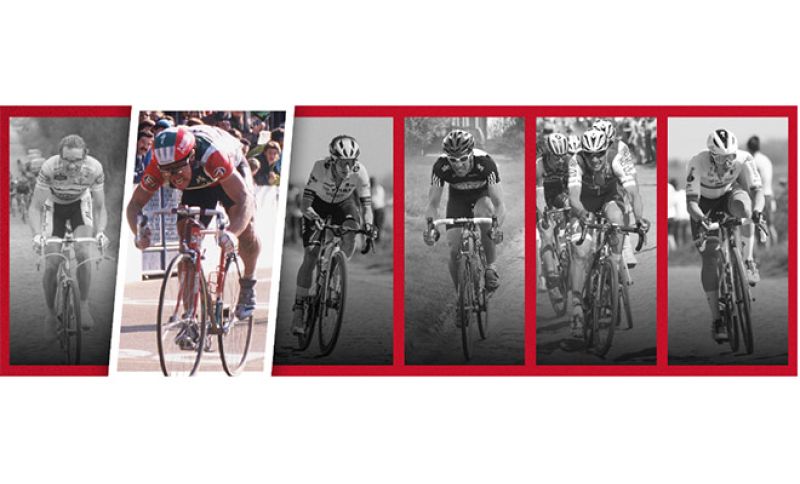

Winning the Queen of the Classics is the dream of a lifetime for an entire category of riders called "Flandriens" as well as for great champions who attribute particular prestige to the Paris-Roubaix Hauts-de-France. But beyond the 95 different winners (5 for women), the history of the event is also marked by top-tier riders who repeatedly stumble on this objective, achieve podium finishes, lose consecration due to a mishap, a puncture at the wrong moment. What did Adrie van der Poel need to win in the 1980s at the velodrome where his son triumphed in three consecutive editions? And Juan Antonio Flecha who came close multiple times to the feat on the cobblestones of the North? And Marianne Vos who has won everywhere? Do the memories of the podium have a bitter taste only for Zdenek Stybar, Steve Bauer or Lorena Wiebes? Questions and answers in a series of six interviews, produced in collaboration with ASO, that will accompany us until the appointment on April 12.
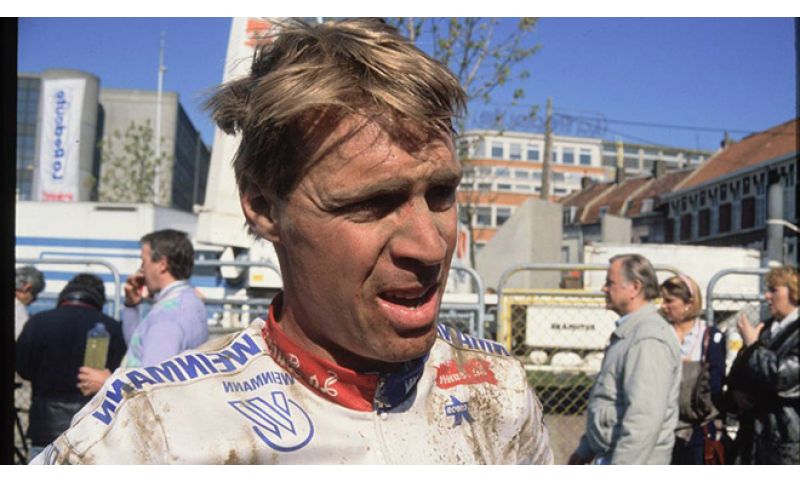
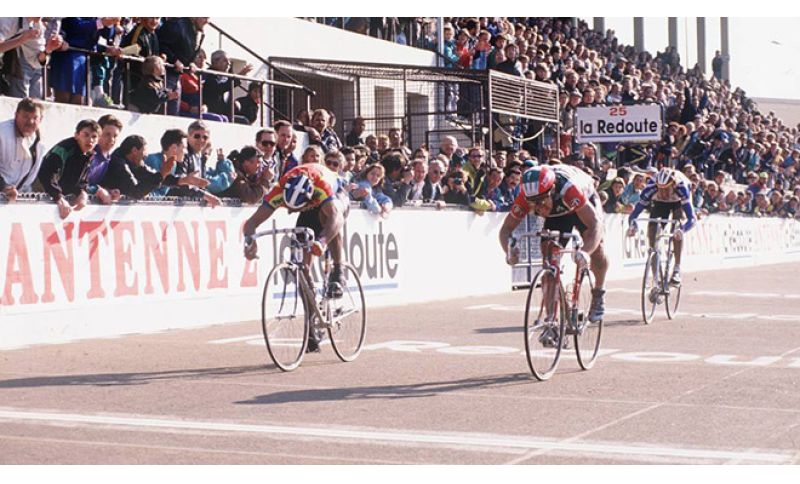
Steve Bauer never truly understood how Paris-Roubaix slipped through his fingers. In fact, even Eddy Planckaert couldn't believe how he had managed to snatch the 1990 edition of the Hell of the North from his Canadian rival, with the two of them crossing the finish line lunging forward with eyes closed, after a furious sprint in the velodrome.
Ten minutes later, the judges announced the Belgian's victory by a minimal margin: less than a centimetre. Immediately, that edition was considered the most hotly contested Paris-Roubaix in history, a reputation it still holds today, despite Gilbert Duclos-Lassalle beating Franco Ballerini by just a few centimetres in 1993. At the Hell of the North surprises are never lacking, and sometimes they are spectacular. But Bauer, despite his competitiveness on the pavé, never managed to find the right opportunity to win it. Thirty years after retiring from cycling, however, the Canadian continues to enjoy success in cycling and is preparing to return to Roubaix as sporting director of the NSN team.
THE MOST UNCERTAIN ROUBAIX IN HISTORY
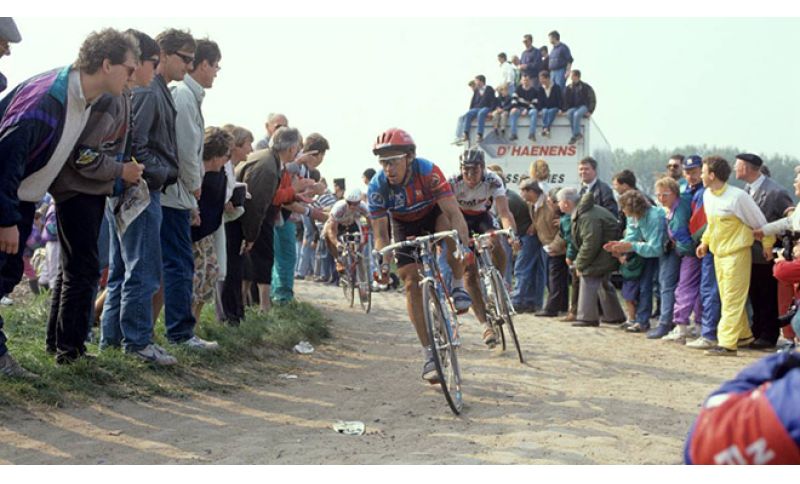
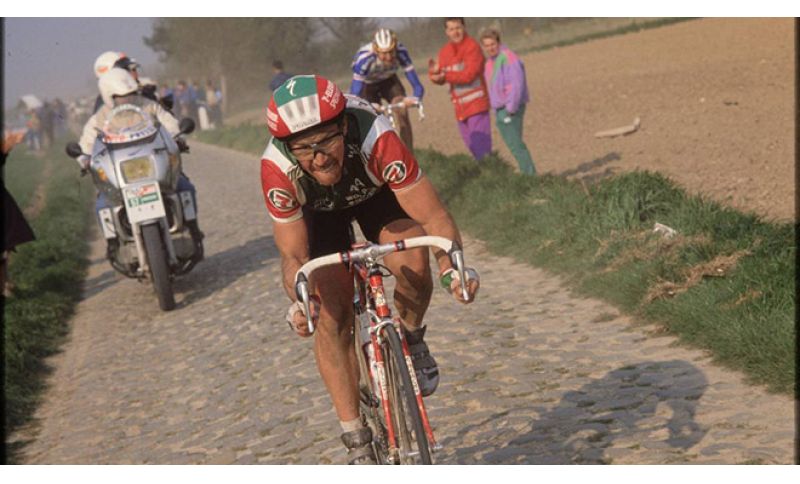
Steve Bauer, Eddy Planckaert and Edwig Van Hooydonck had battled for seven and a half hours when they entered the velodrome at the finish of the 1990 Paris-Roubaix. "Planckaert had been leading for a long time, and I was fortunate that Laurent Fignon animated the race that day - recalls the Canadian -. I was much more patient than in previous years. I followed, I observed... And at Cysoing I attacked to close the gap, a well-executed move. We arrived at the Carrefour de l'Arbre and I believe I was the strongest at that point, but I couldn't drop everyone. Inevitably, it came down to a sprint, with some riders catching up with us on the velodrome".
Among them was Belgian Jean-Marie Wampers, winner the previous year, as well as Frenchman Gilbert Duclos-Lassalle, future winner in 1992 and 1993. The race had been thrilling all day, with minimal gaps, and it was even more so in the velodrome.
No one raised their arms to the sky in victory, everyone waited ten minutes that seemed like an eternity. "It was a strange moment because you don't know what to think or what will happen" Bauer recalls. April 8, 1990 was truly Planckaert's day, who won Roubaix a few years after conquering the Tour of Flanders, despite Bauer's excellent performance.
"I was in good shape, ready, but it also depends on how the race develops, and I think I made the right decisions. I did everything well until the last metre: the only reason I lost the race was because I didn't synchronize the bike throw correctly. Planckaert didn't either, but that centimetre of advantage makes all the difference in the world".
A SPRINT LIKE NO OTHER
"I always thought Roubaix would be an exciting race and suited to me". Although he had discovered the Hell of the North as a neo-professional, Bauer didn't have much experience in the Northern Classics, but he counted on the qualities acquired in American criteriums to go the distance and, possibly, exploit his track background in the Roubaix velodrome.
"It's a fantastic way to finish the race. It's iconic to finish in a velodrome, especially in a race like Roubaix. Thanks to my track experience, I went straight to the front to be able to accelerate or respond to attacks. I saw Edwig Van Hooydonck's attack, I wasn't caught off guard. I passed him, I was ahead of Planckaert on the straightaway. We were side by side but he managed to beat me by a centimetre".
Bauer believes he could have managed the bike throw better: "You push so hard that you see everything black. I almost thought the finish line was a bit further away. It's a 400-metre track and from experience I knew that the ideal trajectory wasn't in the centre, just before the banked curve. But there I made a mistake. Despite that, I did a fantastic sprint".
WIN OR LOSE, IT'S ALWAYS THE QUEEN
"I believed I could win Roubaix, and it was my objective every time I participated" explains Bauer, who raced the pavé classic eleven times between 1985 and 1995. "I learned that it's one of the greatest races in the world. If the rider is inspired, it adds something exceptional to your career, because it takes you into history... And one of the greatest among the stories is my second place by a centimetre. If the race weren't so legendary, I probably wouldn't still be telling that story".
More than any other race, Roubaix, with its stories of survivors and shattered destinies, demonstrates that history doesn't belong only to winners, even though these are particularly celebrated on the velodrome.
"Of course, I would have liked to have my name in the velodrome shower and my piece of pavé in my living room" smiles Bauer, who also lost the 1989 World Championship dramatically, due to a puncture while fighting for the rainbow jersey against Greg LeMond. "Winning is what everyone aspires to. But what I remember most about Roubaix is having raced great races: a second place, but also a fourth, an eighth. I was always in the leading group. I wasn't a domestique. I aimed for victory, and it's a precious memory".
THE CHALLENGE CONTINUES
1996 was Steve Bauer's last season in the peloton, the only year in which he did not participate in Paris-Roubaix, that year dominated by Johan Museeuw, Gianluca Bortolami and Andrea Tafi of Mapei. "Their collective strength was difficult to beat. Roubaix is a race where several favourites can win, by its very nature. But a team like that dominated thanks to the number of riders capable of controlling the front of the race in the finale".
Thirty years later Bauer observes the dominance of champions like Mathieu van der Poel and Tadej Pogacar from his privileged position as sporting director of NSN (whose Roubaix ambitions this year are based on riders like Hugo Hofstetter and Lewis Askey), after experiences with CCC (with Greg Van Avermaet, 12th in 2019) and Astana. "It's important to follow the race developments, it's a race where you need to be alert at every moment. There's never a moment of respite: from the start to the first pavé sections, then all the way to the Arenberg forest and the finish. You can never lose focus. You need to be concentrated all day".
But even so, luck could turn its back on you....
THE PROFILE
Steve Bauer
Born June 12, 1959 in St. Catharines, Canada
Teams: La Vie Claire (1985-1987) / Helvetia-La Suisse (1988-1989) / 7-Eleven, Motorola (1990-1995) / Saturn (1996)
Main victories: Züri Metzgete 1988 / Stage 1 of the Tour de France 1988 (5 days in yellow jersey that year, 9 in 1990) / 2 stages of the Critérium du Dauphiné / GP of the Americas 1988
Paris-Roubaix results: 1985: Retired / 1986: 29th / 1987: Retired / 1988: 8th / 1989: Retired / 1990: 2nd / 1991: 4th place / 1992: 17th place / 1993: 23rd place / 1994: Retired / 1995: 17th place
Distinctive feature: Coming from the other side of the Atlantic, Canadian Steve Bauer knew he had to learn the secrets of the Northern Classics. "The French called me 'the Canadian Bauer'" he recalls with a smile. Instead of settling near the Mediterranean, he chose to live in Gullegem, in the heart of Flanders.
ALREADY PUBLISHED

 1
1


 1
1


 1
1
1
1
1
1
1
1

 Ritratti
 Oscar
Oscar Albi d'Oro

