

















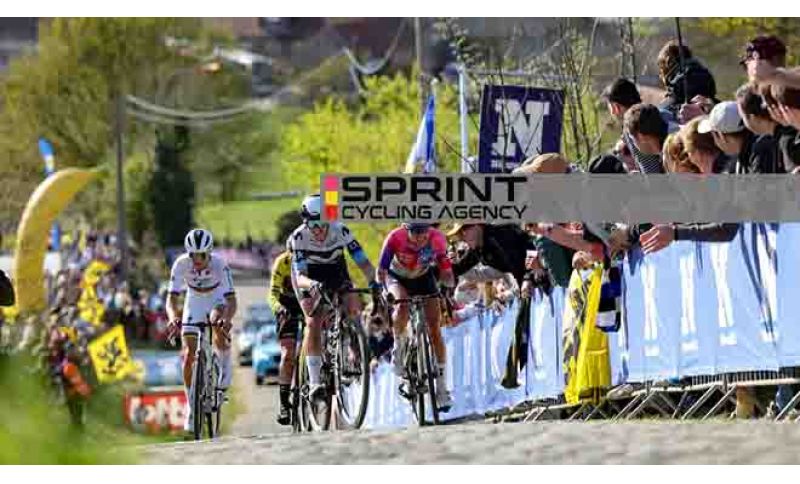
The Flemish spring is about to begin and not only the riders have started preparing for the first appointment on Saturday with the Omloop Nieuwsblad, 208 km from Ghent to Ninove. Special training was also conducted by all the figures involved in race safety. Thus the technical escorts, mobile marshals and all the people on motorcycles or on foot tasked with monitoring have "trained" for a week with the aim of making races safer. The drills were conducted both in sunshine and in rain and wind, because in Belgium, between March and April, the weather is extremely variable.
For the final training session, marshals and technical escorts conducted their simulations in the rain and cold of late February on the roads of Kruishoutem, in East Flanders, not far from Oudenaarde. There are approximately fifty members, both experienced and new, from the non-profit organization Motorbeveiliging (Motorized Safety), who attended a course to refresh their knowledge on the rules to follow during races: in the preceding days, on the field there were new volunteers who followed a well-planned course on how to keep the race safe for cyclists and spectators.
"Safety first. Because that is our objective. We have the obligation to guarantee the safety of the riders, but also of the caravan, ourselves and the spectators - said Motorbeveiliging president Chris Cleven - There will be marshals at all intersections. We must identify and secure all possible dangerous situations: a traffic island, a vehicle parked where it is not allowed and much more".
Men and, to a lesser extent, women with years of experience on two wheels conducted special training sessions. On motorcycles they performed slalom exercises and checked intersections and verified possible obstacles on the route. "Most of us haven't been on a motorcycle for several months; the last race was in September - Chris Cleven continued - When you're out of service for so long, you need to readjust. It's about regaining that fluidity of riding, and at the same time laws and regulations are constantly changing. Our staff must know them all. That's why we're here".
The technical escorts are experienced but, being volunteers, they have difficulty finding young people willing to do this service. "We are mostly people in their fifties, often in their sixties and this is becoming a problem. Our average age is 55 years and we hardly have any young people anymore. They're no longer interested, after us it will be over. My prediction? In about twenty years we'll be racing on closed circuits".
Young people are few, but there are some, and among them is thirty-one-year-old Arno Wauters. "My father always raced and for him safety was fundamental. I simply fell into it. I think time is the biggest problem for young people. I also have a family and it's difficult to find it. And besides, this can't be considered a job, since only a reimbursement is given. This year I'll participate in only three races, but I'd like to do more".
It is often said that there are too many vehicles in cycling races. Too many cars and motorcycles, which could create safety problems. "People often say: there are more cars and motorcycles than cyclists - Cleven continues - Well: we are truly necessary. Belgium is a special country, hellish. In France you can travel 80 kilometers between two towns without finding anything in between. Here, every kilometer is an obstacle. In a 200-kilometer race, you often have to intervene more than 200 times. We don't even make contact with the riders. We ride ahead, we stop if there's something to secure. And then we move on once the group has passed".
The people in the technical escorts make continuous detours to get back in front of the group and to do so they must respect traffic rules: "If you drive too fast, the fine will be sent to your home. And then you pay it - explained one of the instructors - Men and women are in the escorts for fun. But at the same time they know they are doing something incredibly serious". After the theoretical lessons, the motorcyclists then set out to test the race routes and identify possible obstacles.
The mobile marshals who will lead the Omloop Nieuwsblad and the Kuurne-Bruxelles-Kuurne during the opening weekend are working hard: "It's a job of responsibility towards the riders. That's why I always say it during theory lessons: looking for aunt, uncle or nephews waving along the road is absolutely out of the question. We have only one task: to guide the cyclists to the best of our ability".
No one in Belgium is part of the technical escort for money, the maximum reimbursement recognized for a single race is less than 60€. Just enough to pay for gas, because a sandwich is always provided by the organizers. In Flanders the races are about to start and the watchword is always the same: maximum safety for riders and the public.

 2
2


 2
2


 1
1
1
1
3
3
1
1
1
1
3
3

 Ritratti
 Oscar
Oscar Albi d'Oro

