

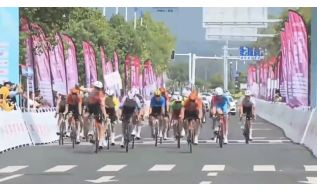


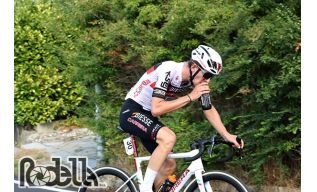















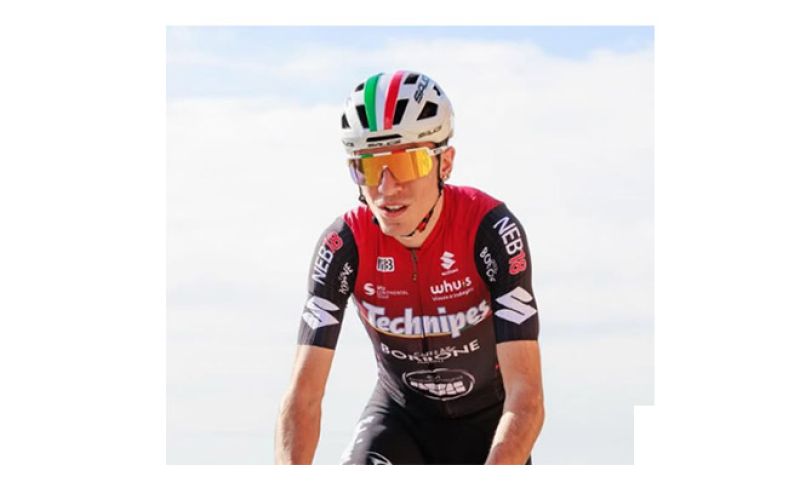
On Sunday the Giro di Campania will not only pass through five provinces. It will also pass through the biographies of those who grew up as riders on those roads. Ivan Toselli is one of them. Together with Giuseppe Sciarra and Michele Pascarella, he will represent that Campanian component of the group that, with the return of professional racing after twenty-five years, adds something that appears neither in the altitude profile nor in the start list: the value of racing on home roads.
For Toselli, this meaning becomes even more evident when the route touches Maddaloni, his hometown. But before the emotion comes the race. And before the race comes a question that in cycling is worth more than any prediction: how will the legs feel? "I'm coming off a difficult period, I had mononucleosis and so my condition is still a big question mark. I'm not at my best, we'll have to see what the sensations tell me".
No grand statements, then. Quite the opposite, in fact. Toselli arrives at the Giro di Campania with the caution of someone who knows well the distance that can exist between expectations and what the body decides to allow on race day. His reading of the course, however, is already fairly well defined. He doesn't imagine a race that will explode on a single climb. The distance will weigh, as will the constant changes of pace and the small attacks, but Agerola—the altitude point inevitably most watched—is not considered a prohibitive difficulty. "It's a very long race, but there are no impossible climbs. Agerola is manageable. Then there are other small climbs, some attacks, and with so many kilometers in the legs even those can make themselves felt". It's a reading that aligns with the one already offered by organizer Claudio Terenzi: Agerola can break up the race, but probably won't be enough, on its own, to decide it. Toselli imagines a scenario still relatively large heading into Naples.
"In my opinion, you could arrive at a sprint with sixty or seventy riders. Unless a good breakaway gets away". And it's precisely the breakaway that could be one of the possibilities he might try to pursue. Team tactics haven't been defined in detail yet, but the intention is not to limit themselves to waiting for events to unfold. "If there's an opportunity, I'll try to go for a breakaway. Otherwise I'll see how I feel on the climbs and try to play what I can there".
He hasn't done a complete reconnaissance of the course. Some areas are far from his usual training grounds, and Naples itself, for someone who needs to train on the road, presents obvious difficulties. "I don't ride much in Naples, there's too much traffic. I haven't tried all the roads of the race". There's also a variable less visible than the altitude profile, but potentially decisive: the sequence of races that in these days is taking various riders through Abruzzo, Lazio, and Campania. A sort of small circuit of Central-Southern Italy that can transform itself, depending on the athletes, into an advantage or a burden. "For some it can be useful, because racing helps them find their condition. For others it can weigh heavily. Some might arrive with broken bones, others might be even better. We'll see". It's perhaps one of the technically most interesting aspects of this edition. In September, the fatigue accumulated during the season becomes a second altitude profile, invisible on maps but often as decisive as a climb.
Toselli also belongs to a generation that grew up while professional cycling enormously accelerated the timeline of maturation. Young riders win earlier, are observed earlier, and above all are judged earlier. On this, Ivan has a very clear idea. "Today there are many very strong young riders, but in my opinion we shouldn't stress them. We shouldn't put too much pressure on them. And as for professionals, I have enormous respect". Words that tell his approach well: ambition without grand statements, respect without fear, desire to test himself without turning every race into a definitive exam.
Then comes Maddaloni. And there the technical component inevitably gives way to the emotional one. "I'm very emotional because the race will pass through my hometown. When I race at home I always try to give something extra". Maddaloni, after all, is not just any place in the geography of Campanian cycling. Toselli immediately recalls the history, the start of the Giro d'Italia from the Villaggio dei Ragazzi and an image that belongs to the collective memory of this sport: Marco Pantani.
On Sunday, then, on the roads of the Giro di Campania there will be Toselli, Sciarra, and Pascarella, three Campanian riders called to experience from within the return of a race that for years has been missing from the professional calendar. Toselli, more than the others, will have a particular appointment: the one with his roads. He doesn't promise a result. He couldn't, and probably it wouldn't make sense to do so. He promises something more concrete. "Let's hope the legs are good, that good sensations come. But one thing I can tell you: I'll give everything". And for those who on Sunday will see the Giro di Campania pass in front of their homes, perhaps this is precisely where we should begin.



 1
1
 1
1

 Ritratti
 Oscar
Oscar Albi d'Oro


Se sei giá nostro utente esegui il login altrimenti registrati.