
















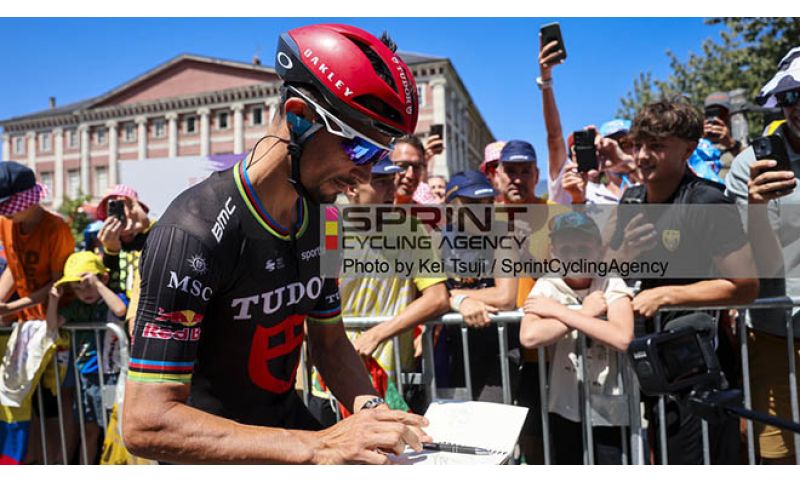
The final applause for Julian Alaphilippe has arrived. Loulou has chosen to step off the bike and with words that only great champions know how to say, he has decided to bid farewell to the world of cycling: "I retire with immense gratitude"
There are farewells that resemble a defeat and others that, instead, have the taste of a victory. Julian Alaphilippe's belongs to the second category. The two-time world champion has decided to step off his bicycle without regrets, with the awareness that the moment has truly arrived. There is no bitterness in his words, only gratitude for a career lived always with his heart before everything else.
"I gave everything I had and cycling gave me everything in return", he said in the farewell interview released by Tudor. "That's why I can say it with a smile: I'm retiring. Not with sadness, but with immense gratitude. To all the fans who supported me on every climb: thank you. Thank you for everything".
It is the final chapter of a story spanning sixteen years, which began far from the spotlight and became, over time, one of the most moving in modern cycling. Alaphilippe was a champion, an attacker, a classics rider, a protagonist in the Grand Tours and, above all, a rider capable of transforming an ordinary day into something to remember.
The decision came almost the way his attacks did: by instinct. "I've always raced by instinct, attacking when my legs were burning, not when the numbers told me to. I made this decision the same way. I woke up one morning at a training camp and I felt it: this is my last year. Without sadness".
No calculations, statistics, or schedules were needed. Just that feeling that only an athlete can recognize. After a lifetime spent chasing the limit, Alaphilippe understood that the moment had come to stop.
And he does so with a palmares that tells only part of his story: two world titles, fourteen days in the yellow jersey at the Tour de France, victories at Strade Bianche, Milan-San Remo, Flèche Wallonne, stage wins in the Grand Tours and that extraordinary day at the 2024 Giro d'Italia, when at Fano he became simply Loulou again.
Reflecting on his career, the first word that comes to mind is just one: "Gratitude". Because before becoming Julian Alaphilippe there was a boy from Saint-Amand-Montrond who raced in cyclocross and played drums at village festivals with his father.
"If I had ever told that boy that he would wear the yellow jersey for fourteen days and become a two-time world champion, he would never have believed it".
Then 2019 arrived. The year of consecration, the year when France definitively fell in love with its most unpredictable rider. Milan-San Remo, Strade Bianche, victories in the mountains of the Tour and that yellow jersey conquered at Épernay. Alaphilippe thought it would last "two days, maybe three". Instead it was fourteen.
"The statistics will say I lost that Tour; in reality, it remains one of my most beautiful memories".
If 2019 was the year that transformed him into a national phenomenon, Imola 2020 was the most intimate moment. World champion. A rainbow jersey conquered with an attack that seemed written for him. And then that gesture at the finish line, his finger pointed toward the sky, to remember his father.
"I crossed the finish line and pointed to the sky, my father".
A year later his second world title would come, at Leuven. Another memorable day, this time in Belgium, in front of a huge crowd. "And Leuven, a year later, was the celebration that Imola couldn't be because of Covid. That wall of people in Belgium... Belgium became my second home".
Two rainbow jerseys, two different stories, both inextricably linked to the man before the rider.
But a career is not made only of victories. And Alaphilippe doesn't hide the toughest moments. There's the 2020 Liège-Bastogne-Liège, when he raised his arms too early and let slip one of the most prestigious Monument Classics. A mistake that became one of the most famous frames of his career.
"It cost me a Monument Classic. But this is also my way of being: I raced with my heart in my hand, with all the mistakes that come with it".
And then there's 2022, the terrible crash at Liège, the punctured lung, broken ribs and a fractured shoulder. But also the months that followed, when every result seemed to become a trial. "Sometimes it hurt more than the crash itself".
What kept him on his feet, however, were the people who continued to believe in him. "Receiving support when you win is easy. Receiving support when you lose, that's rare".
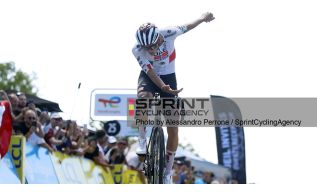
Cycling, however, would grant him another great day. Giro d'Italia 2024. A 150-kilometer breakaway, the group behind him, Alaphilippe ahead of everyone. Alone. The finish line at Fano was waiting for him and Loulou arrived with his arms raised, finding something that perhaps even he didn't know he had lost. "It wasn't my answer to the critics, but to myself: proof that the flame still burned".
That victory was worth much more than a stage win. It was proof that Alaphilippe could still be Alaphilippe.
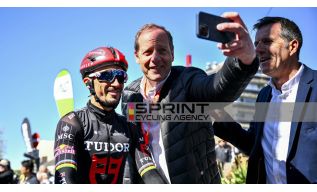
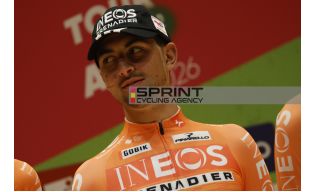
He spent his recent seasons with Tudor Pro Cycling, in a different role than in the past. Less a rider to protect, more a voice to listen to.
"I had the opportunity to give something back: to help younger riders read the race and pass on to them everything I was fortunate enough to learn in 16 years".
A new dimension of his career, perhaps less loud but equally important. "Being listened to and respected by the new generation is a privilege".
Now, however, he doesn't want to think about the future yet. The first thing Alaphilippe desires after stepping away from cycling is not a new project, nor a new role in the world of two wheels. It's home.
"Not having to be away from home 250 days a year is not something I'll miss. Being able to finally fully enjoy time with my son is what I'm looking forward to most".
What he will miss, instead, is the suffering. That sensation that for years accompanied him on the climbs, on the cobblestones and in the final kilometers of races.
"I'll miss the taste of suffering. The moments of camaraderie with the guys, in training camps and in races, the team life".
But now there's something else. There's family. There's silence. There's the need to breathe after sixteen years lived at full speed. And it's to the fans that Alaphilippe dedicates his final words. To those who waited for him on the pavé, on the mountains, on country roads. To those who cheered for a victory and to those who applauded him even when he finished far from the front.
"This farewell is as much theirs as it is mine".
The French rider knows he has left something along those roads: emotions, smiles, cheers, memories.
"I hope I've given you something in return: some emotion, a reason to cheer, a smile, a memory shared with your father or your daughter at the roadside".
Then, the final request. "Just this: I'll stop talking too for a while. I won't give any more interviews and won't answer any more questions about this decision. Everything I wanted to say is here. I need some time. Peace and quiet, and especially time to spend with my family. That's where I want to be now. Thank you for respecting that".
Julian Alaphilippe stops. Not because he has lost, but because he feels he has given everything. Loulou leaves the group with a smile, just as he wanted. With two rainbow jerseys on his shoulders, a yellow jersey imprinted in the memory of France, a victory at Fano and a long series of days impossible to forget. And above all with the certainty that, for sixteen years, when there was a choice between caution and courage, he almost always chose the harder road.
The one that leads to legend.

 3
3


 3
3


 1
1
1
1

 Ritratti
 Oscar
Oscar Albi d'Oro

