


















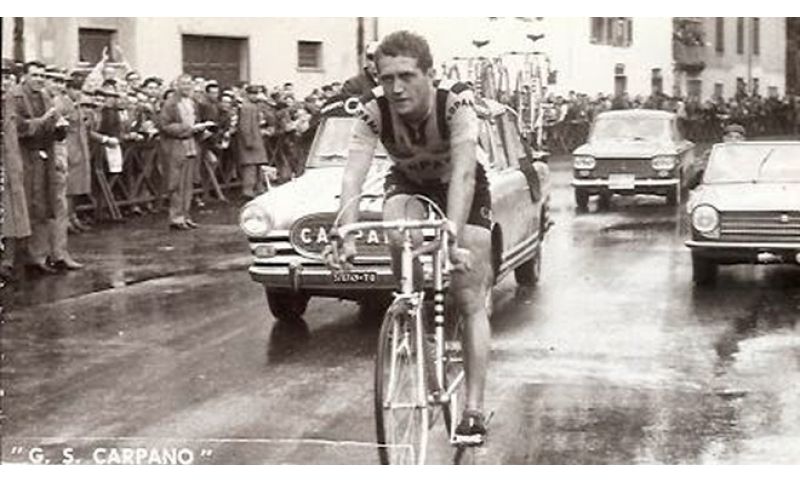
It wasn't me who sought out Italo Zilioli. Perhaps this is the detail that makes this story different from all the others. Some time ago I had written about Fabio Casartelli, about his death at the Tour and what remains of a rider when the news cycle stops measuring his time and begins to preserve his memory. That piece had also reached Zilioli. And one day the phone rang. On the other end was him. I confess it moved me, surprised me, and in some way made me proud. Those who write about cycling are used to seeking out riders, asking them for a memory, a quote, a few minutes of their time. This time it had happened the other way around. A champion had been the one to seek out the person who had written.
Perhaps for this reason, when we began to talk about the Giro della Campania, the interview lasted very little time. Not because the conversation was brief, quite the opposite. Simply the questions fell away. Zilioli began to remember. And I, at a certain point, stopped interviewing him and began to listen. "It was a great classic," he says. And for them it had an added value because Coppi and Bartali had raced it before—names that were not yet statues but living men in the group's memory. The Campania was grueling, very much so. Starts and finishes in Naples, roads toward Caserta or the Sorrento peninsula, towns crossed on sometimes broken cobblestones, kilometers that went well beyond two hundred.
In 1968 it was 264.5 kilometers. Zilioli won ahead of Franco Bitossi and Ugo Colombo, all riding for Filotex. But he doesn't tell the story of the podium. He tells the story of Agerola. Colombo had been alone out front, the race had split apart. Zilioli attacked from the group, Bitossi followed him and on the climb they caught up with their teammate. Then together toward Naples. And as he speaks, cycling from that era reappears whole. Two sandwiches during the race, he recalls. And eating them on the bike was already an exercise in itself. Few water bottles. Steel bicycles, hard gearing, first five sprockets, then six. "We rode on strength," he says. Today, many more gears, different cadences, different positions on the bike. A whole world has passed. Yet, in his words there is not only nostalgia.
When he remembers the Amalfi Coast he smiles. He says that he didn't always ride with his eyes fixed on the wheel in front: sometimes he looked around. He allowed himself the luxury of seeing the sea, the towns, the beauty that flowed alongside the effort. Perhaps this too was cycling. And then comes Bitossi. Twenty-two days earlier, at the Milano-Torino, he had beaten him at the velodrome with one of his track rider inventions. In Naples, Zilioli recounts, Franco perhaps was still thinking about that day. He didn't give him anything, he's careful to point out. But in his words remains the affectionate sense that he hadn't wanted to rob him of the race honors once again. And one comes to think of how much respect could dwell, even then, within rivalry itself. Zilioli also remembers Zandegù and laughs again telling of that fan who insisted on handing him a newspaper to tuck under his jersey before a descent. "But at least it's from today?" he replied. And then there was Ciro Di Meo, from Bacoli, who at the Naples finishes would bring him fresh water. In a cycling world stingy with water bottles it was almost a precious gift. Zilioli would promise him a visit, Ciro would answer: "God willing."
It is these details that tell what a race truly was. Not merely a finishing order, but a geography of men, gestures, words. When I ask him how the Giro della Campania can become great again, Zilioli doesn't speak of UCI categories or calendars. He says it takes courage. And then he speaks of words, of stories, of new means of communication. A race, he maintains, must be told, made known, loved again. It's curious. Our conversation had been born precisely this way: from an article that had reached him and from a phone call that had reached me. Perhaps Zilioli has already explained, without meaning to, what the Giro della Campania needs to return on September 20th. It's not enough to put a race back on the road. You must give it a voice again. Because a classic doesn't live only in the kilometers, in the honor rolls or in the names of the winners. It lives as long as someone still wants to tell its story and someone else, listening, manages to see again a man climbing toward Agerola, the Amalfi Coast sea at his side and, at the finish, a friend waiting for him with some fresh water. "God willing."
Giovanni Di Trapani is a senior researcher at the CNR currently on secondment to the Office of the Prime Minister: he coordinates the support structure of the Bagnoli Coroglio Commissioner.

 3
3


 3
3


 9
9
1
1
1
1
4
4
2
2
9
9
1
1
1
1
4
4
2
2

 Ritratti
 Oscar
Oscar Albi d'Oro

