


















If the Giro d'Italia Women made headlines with the disqualification of Lorena Wiebes for using a bike that was too light, the current yellow jersey wearer and her teammates at the Tour de France Femmes are now under scrutiny for another possible irregularity in compliance with regulations.
Ahead of tomorrow's time trial, according to reports from the website WielerFlits, several teams have asked the UCI to intervene on a practice that, they claim, is becoming increasingly widespread in time trial events: some athletes would be using chest padding to artificially modify their torso profile and gain an aerodynamic advantage.
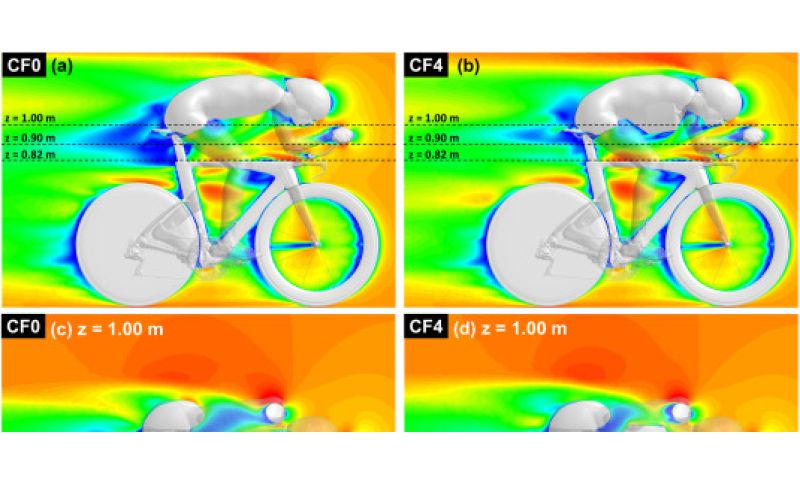
The principle is the same that emerged and was discussed in the case of radio receivers placed on the chest instead of the back and in the case of the disqualification of Jan-Willem van Schip for water bottles hidden under his jersey: changing body shape to optimize aerodynamic profile. According to studies by aerodynamics professor at Heriot-Watt University in Scotland and LUT in Finland Bert Blocken (of whom we show a photo published by the Dutch publication in a detailed article, editor's note), such a solution could reduce aerodynamic drag by up to 3.6%, with a gain of approximately 0.8 seconds per kilometer under the most favorable conditions.
Article 1.3.033 of the UCI regulations explicitly prohibits any artificial modification of a rider's morphology through clothing or added objects. The penalty is severe: exclusion from the race, cancellation from the results and a fine.
For this reason, ahead of the Tour de France Femmes time trial, several teams are calling for stricter controls. The proposed idea is to conduct checks immediately after the time trial in a closed tent to ensure that athletes are not hiding anything in their bra or under their body suit. As they say in France, affaire à suivre.
Scientific Evidence
A survey conducted among the teams reveals that several women's squads are frustrated by this. Blocken understands this frustration. Several years ago he conducted research on this matter and is well aware of this phenomenon.
"We're talking about a chest fairing, which allows you to modify the air flow around the body, thus reducing pressure on the thighs. In this way the cyclist experiences less aerodynamic drag. It's not that you gain dozens of seconds in a time trial, but in a stage of 20 to 30 kilometers this measure can gain seconds that can prove decisive," emphasizes the Belgian professor who two years ago conducted an in-depth study on chest fairing among time trialists and triathletes, published in ScienceDirect. It emerged that it is possible to achieve a reduction in aerodynamic drag of up to 3.6% by using an optimally shaped object that covers the entire torso. This translates to a time gain of at least 0.78 seconds per kilometer.
Two years ago, the magazine The Triathlete published an article on research conducted by Blocken and Jim Manton (ERO Sports) on the advantages triathletes gain when they tuck a water bottle under their shirt. For an average athlete, this can result in a saving of over 12 watts, which, in a full Ironman, translates to a time gain of up to two minutes. In this case too it was clearly visible that the water bottle aerodynamicizes the torso and channels the air flow between the legs, thus reducing the counter-pressure on the pelvis.
The cycling world had been pre-alerted to the issue by Blocken himself who, again on WielerFlits, revealed: "At the time I discussed it with Michael Rogers of the International Cycling Union (UCI). Back then the discussion was mainly about the 'abuse' of radio communication equipment, which was being positioned on the chest to reduce aerodynamic drag. I reported our research to them. The UCI is therefore aware of this phenomenon".
Strict Rules and Penalties
UCI regulations clearly state that it is forbidden to place objects on the chest. Article 1.3.033 stipulates that clothing must serve exclusively as clothing and must not artificially modify the morphology (body shape) of the rider. It is not permitted to apply foam, padding, adhesive tape or plastic shapes on or under the chest to create an aerodynamic shape. Texture differences aimed at improving aerodynamics are only permitted if they are woven or sewn directly into the fabric (with a maximum surface roughness/height difference of 1 mm).
If a rider, male or female, is caught violating article 1.3.033 during or after a race, the result is immediate exclusion from the race (or cancellation from the standings). Depending on the level of the race (such as a WorldTour time trial or World Championships), a monetary penalty is also imposed, which typically ranges from 200 to 1,000 CHF and can be even higher in case of serious or intentional violations.
Ahead of the time trial scheduled for tomorrow at the Tour de France Femmes (21 kilometers from Gevrey-Chambertin to Dijon), several WorldTour teams are therefore launching an urgent appeal to the UCI jury to explicitly enforce this rule.

 4
4


 4
4


 2
2
2
2
2
2
2
2

 Ritratti
 Oscar
Oscar Albi d'Oro

