















The orange hell of Alpe d'Huez has another winner besides Tadej Pogacar. But if the Slovenian was the fastest, the Dutch Corner wins again the decibel race.
Every time the stage winner changes, every year the protagonists of the general classification change, but on Alpe d'Huez there is one certainty that knows no passage of time: the Dutch Corner remains the beating heart of the most famous climb of the Tour de France.
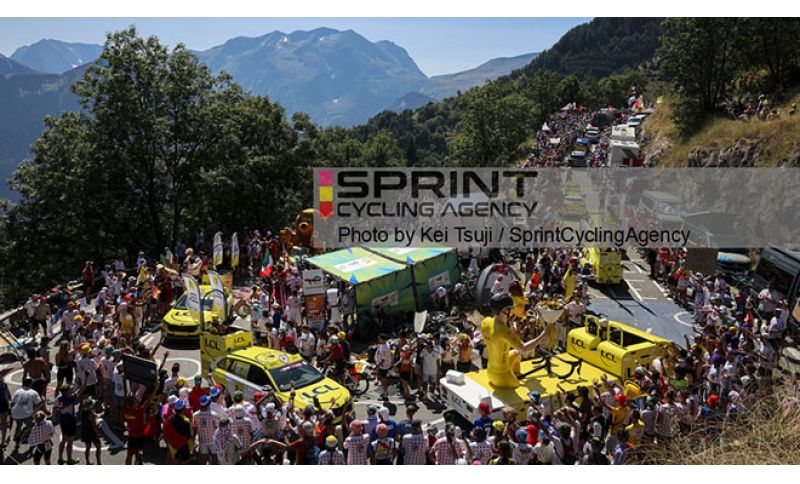
Once again this year the legendary hairpin number 7, known throughout the world as "Dutch Corner" or "De Nederlandse Bocht", has confirmed its reputation as the noisiest, most colorful and spectacular place of the Grande Boucle. The images broadcast worldwide during the nineteenth stage told the story of the atmosphere experienced, defining that stretch of the climb as the most insane atmosphere of the Tour de France.
An exaggeration? You just need to spend a few minutes at that hairpin to understand that it is not at all.
An orange sea invades every centimeter of the road. Dutch national team shirts, wigs, hats, flags, improbable costumes, Bluetooth speakers blasting music at full volume and thousands of people waiting for hours for the riders to pass transform the climb into an open-air stadium.
The tradition of the Dutch Corner was born in the 1970s, when Dutch climbers often dominated Alpe d'Huez. Joop Zoetemelk won here in 1976 and 1979, while the last Dutch success on the climb remains that of Gert-Jan Theunisse in 1989.
Year after year, hairpin number 7 became a sort of pilgrimage for thousands of enthusiasts from the Netherlands, capable of transforming a simple stretch of road into a gigantic popular festival. Over the years, however, there have been no shortage of excesses.
In the past, incidents occurred at this very point that sparked debate, such as the throwing of beer and even some spitting directed at Chris Froome during his Tour de France victories. For this reason, in the 2026 edition, the organizers decided to intervene significantly.
For the first time, metal barriers were installed along the Dutch Corner, while a massive security operation presided over the entire area. In addition to French gendarmes, Dutch police officers were also present, having arrived to help manage the crowd.
Despite the presence of approximately 600,000 spectators distributed along the 13.8 kilometers of Alpe d'Huez, the atmosphere remained extraordinary without degenerating into the problems that had characterized some past editions. In fact, among the orange sea you encounter fans from all over Europe.
There is an improbable Elvis Presley lookalike and there are groups of Germans displaying a banner dedicated to Jan Ullrich and countless enthusiasts who share the same passion regardless of their flag.
The music changes continuously: from traditional Dutch folk songs accompanied by accordion to techno blasted at full volume from the enormous Bluetooth speakers positioned along the road.
When the advertising caravan passes, the party reaches maximum enthusiasm. Then, when the riders arrive, the noise becomes almost deafening.
Many champions respond to the warmth of the crowd by raising their arms, smiling or asking for even more noise with a hand gesture, transforming the climb into a spectacle within the spectacle. The only sour note of the day came with the serious accident involving Colombian Einer Rubio, forced to withdraw after colliding with the UAE Team Emirates-XRG team car, which braked suddenly to avoid a fan who had ended up on the road. An episode that reminds us how thin the line is between the magic of Alpe d'Huez and the risks posed by such a massive presence of spectators.
For this very reason, many fans welcomed the new security measures positively. Alpe d'Huez thus continues to be one of the most fascinating symbols of world cycling. A climb where the race intertwines with popular passion, where every hairpin tells a story and where, once again, the Dutch Corner has won its personal decibel race, proving that the Tour de France is not just a sporting competition, but also an extraordinary celebration capable of attracting hundreds of thousands of people from every corner of Europe.



 3
3
 3
8
8
10
10
6
6
1
1
3
8
8
10
10
6
6
1
1

 Ritratti
 Oscar
Oscar Albi d'Oro


Se sei giá nostro utente esegui il login altrimenti registrati.