













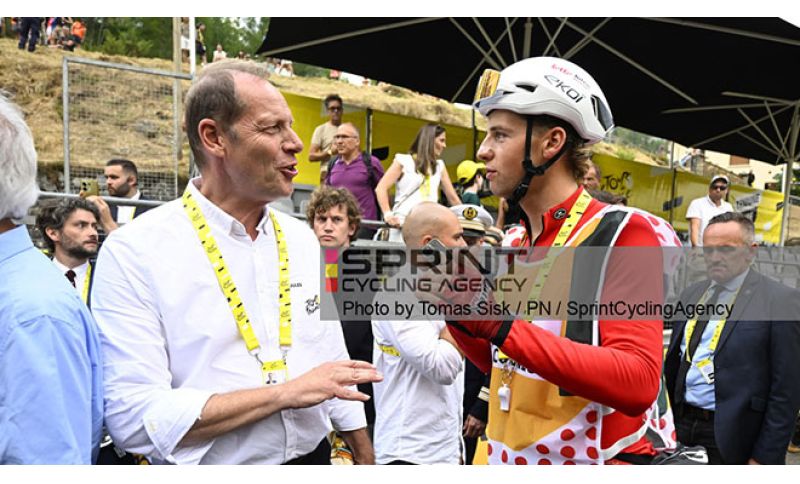
Christian Prudhomme defends the Tour: regarding statements made in recent hours by some cyclists, he reiterated that no French rider has been favored by avoiding anti-doping controls. The Tour de France continues to be a terrain of sporting challenges, but also of controversies off the road. Following the discussions that arose after anti-doping controls were carried out during the night on some of the race's protagonists, the director of the Grande Boucle Christian Prudhomme decided to speak publicly, firmly rejecting any accusation of favoritism towards French cyclists and defending the work of the International Testing Agency (ITA).
Yesterday morning, the head of the Grande Boucle spoke at the start of the eighteenth stage from Voiron, emphasizing a concept he considers fundamental for the credibility of modern cycling: the Tour de France has no role in choosing which riders to subject to controls.
«We fought to have an independent agency and now we have one - he declared - I have no intention of interfering with their work. Not only am I not informed, but I should not be».
His words come after statements from Slovenian cyclist Matej Mohoric (Bahrain Victorious), who had suggested that young French rider Paul Seixas, one of the great revelations of this Tour de France, may have received different treatment compared to other general classification contenders.
«It would be appropriate to guarantee equal treatment for everyone» Mohoric had stated, pointing out how, in his view, the nineteen-year-old Frenchman had not been subjected to the nighttime controls that had instead affected other race protagonists.
An observation that immediately sparked debate, but which Prudhomme rejected without hesitation. «The UCI wanted to create a completely independent agency. I learn about controls at exactly the same moment you do, and often even after. I receive no advance information and should not receive any».
Prudhomme's statements also come following the official statement from the ITA and UCI, which defended the decision to carry out anti-doping controls during nighttime hours, explaining how this is an exceptional but necessary measure to combat the phenomenon of microdosing prohibited substances.
During this year's Tour, both Tadej Pogacar and Jonas Vingegaard were subjected to controls in the very early morning hours, a decision that had caused discontent among some teams, concerned about their leaders' recovery during the alpine stages.
Prudhomme, however, had no doubt in defending the ITA's work. «The ITA is doing exactly the job it was created for - he stated - I perfectly understand the emotions of the riders, but we wanted an independent agency. It is exactly what we have obtained and it is what we have always asked for».
The Tour director also recalled a significant historical passage. In 2008, in fact, the race was organized without direct involvement of the International Cycling Union precisely to allow anti-doping controls to be managed completely independently from the French Cycling Federation, a choice that marked a turning point in the credibility of the fight against doping. According to Prudhomme, nighttime controls simply represent one of the tools now available to investigators.
«Naturally this type of test cannot be carried out every evening. In this case they were executed between two mountain stages, but this is exactly the role of the ITA».
In recent days, some had hypothesized that such invasive controls could fuel suspicions against Tadej Pogacar, increasingly close to winning his fifth Tour de France. On this point too, Prudhomme was categorical.
For the Grande Boucle director, the Slovenian has no need to prove his own talent, which emerged from the very beginning of his career.
«Pogacar has shown extraordinary qualities since he was very young. At twenty he was already on the podium of the Spanish Vuelta, also winning stages. He is an exceptional talent».
Finally, Prudhomme launched a reflection destined to spark discussion beyond the cycling world. «I wonder if controls of this type are carried out with the same intensity in other major sports, including the most popular one in the world, football. Personally I am not so sure».
A consideration that reaffirms the conviction of the Tour director: today cycling is probably the sport that invests most in the fight against doping, even at the cost of subjecting its champions to invasive and uncomfortable controls. A choice that can create controversy, but which according to Prudhomme represents the price to pay to continue strengthening the credibility of the most important race in the world.

 5
5


 5
5


 1
1
5
5
9
9
1
1
5
5
9
9

 Ritratti
 Oscar
Oscar Albi d'Oro

