

















Amerigo Sarri left us at the age of 97. Born on November 10, 1928 in Figline Valdarno, the father of current Atalanta coach Maurizio, he dedicated himself to cycling immediately after the end of the Second World War. Considered a climber with a good turn of speed, he won extensively among juniors and amateurs, earning him recognition as one of the most promising talents in the national cycling scene. After the Second World War ended, in 1946 he began racing as a junior and with U.S. Figline Valdarno achieved 9 victories. During 1953 he moved up as an independent rider. He achieved no significant results and at just 25 years old, in his prime, he decided to hang up his bike. To remember Amerigo Sarri, we present a special tribute offered by Silver Mele. Enjoy reading.
Cycling never forgets its men, cycling has a different memory than other sports. It doesn't preserve only the winners, the rankings or the jerseys conquered. It safeguards above all the men. Those who made fatigue a lifestyle, sacrifice a virtue, and their word an absolute value.
This is why the death of Amerigo Sarri weighs far more than a simple news report can convey. The father of Maurizio Sarri passed away at 97 years old. But with him also departs one of the last witnesses to cycling that smelled of dust, of workshops, of bread and climbs. That of Fausto Coppi, of Gino Bartali and of Gastone Nencini.
Amerigo was not simply a former rider. He was one of them.
When football made way for bicycles
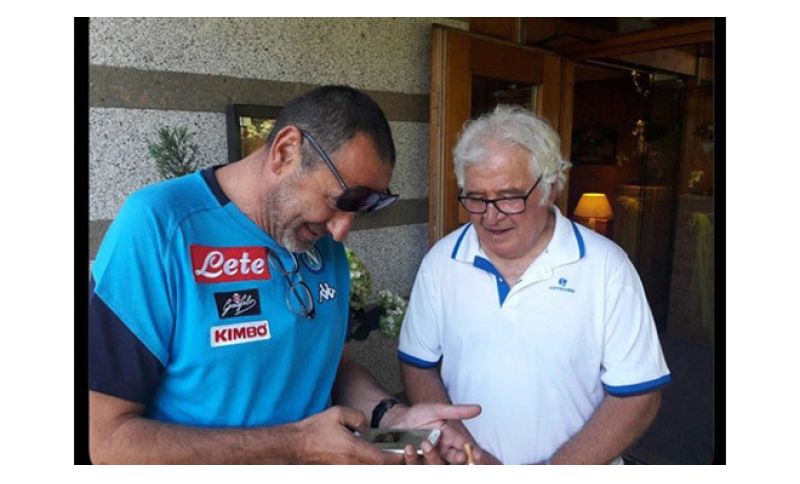
The news of his death immediately took me back to the summer of 2017. Napoli's training camp in Dimaro: I had brought my father Gigi with me, a professional between 1961 and 1966, winner of a stage at the Tour of Switzerland and protagonist of many great Italian races. He followed the Azzurri's training sessions with the respect that belongs to cycling men.
Never a request. Never a photo. Never an intrusion. I spoke to Maurizio Sarri about him. It was enough for him to know just one thing. "He was a rider".
He didn't want to wait. He had us called to the hotel. It was just past two in the afternoon, the team's rest time after a grueling session. Around us were stewards, security checks, executives. Aurelio De Laurentiis was crossing the lobby talking on the phone about transfers and million-dollar deals.
Then Maurizio arrived. He came to meet us as one welcomes an old teammate. An hour talking about Amerigo, Bartali and Gastone Nencini. From that moment on, Napoli disappeared. Football disappeared. The formations disappeared. For almost an hour, only cycling existed.
Valentino Tundisi and I, a cyclist in love before being a member of Napoli's medical staff, remained almost silent. We listened. My father and Maurizio spoke as if they had known each other forever. Out came the stories of Amerigo, his amateur victories, the regret for a professional career that lasted too short, the training sessions with Gino Bartali when the champion passed through Figline Valdarno.
Then another name arrived. Gastone Nencini. The Lion of Mugello. They discovered they had shared the same friend. It was one of those moments when you understand that true sport builds bonds that resist even time itself.
This is why Maurizio Sarri is the way he is
In that afternoon I understood something that perhaps many don't know. Before the ball, in Maurizio Sarri's life there was the bicycle. There were Amerigo's stories. There were Bartali's exploits. There were friendships with men like Nencini. There was a sporting culture that didn't speak of sponsors or social networks, but of sacrifice, respect and work.
Perhaps that's where that dry, essential, almost shy character that has always accompanied Sarri originates. Because cycling, before teaching you how to win, teaches you how to suffer. And those who grow up breathing that air carry it inside them for their entire lives.
The last ride
Amerigo Sarri had left racing at twenty-five years old. But he had never left cycling. He organized races, followed young riders, transmitted a passion that didn't need spotlights. He remained faithful until the end to that world that had taught him everything.
Today I like to imagine that he has found my father Gigi again. And that a little further ahead Gastone Nencini is already there. Three men. Three bicycles. No finish line to conquer. Just a road that continues.
Perhaps with Bartali stopping once more to greet them. Because cycling has a stubborn memory. It doesn't forget its champions. But, above all, it never forgets its men.
to learn more about the story of Amerigo Sarri, reread our Giuseppe Figini's article



 1
1
 1
4
4
1
4
4

 Ritratti
 Oscar
Oscar Albi d'Oro


Se sei giá nostro utente esegui il login altrimenti registrati.