





















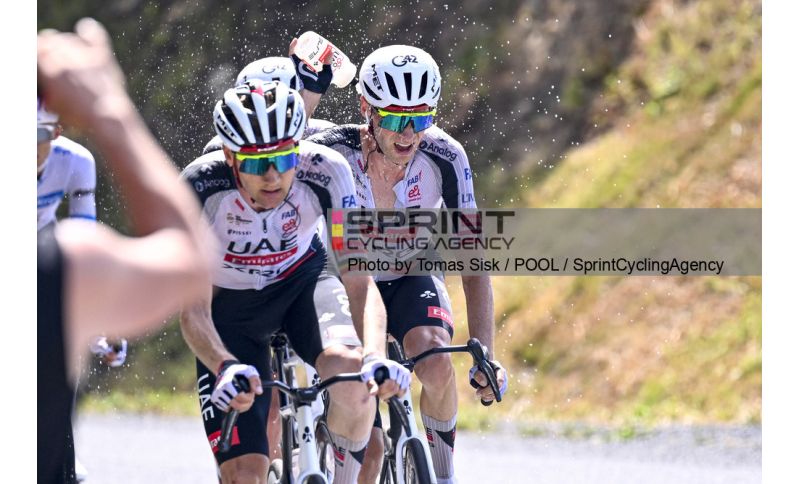
That it's hot at the Tour de France is no longer a secret. Practically from the start of the Grande Boucle in Catalonia, in fact, exceptional countermeasures have been taken to allow teams and riders to face the high temperatures that, for weeks, have been suffocating the entire Old Continent, France included.
Cryotherapy, ice packs, cold water baths and processions to the team cars and neutral support motorcycles to never be without something cool have been the common denominators of the first nine stages of racing and, likely, will be in the coming days when the caravan will again be called upon to face the exhausting effects of the heatwave.
The latter, present multiple times in this period of the year but never so persistent and suffocating, has thus played an absolutely leading role in this opening of the Grande Boucle to such an extent that, thermometers in hand, it is not excluded that the one we are witnessing at the beginning of July could ultimately be the hottest edition of the Tour ever.
This suggestion was given in recent hours by ProCyclingStats, which revealed that the average temperature recorded in the first nine stages was 32.4 degrees Celsius, a staggering figure considering that, since 2007 when Stephan van der Zwan's portal began recording the average temperature values for each stage and edition, the hottest Tour recorded so far was that of 2022 when the Grande Boucle ended in Paris with an overall average temperature of 25.9 degrees.
While it is true that as we approach the major mountains in the coming days the overall value should decrease, the heat wave that has recently been raging across Europe has laid the groundwork for, should there not be significant improvements, the record to be seriously challenged on July 26th.
About the heat, the extraordinary remedies that teams and athletes have implemented in recent days and, above all, how to deal with a trend that scientific studies predict will become increasingly pronounced in the near future, yesterday also spoke the current yellow jersey wearer Tadej Pogacar, who, as a possible expedient for making cycling compatible with what appear to be increasingly physically unbearable summers, has thought of something that to many might seem, depending on one's perspective, extreme or premature: rethinking the calendar.
"In my opinion, this is a matter that should be discussed. If I had the power to change everything, I would modify the entire calendar. I would not race in July and August in the hottest places and would develop a completely different calendar, but it's a topic that needs to be thought about very carefully. It's not something I can do. Perhaps the next step could be to start the stages earlier," said decisively the reigning World Champion, who then, speaking specifically about when to start pedaling, felt the need to clarify that a variation of a couple of hours compared to current start times would not be sufficient for him.
"Yesterday a proposal was made that we could start at 10 o'clock, but for me starting at 10 doesn't change anything because we still arrive with the heat. For example, today when we reached the finish line, it was much cooler than at the start. So we would need to start the stage at eight or nine o'clock, or even earlier. It can be a hassle, but I think the body can adapt to this too, that is, waking up at five in the morning and tackling the stage at eight," Pogacar declared, opening a debate that certainly needs to be addressed calmly while taking into account all the needs (such as those of television broadcasters) of the parties involved.

 10
10


 10
10


 1
1
2
2
1
1
2
2

 Ritratti
 Oscar
Oscar Albi d'Oro

