



















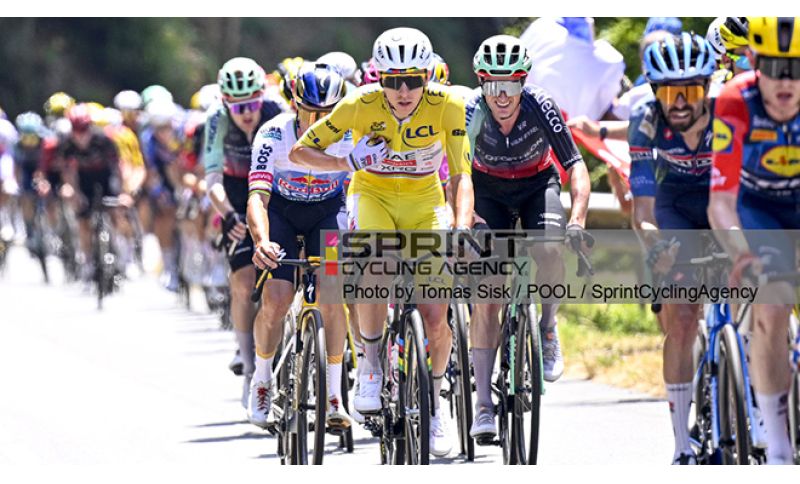
The Tour is running at breakneck speed, but politically it is changing even faster. The eighth stage, 180.4 kilometers from Périgueux to Bergerac, was covered by Tim Merlier in 3 hours 52'50", at an average speed of 46.49 km/h. It was the Belgian's second consecutive victory, achieved after being boxed in on the final bend and launching his sprint approximately 250 meters from the finish line. Up front, spectacle unfolds; behind, however, the general classification contenders have transformed caution into collective strategy.
Pogačar explained that among the yellow jersey candidates, a sort of agreement has solidified: to stay further back in finishes destined for sprints, also taking advantage of the five-kilometer protection zone, to reduce the risk of crashes. It is a technical passage, but also a political one: riders no longer merely submit to the rules; they informally contribute to governing race safety. The result is measurable. In the eighth stage, all ten riders in the top ten of the general classification finished with the same time attributed to the main group. We can define a Classification Neutralization Index, calculated as the percentage ratio between top ten competitors who don't lose seconds and the total of the top ten. At Bergerac the KPI was equal to 100%: ten out of ten. It doesn't mean nothing happened; it means the system prioritized the preservation of time advantage over the pursuit of unlikely gains.
The calm, however, is only apparent. After nine stages Pogačar leads the general classification in 32h17'04", with 2'42" over Vingegaard, 3'27" over Del Toro, 3'30" over Evenepoel and 3'34" over Ayuso. The ninth stage did not alter the gaps between the top nine, but it widened the overall dispersion of the top ten: between the leader and the tenth, now Egan Bernal, there are 552 seconds, equal to 9'12"; of these, 162 seconds are concentrated between Pogačar and Vingegaard. The Vertex Polarization Index, calculated as the ratio between the second-place gap and the tenth-place gap relative to the leader, multiplied by one hundred, therefore drops from 37.7% recorded after the eighth stage to 29.3%: [VPI = (162 / 552) × 100 = 29.3%]. The decrease in the indicator does not, however, signal a weakening of Pogačar's supremacy: his margin over Vingegaard remained unchanged. It is instead the effect of the widening of the tail of the top ten, determined by Bernal's entry at 9'12". The top thus remains strongly separated, while the classification assumes an even clearer structure: Pogačar ahead, a group of eight pursuers gathered within 4'57" and, immediately after, a gap of 4'15" between ninth-place Skjelmose and tenth-place Bernal.
Behind the two leaders, however, the race is compressed. From third-place Del Toro to eighth-place Lenny Martinez, only 54 seconds separate them. Here lies the true competitive space: not yet the direct battle for yellow, but a high-density battle for the podium, in which six riders can exchange positions through a single attack, a crisis, or a nutrition mistake.
In this group there is Paul Seixas, sixth at 3'55". He is 235 seconds behind Pogačar, but just 28 from third place: only 11.9% of his overall deficit. It is the KPI that transforms the rhetoric of the "predestined" into a concrete measure. France occupies 20% of the top ten thanks to Seixas and Martinez, but has been waiting for a winner since 1985. Forty-one years without a Frenchman in yellow at Paris explain why Emmanuel Macron publicly invited Seixas to continue his journey with Decathlon CMA CGM.
It is not a market in the contractual sense of the term. It is symbolic protection of national sporting capital. The Tour is the ultimate global showcase for teams, sponsors and transnational interests; when, however, a possible French winner emerges, the State returns to speaking the language of belonging. Seixas is no longer merely a rider: he becomes a reputational, industrial and cultural asset. Cycling thus transforms into soft geopolitics, competition to retain talent, image and future.
Climate too now enters into the governance of the race. The ninth stage on July 12 was reduced from 185.5 to 155.5 kilometers due to a red alert in Corrèze: thirty kilometers less, equal to 16.2% of the original route. Not a concession to spectacle, but a decision made involving public authorities, health services, security forces and civil protection. The Tour no longer measures only watts and gaps. It measures the capacity of institutions to adapt a global event to environmental limits, to protect athletes and to preserve the social sustainability of the race.
After nine stages, then, the picture is clear. Pogačar governs time. Macron (new manager for the Tour??) tries to govern the future. The organization governs risk. In between, the group races at almost fifty kilometers per hour, but the real Tour is now decided on three fronts simultaneously: the road, power and data.
Giovanni Di Trapani is a senior researcher at CNR currently on secondment to the Office of the Prime Minister: he coordinates the support structure for the Bagnoli Coroglio Commissioner.

 3
3


 3
3


 6
6
1
1
1
1
4
4
2
2
6
6
1
1
1
1
4
4
2
2

 Ritratti
 Oscar
Oscar Albi d'Oro

