
















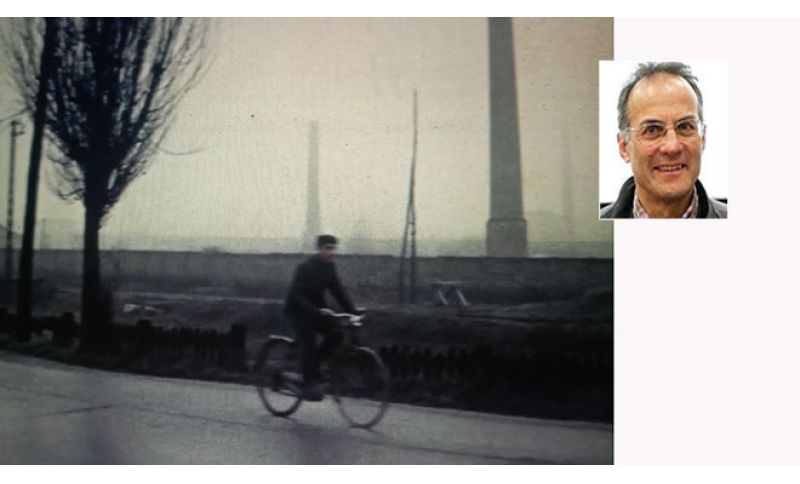
The first photograph is in black and white, dating back to the sixties, it depicts a man who, on a bicycle, is going to work. Behind him there is nothing. That's not true: there is the street, there is a wall, there is a pole, actually, two or three, there is a tree, there is a chimney, perhaps another one, everything is so vague and confused by the bareness of the photograph, by the blurred quality of the shot and of time, also by the gray, cold, earthy sky. Judging by the cap, that man could be a factory worker going to or coming from the factory.
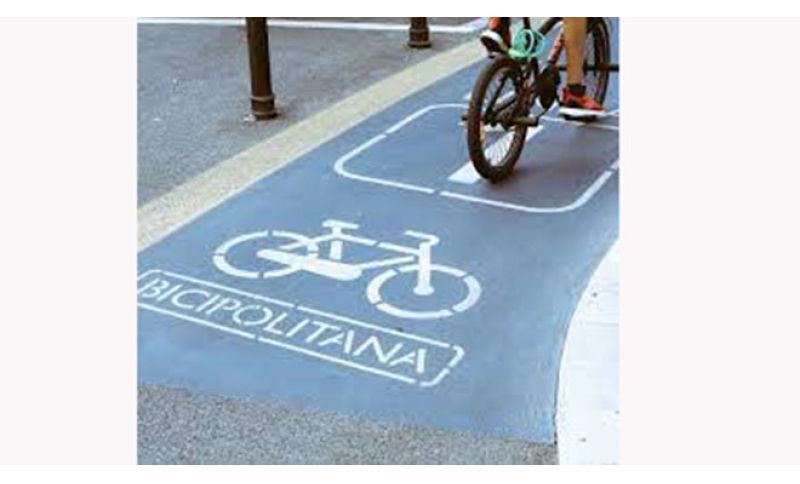
The second photograph is in color, dating back to just a few years ago, it depicts a boy, or rather, the calves of a boy pedaling on a bike lane. Around him you imagine, you sense, you feel the city: streets, cars, motorcycles, people walking, strolling, moving around, voices, noises, car horns. The boy in this photograph is also alone like the man in the other photograph. But it must be the calf, it must be the color, it must be the bike lane, so you come to imagine him weaving through traffic and advancing by the force of his pedals in a road system (the restricted traffic zones, the 30 km/h zones, the bike lanes...) where bicycles are not unwelcome guests or designated victims, but protagonist actors.
Bologna. The Pilastro is a special neighborhood, designed to welcome emigrants, Italian and otherwise, attracted by a job. And a home. It was inaugurated on July 9th, 60 years ago. But there were only houses, public housing, large tenement buildings, a kilometer-long Virgolone seven stories high with 552 apartments. And nothing else. The new residents organized themselves, the Tenants' Committee – a case more unique than rare – managed to accomplish the feat, or the miracle, of modifying the unregulated plan that had not provided for services, support, assistance, not yet, not enough to make human a life already hard in itself. And that's why that bicycle from 60 years ago seemed (or was) so bare, alone, in black and white, and that one now so exclamatory, kaleidoscopic and colorful.
The Pilastro has experienced more misery than nobility, but it has managed to find itself again, redeem itself, rise again. The park dedicated to Pier Paolo Pasolini, to name one, is wonderful, a green oasis, an artistic pathway. The Le Torri dei maestri Paolo and Olmo Pesci gym, to name another, where boys and girls with stories so profoundly different cross boxing gloves and destinies, learn rules and secrets, discover themselves and others, is a bastion of humanity. And the Laminarie theater, to name yet another, tenaciously works in the neighborhood, demonstrates that cultural work bears fruit, slowly and courageously, but it does bear fruit, and it will always bear fruit. Laminarie itself made a film about the Pilastro, telling its story, collecting testimonies, passing down images, including that old bicycle in black and white.
If you want to see the film, click here: https://vimeo.com/1105697665/3955280e69




 Ritratti
 Oscar
Oscar Albi d'Oro


Se sei giá nostro utente esegui il login altrimenti registrati.