


















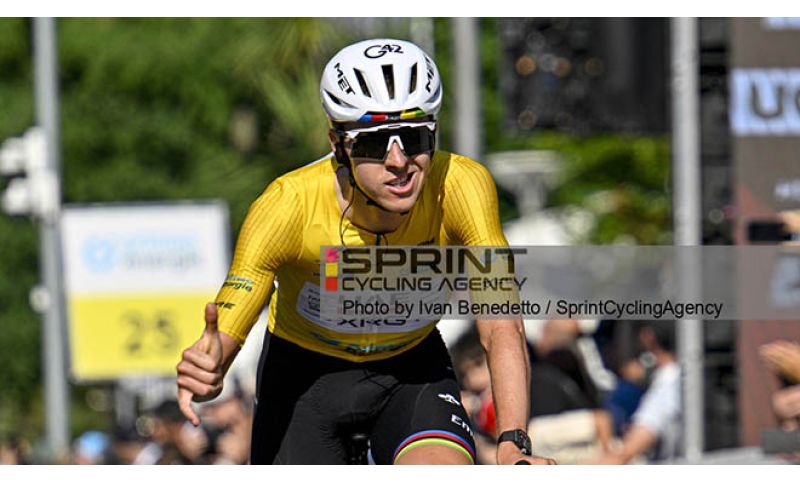
There are phrases in cycling that are worth more than a power table. Sjoerd Bax, a former teammate of Tadej Pogačar at UAE, delivered one that deserves careful reading: a coach of the Slovenian can above all "ruin things", if he becomes obsessed with numbers, watts, graphs, and the desire to transform a champion into a laboratory project. It's a provocation, certainly. But also an interpretive key. Because the Pogačar case doesn't just tell the story of a champion's growth: it tells the transition from talent to system. Bax isn't saying that Javier Sola invented Pogačar. He's saying something more subtle: with an athlete like this, the task isn't to artificially add what's missing, but to free what already exists. And so the question changes. No longer just: how strong is Pogačar? But: how much performance does he produce every time he races? This is where narrative meets statistics.
Our analysis of updated results allows us to read the Slovenian's metamorphosis through some simple but highly significant indicators. The first is the PRD, Performance Rendering per Day of racing. It doesn't measure the absolute value of a victory, but the density of performance: how many times a rider transforms presence into result, a start into dominance, a number on his back into sporting fact. In Pogačar's case, the most impressive data isn't just the number of victories, but the frequency with which they arrive in relation to the days actually raced. In other words, he races less than others, but produces more impact.
2024 was, from this perspective, an almost perfect statistical laboratory. Pogačar conquered the Giro and Tour in the same year, signing twelve stage victories across the two Grand Tours: six in Italy and six in France. But the most interesting number concerns days in the leader's position. In the major stage races he competed in, the Slovenian occupied the position of command for a very high proportion of available days. Translated into technical terms: whenever the race opened up the space for control, he occupied it almost always. This is no longer just superiority. It's statistical governance of the race.
Then there's the second indicator, the ASAD, Active Solitary Distance Index. Here we don't just measure victory, but the depth of the attack. Pogačar built some of his most impressive successes with long, solitary actions, almost off the scale: Strade Bianche, the World Championships, Lombardia, Liège, and most recently a stage at the Tour of Switzerland. These aren't simple solo finishes. They're remote control operations of the race. The champion doesn't wait for the finale, doesn't just respond, doesn't only calculate on the final climb. He moves back the breaking point and forces his rivals to chase not a man, but a new geometry of time.
Bax's words, however, allow us to read what numbers alone cannot explain. The change from Iñigo San Millán to Javier Sola doesn't seem to have erased the aerobic base built in previous years, but rather integrated it with another vocabulary: strength, intensity, explosive work, torque production, time trial bike adaptation, attention to body composition. The international press has emphasized this point heavily: not a dramatic revolution, not a secret method, but progressive refinement. More gym work, more selective intensity, more capacity to produce power after many hours of racing.
From here emerges the third indicator, the ASI, Athletic Specificity Index. Modern cycling is no longer measured solely in kilometers, but in the quality of the stimulus. It's not enough to do volume, not enough to accumulate hours, not enough to chase a threshold. What counts is the ability to build targeted adaptations: strength when strength is needed, intensity when intensity is needed, recovery when the body must absorb, lightness when the calendar demands continuity. Pogačar today seems to be the product of this synthesis: not a transformed athlete, but a talent from which friction has been progressively removed.
The fourth indicator is the PVI, Performance Versatility Index. Here the data is almost visual. Pogačar wins in Grand Tours, in Monuments, in week-long races, on long climbs, on walls, in time trials, on rainy days and hot ones. His strength isn't just vertical, it doesn't concern just one terrain. It's transversal. The Slovenian champion doesn't dominate one specialty: he crosses specialties. In a cycling increasingly fragmented between climbers, time trialists, and stage race men, he tends to recompose what modernity had separated.
This is why Bax's phrase is so important. A coach can ruin Pogačar if he tries to confine him within a number. He can instead make him even stronger if he understands that the number must serve talent, not replace it. Statistics, in this case, don't cancel the poetry of racing. They illuminate it. They tell us that dominance isn't made only of victories, but of density, continuity, depth of attack, versatility and control. Pogačar's true metamorphosis, then, isn't the transition from a strong rider to an invincible one. It's the transition from natural talent to an integrated performance system. More evolved materials, more refined positioning, more targeted preparation, a deeper team, a more selective calendar, more scientific recovery. Each detail adds little. But when that little adds up on an exceptional organism, it becomes a lot. In the cycling of data, Pogačar remains a marvelous anomaly: the rider who forces statistics to chase poetry, and poetry to settle accounts.

 10
10


 10
10


 1
1
1
1
2
2
2
2
1
1
1
1
2
2
2
2

 Ritratti
 Oscar
Oscar Albi d'Oro

