
















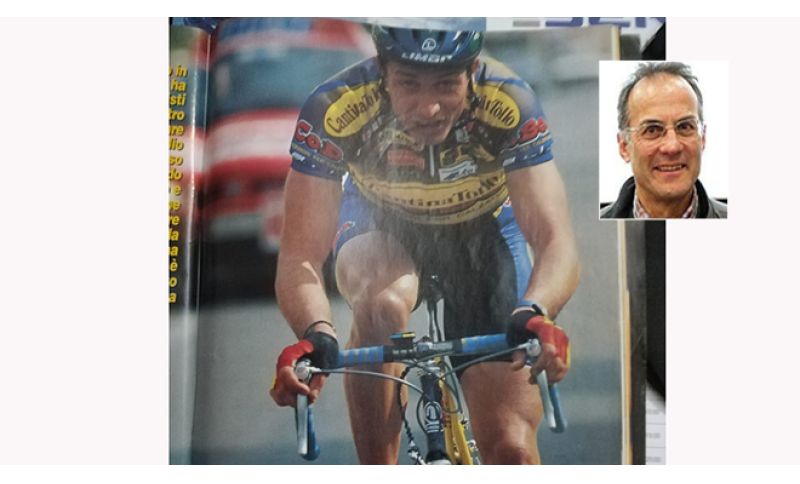
The last-place riders: those at the bottom of the general classification, first in the sentimental standings. Because the last-place riders belong to the domestiques, in perpetual struggle with the time limit and minimal energy reserves. The most human and the most humble. The most like us. The tenth and final installment is dedicated to Gabriele Di Francesco, an honorary last-place rider.
-
He didn't manage it. He would have liked to arrive, even last, at the Giro d'Italia. But as he explains, "it wasn't easy to arrive last, someone would get knocked out the day before, someone else the day after, there was always someone in worse shape, further back, deeper in trouble". Especially since Gabriele Di Francesco, 53 years old, from Nereto in Abruzzo, with three seasons as a professional, never participated in the Giro. But he can be considered an honorary last-place rider.
Ready, set, go.
"Dad was a woodworker, Mom was a nurse, I had one sister. Elementary school, middle school, technical industrial institute—I dropped out in the fourth year. Meanwhile, I had a passion for cycling: I saw a fellow townsman who was a cycling enthusiast, coming and going, seeming happy and content, and I wanted to ride too, until I received a Graziella. Then cycling: my first bike at eight years old, a Vicini with a 24-inch frame, a gift from my parents; my first race shortly after, I came second; my first victory at the second race".
A winner?
"In the youth categories I averaged six or seven victories per season. The Coppa della Liberazione in Florence among juniors, a third place at the Italian championships... In my third year as an amateur I won the green jersey at the Giro d'Abruzzo and the Settimana Lombarda... And in 1996 I turned professional with Cantina Tollo".
A different life?
"Different music entirely. As a domestique, I abandoned personal dreams and dedicated myself to collective tasks. I was altruistic, I'd take ten water bottles from the team car and distribute them to my teammates. Or at the start I'd push hard and drop back 50 kilometers from the finish. In those nineties we went all out".
Days of glory?
"One. Tirreno-Adriatico in 1996, the second stage, from Ferentino to Santa Marinella, I attacked alone after just a few kilometers, built up an eleven-minute lead, held on until seven kilometers from the finish, then got caught—Abdujaparov first, Svorada second, Baldato third. That was the time I came closest to victory".
The gruppetto?
"It wasn't easy staying in there either. When a team leader called, the others fell in line. The rule: steady climbing, death-defying descents, all-out on the flats. Those who couldn't keep up would drop back and often finish outside the time limit".
A rouleur?
"A fast rouleur, but slow on climbs, unless they were short or very short. So I was forced to refine my survival techniques, the art of endurance, the craft of managing on my own. That time in Spain, in difficulty, in crisis, alone, at the very back of the race there was only me, me and me, I couldn't see anyone anymore, the group had vanished, but there was still a race official keeping an eye on me. I saved myself because a funeral procession was passing by, I attached myself to the hearse, on the right side, hidden among the wreaths. The funny thing is that the official, not seeing me anymore, looked for me, but couldn't find me".
Other tricks?
"That time in the United States, at the Grand Prix of Philadelphia in 1996, a World Championship distance, a circuit to repeat endlessly, ready, set, go, all out. After three laps I turned to Germano Pierdomenico, my teammate, and asked him if we shouldn't... hide. He barely had time to answer before he'd already said yes. We hid in a small wood, from there we watched the race, we came back in with three laps to go, among the breakaway riders and the chasing group".
Bonking?
"In Spain, I bonked suddenly, I couldn't see the road anymore, I finished outside the time limit, I decided it was time to quit, I said enough, and I meant it. With one regret: I never lived the life of a true racer. So I don't know how far I could have gone. I preach the racer's life now, as a sporting director. Parties and nightclubs, late nights and dietary slip-ups: don't do like me, I keep telling my riders".
And now, the bike?
"Between my work as a security guard and as a sporting director, I don't have time anymore. Every now and then I get the urge, the passion, the romanticism: I talk and talk, I promise and promise, then I leave the bike in the basement".




 Ritratti
 Oscar
Oscar Albi d'Oro


Se sei giá nostro utente esegui il login altrimenti registrati.