
















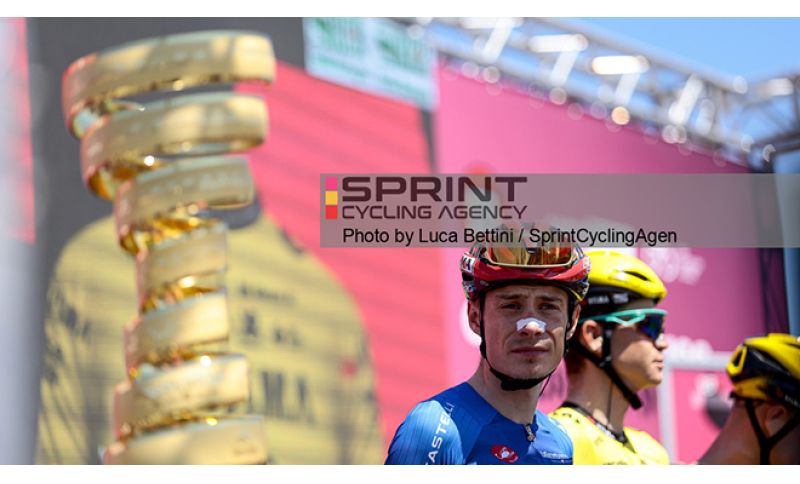
There are moments in a Grand Tour when the standings tell less than the road does. The time sheet preserves its rigor, arranging riders according to gaps, seconds and provisional hierarchies, but it doesn't always manage to capture what cycling delivers to the eye: the sensation that a race has already found its center of gravity. After Corno alle Scale, on the eve of the first rest day, the Giro d'Italia exists precisely within this suspension. The pink jersey still rests on Afonso Eulálio's shoulders, but the mountains have already pronounced a name: Jonas Vingegaard.
His second victory in three days, after the Blockhaus triumph, is not merely another entry in the palmares. It is his fiftieth professional victory, his second at the Giro d'Italia, his second at a mountain finish in his first participation in the Corsa Rosa. On the surface these are numbers. In reality they are sentences, almost verses, within an agonistic grammar that the Dane knows better than most: wait, read, measure, strike. Vingegaard doesn't need to fill the race with his presence. He only needs to appear at the exact point where fatigue ceases to be collective and becomes individual confession.
The most significant fact is precisely this. In nine stages, the Giro has already witnessed breakaways, sprints, team tactics, nervous days and selective finishes; but when the road truly climbed, the result was identical. Blockhaus and Corno alle Scale produced the same technical verdict: Vingegaard first, Felix Gall forced once again into the noble and painful role of pursuer. For the third time this season the two finish first and second in a professional race, after what had already happened at the Volta a Catalunya. This is not coincidence, but trajectory. Gall is today one of the few capable of approaching the Dane on the most severe terrain; precisely for this reason, the fact that he still cannot surpass him gives the statistic an almost narrative value. The Austrian is not just any defeated rider: he is the measure that makes Vingegaard's superiority quantifiable.
National history also adds depth to the result. With the Corno alle Scale victory, Danish stage wins at the Giro rise to twenty-one. Vingegaard becomes the first rider from his country to win two mountain stages at the Corsa Rosa, symbolically surpassing the isolated precedents of John Carlsen and Chris Anker Sørensen. This is a passage that goes beyond sporting records. Denmark, a land of wind, plains and geometries, finds in the most glacial and vertical interpreter of contemporary cycling a voice capable of rewriting its own relationship with Italian climbs. No longer exception, no longer episode, but continuity. Yet, the beauty of this Giro lies in the fact that its truth is not yet fully arithmetic. Eulálio preserves the pink jersey and with it the right of the standings not to be forced. Cycling, after all, is cruel precisely because it never allows perception to fully replace official times. Vingegaard is the technical reference point, but he is not yet the accountable master of the race. In this distance between what is seen and what the stopwatch certifies is born the anticipation: that subtle tension that accompanies Grand Tours when destiny seems announced, but not yet fulfilled.
The first part of the Giro also delivers another statistical element of great interest. The first nine stages have been won by only four teams: UAE Team Emirates-XRG, Soudal-Quick Step, XDS-Astana and Visma-Lease a Bike. Even more relevant is the individual concentration: Magnier, Narváez and Vingegaard have already signed two victories each. The Giro has not dispersed; it has selected. It has narrowed the field of dominant forces, bringing to light only a few teams capable of transforming every opportunity into competitive capital. In this framework, Visma appears not only as the team of the day's winner, but as a structure capable of occupying the strategic space of the race. When a captain wins and a teammate like Piganzoli finishes third in the same stage, the fact no longer describes an episode: it describes depth, control, technical density. Historical comparison makes the picture even clearer. Vingegaard is the first rider to win at least two stages in his first Giro after Tadej Pogačar in 2024; in this decade, in the same category of high-productivity debut, the comparison also passes through Filippo Ganna in 2020 and Egan Bernal in 2021. But the Vingegaard case has its own trait. Ganna translated power into the time trial, Bernal built his authority within a progression as a general classification rider, Pogačar transformed the Giro into total dominance. Vingegaard, instead, is following a quieter and at the same time more unsettling line: he does not yet possess the symbol of the race, but he has already conquered its decisive places.
Today the Giro pauses. The rest day in Grand Tours is never merely a break: it is a decompression chamber, mental accounting, psychological threshold. One rereads what has happened and imagines what might happen. Tomorrow the Viareggio-Massa time trial will tell whether this emotional and technical superiority will also become full numerical superiority. For now there remains a certainty, as clear as certain images that cycling can only produce when fatigue reaches its purest form: Jonas Vingegaard has not yet taken the Giro. But the Giro, in the mountains, seems already to have noticed him.



 13
13
 13
1
1
13
1
1

 Ritratti
 Oscar
Oscar Albi d'Oro


Se sei giá nostro utente esegui il login altrimenti registrati.