















Solitary men. In command or at the back. In breakaway or in pursuit. Climbing or training. In everyday life. That day – June 3, 1927 – Ottavio Bottecchia is also alone, on his bicycle, training. Perhaps he senses it, destiny, an uncomfortable, silent, dangerous companion. Bottecchia is alone because his friend and teammate, Piccin, admits he prefers to dedicate himself to his fiancée. Bottecchia tries, along the way, but always in vain, with two other fellow riders, Riccardo Zille and Luigi Maniago, who tell him not today thanks, because they have things to do, work to attend to. So Bottecchia continues alone. And he is alone when two farmers find him on the ground, thrown from his bike, confused, bloodied, dying, more dead than alive. Bottecchia would die 12 days later, with rare moments of clarity. An unsolved mystery, after the first two mysteries, understood as the victories at the Tour de France conquered in 1924 and 1925. The first for an Italian.
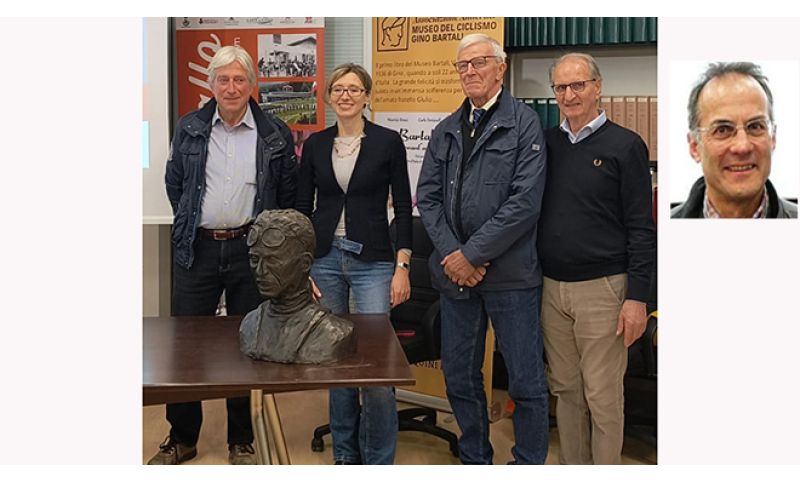
Since yesterday, the Cycling Museum at Ghisallo celebrates Ottavio Bottecchia also with a work of art, a bronze bust by sculptor Guido Merzliak, the second after the one donated to the Ottavio Bottecchia Museum in San Martino di Colle Umberto (Treviso). Seventy-five years old, of Triestine origins, an eclectic artist (also illustrator, caricaturist, cartoonist...) and author, passionate about bicycles and cycling, Merzliak was enchanted by Bottecchia: "I had studied his face carefully to create some engravings, but I wasn't satisfied with the result. I told myself that I had to do something more. So I took the clay and made the sculpture". As often happens, you know where you start, you don't know where you end up: "I feel extremely emotional when I think about where I've arrived. I consider my work modest, but I recognize that I worked well, and seeing it appreciated in this way truly gives me chills".
Merzliak was accompanied by Claudio Gregori, who in recent years has also accompanied Bottecchia at anniversaries, ceremonies, and celebrations. It was Gregori himself who told Bottecchia's story with passion and faithfulness in "Il corno di Orlando" (66thand2nd, 2017). And he did so at Ghisallo as well. Bottecchia, who during the First World War is captured three times and escapes three times the same day of his capture, once asking permission to move the machine gun, which weighs 92 kilos, from one shoulder to the other, taking advantage of the movement and plunging into a ravine about ten meters deep. Bottecchia, who when he returns to the ranks, they ask him why he dragged the machine gun with him and he answers that it wasn't his, but the government's. Bottecchia, whom the French pronounce Botesciá. Bottecchia, who arrives in Paris by train, with a cardboard suitcase and a handlebar, and his racing cap askew. Bottecchia, who at the Tour de France is inserted in place of Brunero in a French team. Bottecchia, whom those from Automoto welcome with coldness and suspicion, sighing "we'll be late, in the evening, waiting for him". Bottecchia, who kisses a fan while pedaling. Bottecchia, who explains: "I don't race for the homeland, which I served on the Piave, nor for applause, but for money. I want my family to escape from misery". Bottecchia, who 12 days before his accident loses his brother, hit by a car.
Bottecchia was a man of climbs, of hardship, of endurance. The sharp gaze, the refined nose, the half-open mouth. The deep wrinkles. The motorcyclist goggles, the scarf around his neck, the tubulars across his shoulder. "El furlan de fero" – thanks, Merzliak – is still among us.
Bottecchia, by the will of Antonio Molteni and Carola Gentilini who direct the Museum, has been placed alongside Coppi and Bartali with full merit. The numbers say so: Bottecchia conquered 34 yellow jerseys, Bartali 23, Coppi 19. "Bottecchia, Bartali and Coppi have three things in common – explains Gregori -. They are the only Italians to have won two Tours. There is no greatness without pain and all three knew tragedy: Bartali lost his brother Giulio, Coppi his beloved brother Serse before dying from a medical error, Bottecchia knew the agony of losing his firstborn daughter of six months and faced the loss of his brother Giovanni before sinking into mystery. All three were protagonists of rebirth: Bottecchia exploded like a dazzling supernova in the Veneto tormented by the Great War; Bartali and Coppi rekindled hope after the Second World War".



 2
2
 2
11
11
5
5
25
25
1
1
3
3
5
5
2
11
11
5
5
25
25
1
1
3
3
5
5

 Ritratti
 Oscar
Oscar Albi d'Oro


Se sei giá nostro utente esegui il login altrimenti registrati.