

















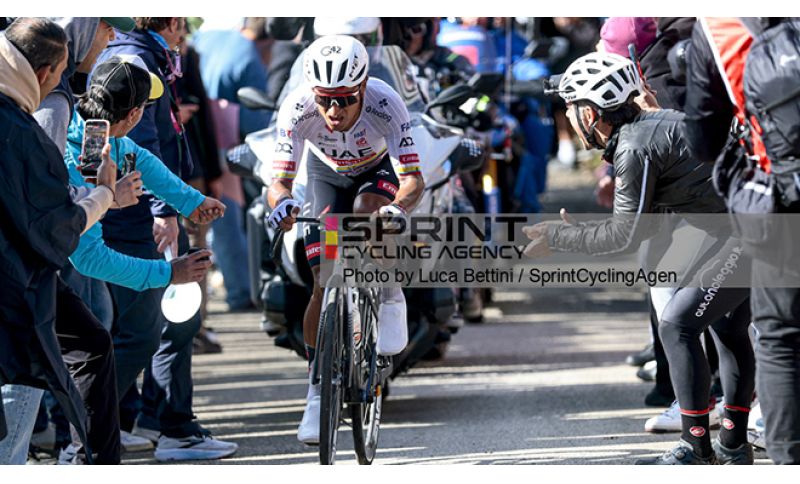
The Chieti–Fermo stage, 156 kilometers at an average of 45.122 km/h, delivers Jhonatan Narváez's second victory and, above all, represents a case of "selective superiority": the ability to transform a fast, nervous, and unstable race into a measurable advantage. The scorecard registers Narváez ahead of Andreas Leknessund, by 32", and Martin Tjøtta, by 42", with 180 UCI points awarded to the winner. But the raw data must be reinterpreted. The margin of 32" over second place, relative to the overall stage time of 3h27'26", amounts to just 0.257% of the stage's duration. On the surface, it appears to be a minimal gap; in modern cycling, it is a significant fracture, because it matured in the final 10 kilometers, when residual energy, positioning, and timing of the attack become decisive variables. Narváez did not win through progressive accumulation, but through breaking the equilibrium: his attack transformed a qualified breakaway into a controlled solo effort, supported by Mikkel Bjerg's work.
From a performance perspective, the most useful parameter is the specific performance index, that is, the ratio between sporting value produced and race time. With 180 UCI points in 3.457 hours, Narváez generated 52.1 UCI points per hour. The figure does not measure physical power in the strict sense, but the competitive density of the result: winning a stage like this means maximizing performance in an unstable context, in which the breakaway was the true tactical arena of the day. The historical profile reinforces the evaluation. Narváez has already claimed two of the first eight stages of the Giro, that is, 25% of the fractions contested. For an athlete not competing for the general classification, it is a performance of absolute significance: it does not produce chronometric continuity, but immediate value, victories, and technical weight. Career data also confirms that we are not facing an isolated episode. Narváez has reached 17 professional victories; four have come at the Giro d'Italia, equal to 23.5% of the total. Six successes have been achieved in Italy, that is, 35.3% of his entire winning output. Italy, and in particular the Giro d'Italia, therefore represent for him an agonistic context with high statistical profitability.
The Fermo stage adds a further indicator: the advantage built after the attack. Calculating the gaps relative to the remaining distance, Narváez gained an average of 3.2 seconds per kilometer over Leknessund and 4.2 over Tjøtta. It was not an anticipated sprint, but a sustained action, capable of transforming every final kilometer into margin accumulation. In a stage closed above 45 km/h average, this gain signals a prolonged superiority. The distribution of the podium clarifies the picture.
Between first and second there are 32", between second and third just 10". The true statistical fracture is therefore not located between Leknessund and Tjøtta, but between Narváez and the rest of the breakaway. Second and third belong to the same performance block; the winner is positioned on a separate level. It is in this double selection—first the breakaway, then the attack within the breakaway—that selective superiority takes shape.
The general classification remains stable but not static. Afonso Eulálio holds the Pink Jersey with 3'15" over Jonas Vingegaard and 3'34" over Felix Gall: 195" over the Dane and 214" over the Austrian. The distance between second and third is just 19", less than 10% of the margin between Eulálio and Vingegaard. The figure signals a classification still elastic, with the Pink Jersey in advantage and the block of contenders compact.
The comparison between general classification and stage victory shows two different forms of performance. Eulálio maximizes positional efficiency; Narváez maximizes result efficiency, accumulating victories, points, and historical significance. UAE Team Emirates-XRG, with 32 seasonal victories and three successes in this Giro, confirms the same logic: Narváez accounts for 66.7% of the team's victories in the Giro d'Italia and 6.25% of the entire seasonal output.
Finally, there is the national dimension. With his fourth stage victory at the Giro, Narváez reaches Richard Carapaz as the most successful Ecuadorian in Giro d'Italia history. Ecuador now counts nine stage victories at the Giro: Narváez alone represents 44.4% of them, while the Narváez-Carapaz pair concentrates eight victories out of nine, 88.9% of the national total.
The Fermo stage is therefore not merely the account of a successful solo effort. It is the confirmation of a now-defined profile: Narváez has won 25% of the stages contested so far, has produced 360 UCI points, has impacted UAE's performance, and represents half of Ecuador's entire heritage in Giro d'Italia stages. While the general classification measures resistance over time, Narváez is measuring the ability to impact the present of the race.

 2
2


 2
2


 9
9
1
1
1
1
4
4
2
2
9
9
1
1
1
1
4
4
2
2

 Ritratti
 Oscar
Oscar Albi d'Oro

