

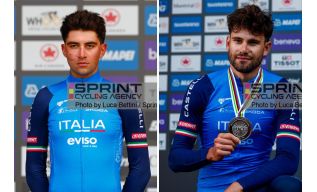














In cycling, numbers rarely tell the whole story, but they often point to where to look. The direct comparison between Afonso Eulálio and Gianmarco Garofoli, read through the races in which the two started simultaneously, offers an interesting snapshot: not so much a definitive ranking, but the profile of two athletes who seem to reflect one another, returning different images of the same ambition.
Based on available direct comparisons, Garofoli appears more consistent. His statistical presence is built on regularity: more often at the front, more frequently placed in intermediate and upper-middle classification bands, with an evident ability to limit negative days. He is the rider who, in quantitative terms, tends to occupy competitive space stably. He doesn't always illuminate the race with a top result, but he often leaves a solid, measurable, persistent trace.
Eulálio, on the other hand, tells a different story. His performance is less linear, but more pointed. Where Garofoli distributes consistency, Eulálio concentrates peaks. His best placements, his incursions into the upper zones of the finishing order, his ability to produce more visible results on the right days outline a more volatile but also potentially more explosive profile. He is the rider who can remain statistically in the shadows for some days and then suddenly occupy center stage. The aggregate data, therefore, should not be read as a verdict. Garofoli has built a significant advantage especially on the consistency of 2025, a season in which the direct comparison saw him often prevail. Eulálio, however, shows signs of growth, especially in the most recent assessments, where the relationship seems to become less one-sided and more open. The timeline thus becomes decisive: it's not enough to ask who has performed better so far; one must observe in which direction their respective curves are moving.
The comparison is also technical. Garofoli seems to have in steady pace, in endurance and in the ability to stay within the race his distinctive trait. Eulálio, on the other hand, appears more tied to the day, to favorable terrain, to the possibility of transforming a positive condition into an impactful result. In statistical terms, one reduces dispersion, the other accepts variability. One accumulates presence, the other seeks depth. One seems to work on frequency, the other on intensity. And it is precisely here that the duel becomes interesting. Because contemporary cycling doesn't reward just one model. Regularity serves to build reliability, gain space in team hierarchies, consolidate reputation. The peak, however, serves to change perception, to impose oneself on attention, to transform a good season into a remembered season. Garofoli and Eulálio, in this sense, are not merely two names compared by a table: they are two different ways of being within competition. The current snapshot shows them close but not overlapping. Garofoli carries with him the weight of consistency; Eulálio that of possibility. The first seems to have already defined a solid base on which to build; the second allows glimpses of still mobile margins, perhaps less predictable, but precisely for this reason sportingly intriguing.
The future will tell whether these trajectories will tend to converge or diverge. It could be Garofoli who transforms regularity into a leap in quality, adding the full result to his profile. It could be Eulálio who gives consistency to his peaks, making his strength less episodic. For now they remain facing one another, as in a mirror: similar in ambition, different in performance, both still within a story that numbers don't close, but are only beginning to tell.

 1
1


 1
1


 5
5
1
1
1
1
3
3
2
2
5
5
1
1
1
1
3
3
2
2

 Ritratti
 Oscar
Oscar Albi d'Oro

