





















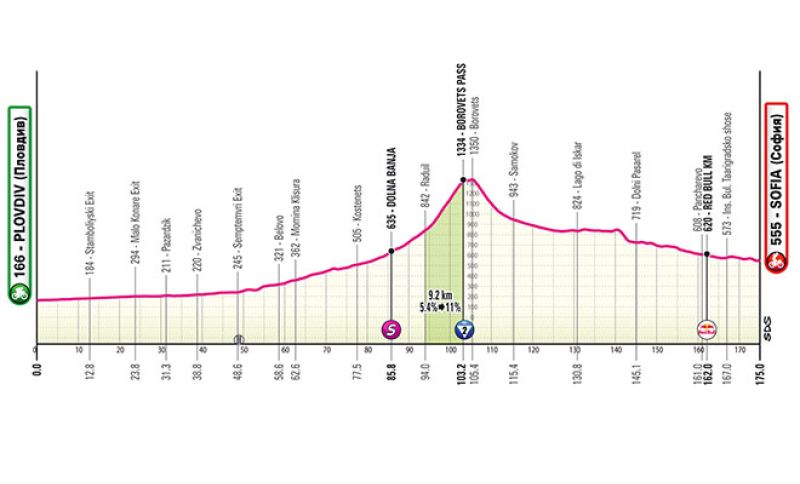
The Bulgarian adventure of the Giro d'Italia concludes with the third stage, the Plovdiv - Sofia of 175 km. This is a section that can be divided into two parts: the first always slightly uphill concluding at the Borovets ski resort (2nd category mountain pass at km 103.2) and the second always slightly downhill until the arrival in Sofia.
to follow the race coverage of the entire stage starting at 12:05 CLICK HERE
The stage is run on wide roads even in the mountains. In the final approach to the city, you enter a fast-flowing sector. The last 8 km are practically straight always in very slight descent until the last kilometer where the road becomes flat. And everything suggests another sprint finish.
THE ROADS OF THE GIRO. The grand finale in Bulgarian territory connects the two largest cities in the country following an overall simple but not trivial route. And, above all, interesting for those following the race.
We start from Plovdiv, which proudly displays the grandiose monuments of the Roman era such as the Theatre, the Forum and the Stadium. Always a center of primary economic and strategic importance, Plovdiv still preserves the testimonies of the peoples who governed it over the centuries. Thus visiting the city offers frequent surprises among Byzantine churches and mosques, characteristic wooden architecture of the period and synagogues. Not to be missed is the Kyniaz Aleksander, the pedestrian street almost two kilometers long on which the most significant palaces built by wealthy merchants of the place in the XVIII and XIX centuries overlook. Among the cobbled streets that venture into the old city you encounter art galleries, museums, music academies and antique shops where you can lose yourself among Soviet uniforms, Turkish carpets and traditional costumes.
After crossing the historic towns of Pazardzhik and Dolna Banja, the road climbs towards Borovets, Bulgaria's most important winter sports resort, several times host to Alpine skiing and biathlon World Cup races. The network of trails that winds from here through the extensive coniferous forests surrounding the locality invites a cool walk in a silent and unusual environment.
Before arriving in Sofia, the road skirts Lake Iskar, the last place to stop before the final sprint. The capital of Bulgaria does not disappoint expectations and despite its size is best visited on foot. Only this way can you be amazed by the magnificence of Nezavisimost Square (Independence Square), or by the distinctive yellow pavements of the historic center: called zhaltite paveta, they were built on the occasion of Tsar Ferdinand's wedding in the early twentieth century.
Absolutely worth visiting are the Cathedral of St. Alexander Nevsky - one of the largest Orthodox churches in the world, adorned by imposing domes plated in gold and with interiors rich in frescoes and splendid icons -, and the Cathedral of Saint Sofia, built under the rule of Emperor Justinian (VI century) with its three-nave interior, barrel vaults and a grandiose dome. The last stop before diving into the city's lively social life is the Church of Bojana, a medieval masterpiece known for its well-preserved frescoes from the XIII century.



 1
1
 1
4
4
1
1
1
4
4
1
1

 Ritratti
 Oscar
Oscar Albi d'Oro


Se sei giá nostro utente esegui il login altrimenti registrati.