

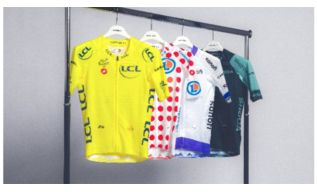



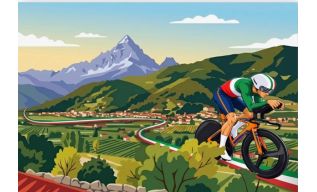
















Here is the blue jersey, one of the most coveted at the Giro d'Italia: the one that rewards the best climber. The mountain points classification dates back to 1933 and was immediately won by Alfredo Binda, who achieved a double with the final pink jersey. Gino Bartali triumphed seven times, irresistible when the road climbed. King of the mountains and overall victory have often gone hand in hand, because the greatest riders have been capable of legendary feats in the mountains. Eleven have achieved this combination: 1933 Binda, 1936, 1937 and 1946 Bartali, 1938 Valetti, 1949 Coppi, 1950 Koblet, 1956 and 1959 Gaul, 1968 Merckx, 1988 Hampsten, 1998 Pantani, 2018 Froome and 2024 Pogacar.
While the mountain points classification dates from 1933, the introduction of a distinctive jersey, in green, came in 1974: Spanish rider Fuente won it. Since 2012 it has been blue: last year it was won by Bologna native Lorenzo Fortunato (Xds Astana). The leader of the daily blue jersey classification receives 700 euros, whoever wears it as the official classification leader gets 750 euros per day, and whoever wins it in Rome pockets 5000 euros.
It is clear that with a formidable climber like Jonas Vingegaard, described by Pogacar himself as "the strongest in the world," it is very likely that this jersey already has an owner. But the Danish rider from Visma-Lease a Bike could aim to win on iconic mountains, such as Blockhaus and Piancavallo, and cross the Giau-Cima Coppi first in the pink jersey (as Bernal did in 2021), leaving the other summits to others. In any case, the blue jersey could be an objective for Giulio Pellizzari (Red Bull-Bora), who has proven he can make a selection in high mountains. Then there are the pure climbers, those who best embody the spirit of this so coveted jersey. Let's start with the Abruzzese Giulio Ciccone (Lidl-Trek), already blue jersey wearer at the Giro in 2019 when he won the Ponte di Legno stage with the Mortirolo, immediately awaited by "his" Blockhaus; then Colombian Santiago Buitrago (Bahrain), first over the Tre Cime di Lavaredo in 2023, as well as his fellow countryman Egan Bernal, king of the 2021 Giro, and in clear recovery after the very serious accident four years ago; Austrian Felix Gall (Decathlon), 5th at the 2025 Tour; Australian Michael Storer (Tudor), twice tenth at the Giro in the last two editions; Vicentine Filippo Zana (Soudal-Quick Step) and the very young Treviso native Alessandro Pinarello (Nsn Cycling).
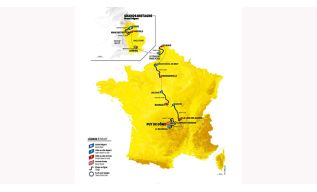
The Giro climbers classification is determined by the sum of points awarded to riders who pass first over the various mountain passes, which are divided into five categories based on difficulty and obviously have differentiated point values. In total, there are 49 mountain passes that will award points at the 2026 Giro. Let's start with the most important, the Passo Giau, Cima Coppi of the Giro at 2233 meters elevation, included in the 19th stage with finish at Alleghe-Piani di Pezzè: at the summit, 50, 30, 20, 14, 10, 6, 4, 2, 1 points will be awarded respectively to the first nine classified riders. The Cima Coppi entered the pink route for the first time at the 1965 Giro.
There are then 9 first category mountain passes: Blockhaus (finish), Corno alle Scale (finish), Saint-Barthélemy, Lin Noir, Pila (finish), Carì (finish), Passo Duran, Piancavallo (1st passage), Piancavallo (finish). In case of a stage finish, 50, 24, 16, 9, 6, 4, 2, 1 points are awarded to the first 8 classified; in case of a summit passage, the points will be respectively 40, 18, 12, 9, 6, 4, 2, 1.
Moving on to the 13 second category mountain passes: Borovets Pass, Cozzo Tunno, Montagna Grande di Viggiano, Roccaraso, Querciola, Colle di Guaitarola, Verrogne, Leontica (1st passage), Leontica (2nd passage), Coi, Forcella Staulanza, Passo Falzarego, Piani di Pezzè. At the summit passage, 18, 8, 6, 4, 2, 1 points will be awarded to the first six classified.
There are 18 third category mountain passes: Byala Pass, Vratnik Pass, Lyaskovets Monastery Pass, Prestieri, Montefiore dell'Aso, Passo del Termine, Colla dei Scioli, Colle Giovo, Bric Berton, Ungiasca, Doues, Torre (1st passage), Torre (2nd passage), Passo dei Tre Termini, Cocca di Lodrino, Andalo-Lever, Fastro (Scale di Primolano), Clauzetto. At the passage, 9, 4, 2, 1 points will be awarded to the first four.
Finally, the 8 fourth category mountain passes: Cape Agalina (1st passage), Cape Agalina (2nd passage), Cava de' Tirreni, Monterubbiano, Capodarco, Fermo, Bieno, Muro di Ca' del Poggio. At the passage, 3, 2, 1 points are awarded to the first three.
What are the rules of the mountain points classification? The rider who wins the most points wins, but in case of a tie, reference is made to any first place on the Cima Coppi and, secondly, to the number of first places obtained in first category mountain passes. In case of further tie, victories in second category mountain passes and so on. The last criterion is the best position of the two riders in the general classification.




 Ritratti
 Oscar
Oscar Albi d'Oro


Se sei giá nostro utente esegui il login altrimenti registrati.