
























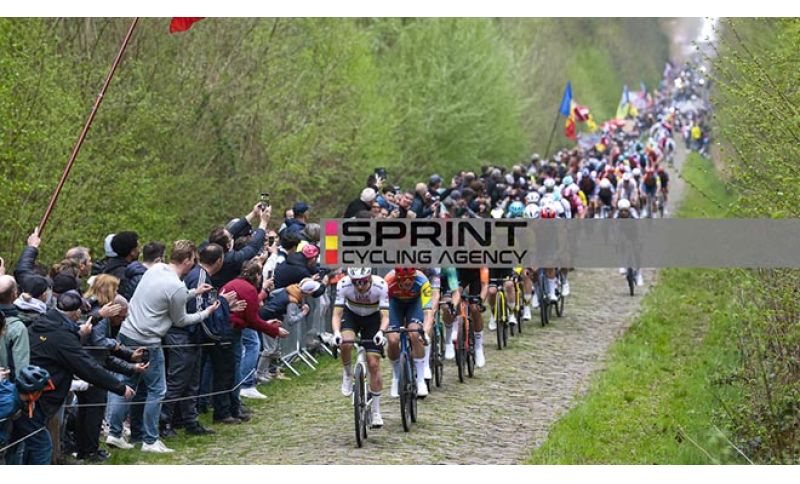
The stones of Paris-Roubaix number six million, they are carefully guarded and are protected cultural assets, but even the most famous pavé in the world has its troubles. It's not a matter of maintenance or anything else, but of thieves who secretly come to take these stones that symbolize the Hell of the North. Sunday marks the 123rd edition and an unexpected threat risks compromising the spectacle and safety of the race: cobblestone thefts along the route. An increasingly widespread phenomenon that is infuriating the organizers and could have serious consequences.
The alarm was raised by race director Thierry Gouvenou during an inspection of the Arenberg Forest, the most terrifying and feared sector of Roubaix. Here, as well as in the Carrefour de l'Arbre section, unscrupulous and disrespectful individuals are removing cobblestones to take them away as souvenirs and, in some cases, to resell them to race enthusiasts. The result? Deep and dangerous holes right in the middle of the road. Gouvenou doesn't hide his anger: «These gestures, apparently harmless, can become extremely dangerous. Riders tackle these sections at speeds that can exceed 50 km/h: hitting a sudden cavity could cause violent crashes and compromise the outcome of the race».
Paris-Roubaix has always been one of the toughest tests in cycling. Its cobblestone sectors, often uneven and irregular, put riders' endurance, technique, and nerves to the test. The addition of artificial and unmarked obstacles, such as holes left by thefts, risks transforming sporting difficulty into real danger. Not only for the protagonists of the men's race, but also for the women's race, both scheduled for the same day. Obviously, the organizers haven't remained idle. To combat the problem, they have mobilized teams of workers tasked with continuously checking and restoring the 30 cobblestone sectors totaling 54.8 kilometers. A supply of spare stones has also been provided to quickly fill areas where cobblestones have been removed. The work is continuous: repeated checks during the week and a final complete inspection on the eve of the race. But the risk remains high as long as the phenomenon is not contained. So even late in the evening there are patrols and among enthusiasts, those who respect the race, actual nighttime patrols have been organized, to try to catch the cobblestone thieves in the act.
Curiously, it's not only humans who influence the condition of the route. In Arenberg Forest, which is part of the Wallers woods, for example, goats are used to graze on the grass between the cobblestones, reducing another risk factor for riders. Wild boars also contribute, involuntarily, to complicating the situation, moving earth and debris across the cobblestone sections. However, according to Gouvenou, nothing is more problematic than nighttime thefts.
The 2026 edition is perhaps one of the most anticipated and promises an exciting duel between Tadej Pogacar and Mathieu Van der Poel. Precisely for this reason, race director Gouvenou launches an earnest appeal: «Leave the cobblestones in their place. It would indeed be paradoxical to see a race decided not by the strength of the athletes, but by an accident caused by an irresponsible act».
Paris-Roubaix is a cycling heritage. Every stone tells a story made of fatigue, crashes, and legendary feats. Taking away a piece means not only damaging the route, but putting riders' safety and the integrity of the competition at risk. In an already extremely harsh context, the Hell of the North certainly doesn't need additional dangers. And the hope is that respect will prevail for one of the most iconic races of all time.

 6
6


 6
6


 2
2
17
17
4
4
1
1
2
2
17
17
4
4
1
1


 Ritratti
 Oscar
Oscar Albi d'Oro

