























In modern cycling, safety remains one of the most complex and controversial issues. Despite technological and organizational progress, one problem continues to emerge with alarming frequency: the time that elapses between a crash and the intervention of rescue services. A gap that, in some cases, can make the difference between life and death, as tragic events like those of Gino Mäder (2023) and Muriel Furrer (2024) have unfortunately taught us.
GPS tracking will gradually become mandatory in all race categories
The issue has become central, so much so that UCI president David Lappartient dedicated an open letter to it on March 13th, sent to the presidents of the category associations Brent Copeland, head of the teams united in the Association Internationale des Groupes Cyclistes Professionnels (AIGCP), Javier Guillen who leads the organizers of the Association Internationale des Organisateurs de Courses Cyclistes (AIOCC) and Adam Hansen, head of the world association of riders Cyclistes Professionnels Associés (CPA), to request the collaboration of all parties and reiterate that GPS tracking will gradually become mandatory in all race categories.
Data born for entertainment, evolved for safety
Among the candidates to provide this delicate and valuable service is Swiss Timing, already a partner for the International Cycling Union's timekeeping, but also Velon, a pioneer in real-time tracking data, which launched its own system over 10 years ago, since then showing fans of this sport the performance of teams and riders during races. Velon collaborates with most World Tour teams and many Pro teams, as well as with all major World Tour races. In 2025, it developed a cutting-edge GPS-based rider safety tracking system, adding safety features to its existing system. First implemented at the 2025 Tour de Suisse, where all participating men's and women's teams used the system with full support from the race organizer. At Velon's invitation, the system was presented to various UCI officials during the race.
Velon's proposal
"Since then, Velon has continued to develop the real-time tracking and safety system, which provides teams and race organizers access to a customized dashboard that shows real-time positions and sends alerts if riders leave the course, stop for a period longer than the preset time, or show an unexpected deceleration from high speed to low speed – explains Graham Bartlett, CEO of Velon. - The system was used in the 2025 edition of the Giro di Lombardia and the 2026 UAE Tour. It was also deployed at Strade Bianche and Tirreno-Adriatico and will be in action tomorrow at Milan-Sanremo. On behalf of all stakeholders in professional cycling, Velon commits to providing an economical and reliable solution that improves rider safety and can be enhanced as technical advances become available, such as AI modeling (something Velon has already introduced into its technology)".
SAVE = Safety and Alert Velon Environment
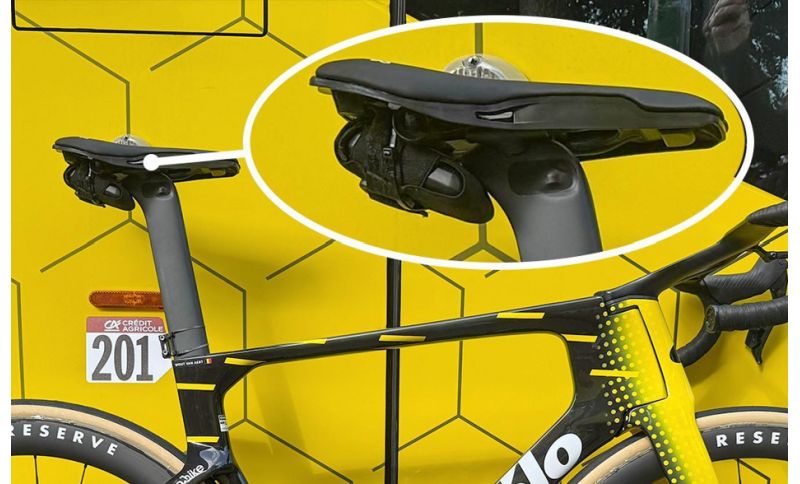
The system developed by Velon was born with a completely different objective: to improve television storytelling through real-time data such as speed, power and cadence. Since 2016, these devices installed under the saddle transmit live information to broadcasters, helping to make the race more understandable and engaging. From this technological foundation, a new function has developed: safety.
The question became inevitable: if we know the position of every rider in real time, can we also understand when something goes wrong? The answer is yes, and it has materialized in the SAVE (Safety and Alert Velon Environment) system, a platform that uses data already collected to automatically identify critical situations.
The operation is based on two main parameters:
- Sudden deceleration: an abrupt transition from high speed to zero can indicate a crash
- Deviation from the course or prolonged immobility: a rider off trajectory or stationary for too long generates an alert
When one of these anomalies is detected, the system immediately sends the rider's precise coordinates to an operations center. From there, it is possible to direct the nearest rescue vehicle.
The key point is not just knowing that something happened, but knowing exactly where.
A more accessible system than in the past
One of the most interesting aspects concerns transmission technology. Unlike traditional systems used, based on radio signals and aerial relays, Velon uses cellular networks. This brings two fundamental advantages:
- Lower costs, therefore greater accessibility even for smaller races
- Scalability, an essential element for possible large-scale adoption
The stated objective is clear: technology that only works in major races will never become a standard.
Despite the progress, the system is not perfect. The main critical issues concern:
- Areas without coverage (typically in high mountains or remote areas)
- Possible false positives, to be filtered with increasingly sophisticated algorithms
To improve its reliability, hybrid solutions are being studied, including the use of satellite connections (such as Starlink) mounted on race vehicles. Furthermore, the devices already integrate sensors such as gyroscopes, which in the future could allow even more precise crash detection.
The real challenge: it's not technical, but political
If the technology already exists, why isn't it yet mandatory? The answer is complex and concerns power balances, data rights and governance. Velon represents the interests of part of the teams, while the UCI is developing its own alternative system with its Swiss timing partner. The main issue is data management: who controls it, who uses it and for what purposes. In the meantime, however, one thing is certain: every second saved between incident and intervention can save a life. The future of safety passes through here and, in this sense, 2026 could be a decisive year.



 2
2
 2
2


 Ritratti
 Oscar
Oscar Albi d'Oro


Se sei giá nostro utente esegui il login altrimenti registrati.