


















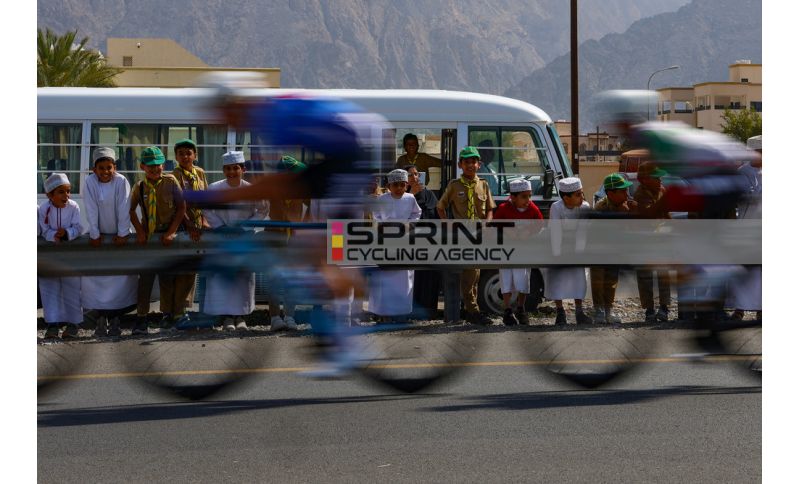
Until 15 years ago, talking about cycling in Oman was not just difficult, but practically impossible. Then A.S.O arrived with its stage race, a crazy idea in a country where almost no one rode bikes; initially many champions were racing, but the public was scarce. The government believed in it from the start, in fact, it was the first to do so, investing in roads with a thousand lanes and gigantic boulevards, but above all understanding that sport was the main vehicle for moving cycling. Every year since 2010, in February for a week, Omanis try to coexist with the two-wheeled sport, once they were indifferent, but now they are becoming fond of it.
Last year we were struck by the ordinary people's relationship with cycling, almost disinterested and often frightened. Cyclists passing on the roads were like aliens to be seen secretly behind house walls, the streets were almost empty and if someone was passing by, they would turn the other way. However, there was a public, scattered randomly and in the most unlikely places, often stopping roadside and watching the passage while staying in their car or climbing on it to see better. There were men and children with their flags waving, women were rare, but those who were there observed in amazement. The water bottles thrown by the riders, for us a precious trophy, became common objects that were almost not collected, the few who did were scolded by parents or received puzzled looks. It was a particular way of experiencing cycling, in some ways almost absurd, yet we had perceived that for some, interest was there, they just needed to find a way to express it.
From one season to another, there are new riders, jerseys change, often even the races, but in Oman cycling has literally taken giant steps in just one year. It is the country of change where everything flows at double or even triple speed, year after year new roads are built, palaces, entire towns that a handful of months earlier did not even exist. Everything changes, as does the relationship with sport. Upon our arrival for this edition of the Tour of Oman, we immediately realized that there was something extremely different in the air, in the words of the Omani cycling federation president who praised the good work done, in the emotion of local riders and in the number of people involved. Except for one stage, the route was the same as last year, same cities, same villages, we expected the usual few people along the roads and instead the public's relationship had changed. Almost like magic, a bicycle race was attracting spectators, there was curiosity, there was a desire to discover and we with them absolutely wanted to know what had happened in less than twelve months. It was enough to ask a few questions to the organizers, to the people present in the start and finish areas to understand. Last year it was not a simple operation, they often moved away almost scared and when we managed to extract a few words, the conclusion was that they knew very little about cycling, if anything at all. Between 2025 and 2026, the Ministry of Sport, assisted by Tourism and Health, heavily invested in cycling, supported small realities in the hinterland, promoted it in schools and on television. The Omani National Team began to think big, became a symbol of courage, almost a model to show to all young generations who now have champions to admire. The organization of community races during the Tour of Oman was the last piece of a total change involving everyone.
Now following cycling is no longer strange, certainly not common, but something absolutely fascinating. In schools, they are starting to talk about this distant sport, there is curiosity, there is no more embarrassment. If until last year in the start and finish areas of the Tour of Oman there were mostly tourists, this time we saw local people fighting to secure a spot at the barriers. Some tried to approach the stage, often bewildered, they asked us questions to know exactly what was happening, but this time they did not turn their heads away, they decided to stay. We witnessed the first selfies with champions, some boys at Sink Hole followed the wave of some Westerners and posed with winner Molano, others more discreetly began to take photographs. On television, very little is shown, often the public is focused only at the finish, but in reality, on the streets is where we found the biggest surprise. In those same wide boulevards that last year were deserted, this time entire school classes were waiting impatiently for the passage with their little flags, males and females, there was no difference. In the villages, they were no longer content to watch from afar, just one person on the street waiting was enough to encourage others to join, often they did not know exactly what was going to happen, but decided to wait, driven by curiosity. The elderly with their small chairs had set up kind of VIP zones under large trees while girls and boys were already ready to fight for a water bottle. When we preceded the race, we happened to see entire families waiting for the passage, hand in hand and with a dreamy look, more than half an hour in fervent anticipation of something that until a handful of years before did not even exist.
From these days in Oman, we take home many memories, many images that we would never have thought of seeing. Children, teenagers, men and women fascinated by a sport they are beginning to know and experience as we do. Some have started collecting water bottles, others dream of becoming athletes even if they still do not know how to do it. Then there are those who discovered what it means to be a fan, to care about something more than anything else, as in the case of a group of kids who at the end of the fourth stage proudly showed a sign to the camera that read "we love tour of oman". Everything in Oman runs fast and is destined to change, who knows, perhaps next year along with new resorts we will also see the passion for cycling beat even stronger.

 1
1


 1
1


 2
2
1
1
2
2
1
1

 Ritratti
 Oscar
Oscar Albi d'Oro

