
















January 27th is Holocaust Remembrance Day, established by the UN in 2005 to commemorate the victims of the Holocaust and Nazi persecution. For us, it's an opportunity to remember, once again, Gino Bartali.
It was an apparition. Giro d'Italia of 1954, June 6th, the time trial from Gardone Riviera to Riva del Garda, long as a marathon, 42 km, first Hugo Koblet, pink jersey Carlo Clerici, long live Switzerland. "I had left home, in Bonaldo di Veronella, with two friends, about a hundred kilometers, by bike. It was there in Gardone that Bartali appeared to me. He was testing the frame, warming up his legs, breaking his breath. I couldn't resist the temptation and dared to greet him. Extremely kind, he responded. Then I turned my bike and went home. Exalted by the magic of that encounter, I didn't feel the chain but a choir of angels. My friends, who were already racing as amateurs, struggled to keep up with me and then told me I should start racing. I obeyed. I wasn't even 16, I was a beginner. In the first race, I had problems with the gear. In the second, I won by a large margin."
Renato Giusti would become a rider, a true rider, as riders say, quick on the bike, quick in his head. "Amateur, I entered the national circuit, but when I wasn't called up for the Reims World Championships in 1958, where my sister also lived and therefore I would have loved to race, I went to the officials and said clearly that I was poor, that I was racing to make a living and they could keep the blue jersey." Professional from the end of 1959, Giusti also raced under Bartali: "It was 1963, San Pellegrino had withdrawn from professionalism, the team moved to Firte, where there was a lot of passion but no money, to the point that it wasn't admitted to the Giro d'Italia, I took the opportunity and stopped racing. I wasn't even 25."
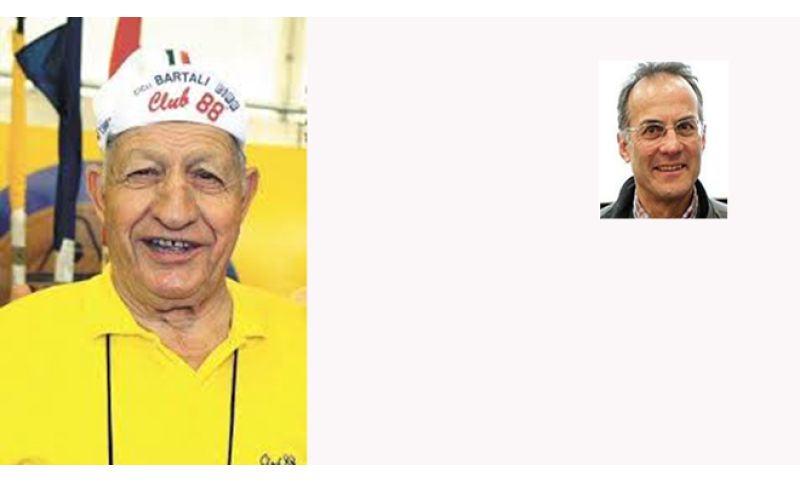
But cycling was in Giusti's destiny and Giusti would remain in cycling: "As a friend, a supporter, a sponsor. And a friend, a supporter, a personal sponsor of Bartali. 'Giustino', he called me, because I was never big and bulky, but also because the diminutive held affection, warmth, intimacy. Since Gino was a believer but also gullible, he was often tricked because of his goodness. And when things weren't going great, I hired him: for 10 years he wore a cap with the Club 88 logo, the brand of intimate clothing I manufactured. He always wore it, he was rigorous and precise about it, there was no cycling occasion, from races to meetings, from 'Processo alla tappa' to Giro d'Italia stages where he didn't show up without the cap. Once it even happened in France, they wanted to film an interview, they asked him to take it off, he was resolute: either with the cap or nothing."
These were the years when Bartali was Italianizing the Giro and touring Italy in his car ("He always drove. The only two people he allowed to drive were Lino Ciocchetta and me"), stopping the car and the life of towns and villages, distributing and autographing postcards, shaking hands, enduring pats, giving predictions, smiles, grumbles, historical memories, immortalized in photographs that continue to emerge and portray him in boutiques and workshops, tables and parties, a popular protagonist by popular acclaim in that divine human comedy that is cycling. "Gino knew that in the courtyard of my house, there was always a tiny little house ready for him. And so he would call me, warn me, stop, eat, sleep, leave. Unstoppable, tireless, uncompromising."
The Righteous and Giustino: a friendship, solid and supportive, never flaunted. It was known, and that was enough. "The last time I saw him was a few days before he died - says Giusti -. I went to visit him at his home in Florence. He was a victim of shingles. He couldn't even bear the contact with the tank top. He kept one shoulder exposed. His skin was burning. He was almost 86, he still seemed strong to me, but suffering and very tired." Shortly after Bartali's death, Luigi, one of his sons, arrived at Giusti's house. "Gino had been clear: his car, the last one, a Golf, he was giving to me. I asked to buy it: no way. To Luigi, I paid for the train ticket and - let's say - gave a tip." Knowing Giusti's proverbial generosity, one can think that the tip was at least equal to the commercial cost (the sentimental value would have been impossible) of the car. "Sometimes I take a little ride: it's like new."
And to think that Giusti was a Coppi fan: "I was fond of Coppi for his class, style, elegance. Then I was also fond of Bartali for his honesty, goodness, generosity". Holocaust Remembrance Day is a Bartali day, not a Coppi day: "When we talked about war, he would cut it short. Good deeds are done, but not spoken about. And he would change the subject."



 1
1
 1
1
1
1
1
1

 Ritratti
 Oscar
Oscar Albi d'Oro


Se sei giá nostro utente esegui il login altrimenti registrati.