















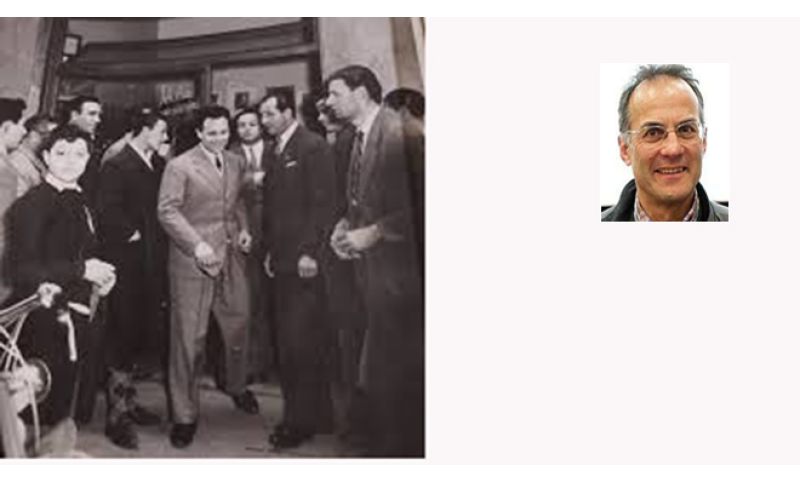
Vuelta. Spain. Granada. Claudio Villa. These three connecting rings from Vuelta to Villa are not coincidental. The Little King of Italian song was crazy about cycling, with around fifty million records sold worldwide, four victories at the Sanremo Festival plus a Naples Festival and two Canzonissima wins.
A Trastevere Roman, with a tenor voice, he began with a tricycle ("The joy and sorrow of Carmelo the tinsmith"), continued with a bicycle ("Somehow acquired a Neri bicycle, on which I managed to install a luggage rack capable of holding at least twenty-five bottles"), water to sell, and raced for his own commerce ("Straddling bicycles, in the blink of an eye, almost like Binda and Girardengo, we arrived at the source with such joy that you could read it on our faces even in the dark"). Until pedaling transformed into singing ("I liked singing and did it often, maybe in front of the mirror or cycling").
Cycling, therefore. "Given my great passion for cycling," Claudio Villa wrote in his autobiography "A Wonderful Life" (Mondadori, 216 pages, from 1987, edited by Gianni Borgna, a copy miraculously resurfaced in a book crossing), "I had asked Vis Radio's owner, Scoppa, if in Florence he knew someone who could introduce me to Gino Bartali. Scoppa replied yes, since in that Tuscan capital, Vis had a distributor who was Bartali's personal friend". Done and dusted. "Meeting the great champion was like reaching a milestone for me, a cycling enthusiast. When he told me that during races, in moments of relaxation, he used to sing my songs, I felt like I was touching the sky with a finger. We became friends to the point that I was godfather at his daughter's baptism". Then "our paths diverged". Other lives, other roads, other stages. "I saw him again years later at the Vigorelli in Milan as a radio commentator. And despite my name being more popular than his", Claudio Villa was never modest, "he didn't let me climb onto the RAI stage, using the excuse that authorities wouldn't allow it".
There was no Bartali without Coppi, not even for the Little King. Indeed: "Always because of my cycling passion, I met Fausto Coppi. Another caliber of champion, but above all, of a man. Complete, sublime, phenomenal". Claudio Villa explained: "Destiny was cruel to him, reserving sufferings as great as his magnificent victories. And in a bigoted Italy, which definitely sided with Bartali, he experienced many moments of pain and desperation, together with a wonderful woman: Giulia Occhini, the 'white lady'. Stigmatized by a hypocritical and moralizing public opinion, persecuted by a relentless campaign of clerical inspiration, Coppi managed, with his exceptional class, to crush all his opponents, sporting and otherwise".
If initially the allegiance was with Bartali or Coppi, it later became with Coppi or against Coppi. Claudio Villa took a side: "Personally, I was always on the 'champion's' side and his Giulia. How many times I went to the Tortona cemetery (Castellania, ed.) to cry in front of his tomb, where he rests next to his brother Serse, who died following a fall in the Giro d'Italia (Giro del Piemonte, ed.) just before entering the Turin velodrome. Well, there was never a time I didn't find his companion, bent over his tomb laying flowers".
The moral: "Fausto Coppi, the greatest cyclist of all time. Yet a crude propaganda stubbornly tried to create an absurd dualism between the 'Catholic' Bartali and the 'communist' Coppi, moreover overlooking the fact that if the first could certainly be defined that way, Coppi, just as certainly, could not". Bartali and Coppi fan, he was a Villa municipal.



 4
4
 4
4
4
4
4
4

 Ritratti
 Oscar
Oscar Albi d'Oro


Se sei giá nostro utente esegui il login altrimenti registrati.