















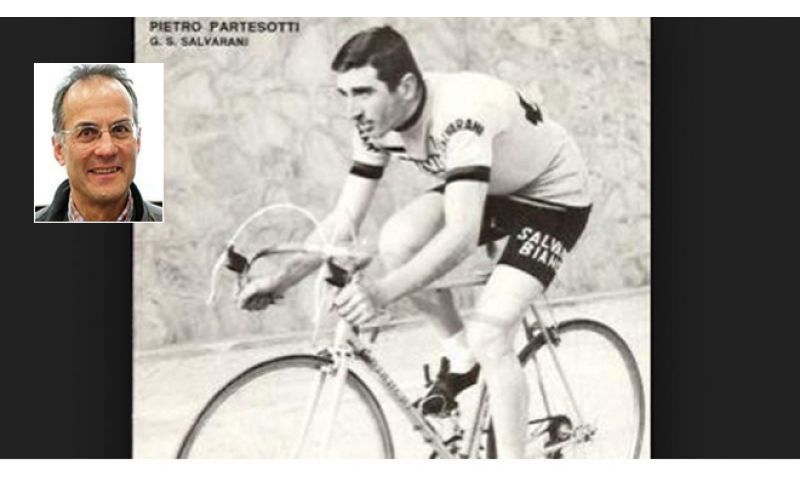
Five days until the Giro d'Italia 2025. While waiting for Roglic and Ayuso, Bernal and Carapaz, Ciccone and Tiberi, Van Aert and Pidcock, we live the countdown through the stories of ancient protagonists. Today, -4 to the starting line, it's Pietro Partesotti's turn.
You become a domestique. Pietro Partesotti was born a captain. Captain of himself. A form of recklessness, or anarchy, or independence. A type of cycling where if you had legs, you played your game, and if you didn't, just finishing was already an achievement. Pepòn is 84, from Reggio Emilia, and a professional from 1963 to 1968, he rode four Giros, from 1963 to 1966 (plus a Tour de France in 1965 and a Vuelta in 1968). As a domestique. Domestique for Vito Taccone, Vittorio Adorni and Felice Gimondi.
The first Giro?
"The first lesson. In 1963. As a neo-professional. The first stage, Naples-Potenza, 182 km, ready, go, a breakaway, about fifteen riders, Adorni, Balmamion, Massignan, De Rosso inside, me too, the advantage rising visibly, until Alfredo Sivocci, Lygie's sports director, ordered me to wait for Taccone in crisis. I stopped, got off the bike, sat on a milestone, and on that milestone I waited 13 minutes before Taccone arrived."
Best placement fourth: fourth in Treviso-Gorizia in 1963, fourth in Viareggio-Chianciano Terme and fourth in Belluno-Vittorio Veneto in 1966.
"I'm not like Roberto Poggiali, a living almanac, who remembers all stages of all tours and all races of all riders. I remember little or nothing, and I'm sorry I'm making a poor showing here. The truth is that, once understood the situation, cycling had become just a job for me, like that of a painter or plumber. I started enjoying cycling only when I got off the bicycle and got into a camper, and from the camper I followed Giro and Tour, on the roadside, in the Alps or Pyrenees, among fans and sports enthusiasts, with sausages and drinks. And only then did I feel on my skin how many emotions a man, or a woman, on a bicycle can give."
Never moved during the race?
"Twice. The first Milan-Sanremo, in 1963, which was also my first professional race, which still moves me when I think about it. And the eve of the 1965 Tour de France, when the postman knocked at home announcing a telegram, I opened it, it said to report immediately to the Jolly Hotel in Parma. I got chills, my father had tears. There I found Gimondi, also called up at the last moment to replace two Swiss riders, I believe, who had withdrawn. It was a wonderful Tour for its grandeur, a gigantic organization, every morning before departure the riders would climb onto a podium and be introduced - one by one - by a speaker who said everything about everyone, from A to Z, and made us feel like demigods. And it was a triumphant Tour for Gimondi, first, but also for all of us who had helped him."
Two years with Lygie, four with Salvarani.
"But the group was a big family. I remember, yes, Gianni Motta in the pink jersey in the 1966 Giro, that year he was flying, unstoppable, on the last day he gave me the green light, 'go Pepòn', even though we were on different, indeed, rival teams. Motta asked me to join him at Molteni and Adorni to join the Salamini, but I said no thanks to both, and for a year Adorni didn't speak to me. I said no thanks because at Salvarani I was fine, it was a family within a family, they treated me almost like a captain. Luigi Salvarani, the big boss, had furnished my house, invited me to the inauguration of a villa bought in the center of Parma near the Tardini stadium and on that occasion gave my wife a brooch, which we still keep."
Was everything more human?
"I remember, yes, all the Salvarani at the Andreola Hotel in Milan, where Fausto Coppi also went. It was the eve of the 1965 Milan-Sanremo. Luigi gathered us, then promised: if one of you wins, there are 500,000 lire each. An enormous sum for me. A sum that, at a certain point, with a three-man breakaway - Adorni, Balmamion and the Dutchman Den Hartog - seemed already in our pockets. Too bad Adorni was then beaten in the sprint by Den Hartog. And I remember, this too, Luigi Salvarani when he came to the Vuelta in 1968 and, after two stages, asked how things were going. Italo Mazzacurati, domestique and cashier, answered dejectedly: badly. Whatever will be, will be, but from that day we won stages with De Prà, Altig, Guerra, Peffgen and Gimondi and wore the leader's jersey with Altig and finally with Gimondi. Insatiable."
Was it a different cycling in relations with journalists?
"They were with us, among us. One day during the race Sergio Zavoli approached me with the camera. But I was suffering, tired and nervous, and I told him to go to hell. In the evening he came to my hotel and told me that if my job was pedaling, his was interviewing. I understood perfectly and immediately apologized. Years later Zavoli was among the speakers at a conference, at the end I made my way through those asking for an autograph, introduced myself, he remembered me and I apologized again. Especially since, politically, we were both on the same side, indeed, I was a bit more."
ALREADY PUBLISHED



 4
4
 4
1
1
4
1
1

 Ritratti
 Oscar
Oscar Albi d'Oro


Se sei giá nostro utente esegui il login altrimenti registrati.