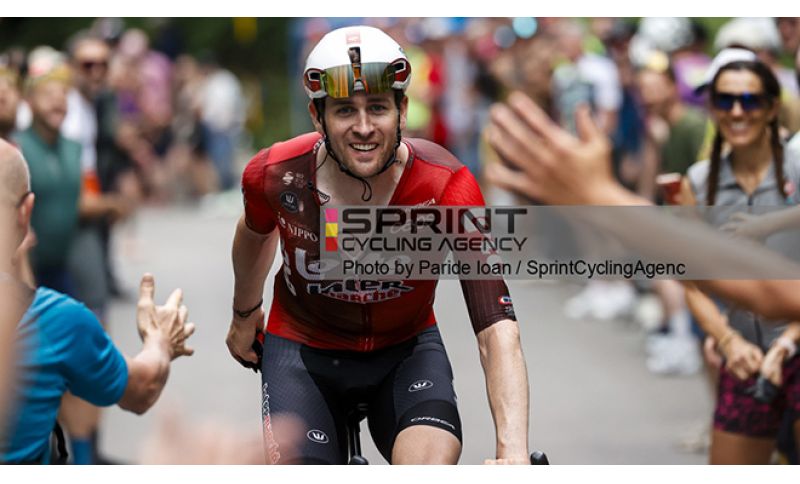
Today Toon Aerts will not be on his bike to defend his European Champion title. The Belgian was forced to stop after a serious injury in Denmark and will have to watch the Continental race on television. For Aerts, the past season has been a true battle of emotions, from triumph to pain.
The 33-year-old Flemish rider, in an exclusive interview for Belgian television, recounted a year of opposite emotions: the victory at Middelkerke, the loss of the child he was expecting with his partner Tamara, the discovery of the Giro d'Italia and the crash in Denmark, followed by an infection. Now a long rehabilitation awaits him.
Toon Aerts will not be able to defend his European cyclocross title. The reigning champion of the Charles Liégeois/Lotto-Intermarchè team is still dealing with a long and difficult recovery following the crash at the Tour of Denmark, which caused him a fractured kneecap and a serious knee infection. Aerts retraced a year lived on a rollercoaster: from the joy of continental triumph to a private loss, to the fear of never being able to ride a bike again.
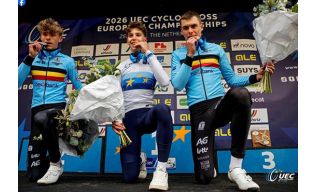
At Middelkerke, a year ago, Aerts was not the favorite. "That role belonged to Thibau Nys. However, I knew I was in excellent form and I was calm at the start." A crash had forced him to chase; in the final, after catching up with the leaders, he accelerated before the last corner. "I wasn't thinking about winning: I just wanted to get on the podium. Then I realized that Thibau wouldn't be able to pass me. It was a relief, pure euphoria."
The tension accumulated over the years dissolved all at once. In the tent behind the podium, he recounts, he risked hyperventilating; Joran Wyseure had to help him calm down. "After what I had been through, I would never have imagined becoming European champion for the second time. Those hours, from the ceremony to the celebrations at home, were perhaps the most beautiful of my career."
But the joy didn't last long. His partner Tamara was pregnant, news that only a few knew about. The Friday after the race she felt unwell and, after a visit to the emergency room, the couple discovered they would lose the baby. "At Middelkerke I had felt like I had won together with our baby. Then our world collapsed. I went from total euphoria to deep pain: for a moment cycling didn't matter to me anymore."
Aerts raced at Merksplas the next day, but admits he wasn't mentally present. The team gave him time to deal with the grief. "During the training camp, for the first time in my career I wanted to stay home. Training for four hours and then spending the rest of the day in bed, while Tamara tried to recover, was incredibly difficult. For the first time my private life and my sports career came into collision."
The cyclocross season never found the rider seen at the Europeans again. After the last race at Lille, Aerts began looking at road racing with ambition. He carefully prepared for the classics and the Giro d'Italia: three weeks in Girona, training followed to the letter, weighed food and hyperbaric tent. "I didn't want to make any mistakes. I wanted to become one of them, a WorldTour rider."
The road held surprises for him. At Roubaix and the Tour of Flanders he discovered races that as a child he had never dreamed of, but that he ended up appreciating. And at the Giro d'Italia, after three demanding weeks, he felt he had grown. "I'm the type of rider who improves by spending many hours in the saddle."
In the twelfth stage, with the finish at Novi Ligure, he came close to victory: second behind Alec Segaert. Sports director Maxime Bouet had sensed that the route could suit him. "Only in the middle of the sprint did I realize that Alec was ahead. At the moment I was happy with second place; that evening, in bed, I thought that winning could have changed the perception of my career. For many, I was a cyclocrosser trying his hand at road racing. Yet at the Giro I spent the three most beautiful weeks I've ever spent in the saddle."
Then, the accident in Denmark. Aerts was helping the team prepare for the final stage sprint when he was involved in a crash. He managed to get back up and reach the finish line, but the tests left no doubt about the severity, with a fractured scaphoid and, later, a fractured kneecap. After surgery on his knee, he hoped to return in time for the start of the cyclocross season. Three weeks later, however, fever arrived, a very strong inflammation and pain that became unbearable.
The knee was operated on and washed multiple times with specific drains; Aerts spent two weeks in the hospital, also undergoing cardiac checks because the bacteria could have reached his heart. "For a moment I even feared amputation. The knee was full of dirt." The support of hospital staff and the team, he recounts, was decisive also on a psychological level.
Now the priority is recovery. No defense of the European title, no immediate return to racing: only a long and difficult path. Aerts, who on the pavé had learned to suffer and keep going, will have to face the most difficult test away from racing.





 2
 2















 Ritratti
 Oscar
 Albi d'Oro


Se sei giá nostro utente esegui il login altrimenti registrati.