
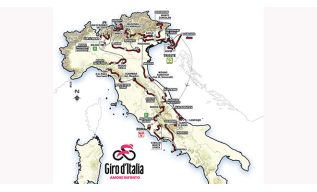




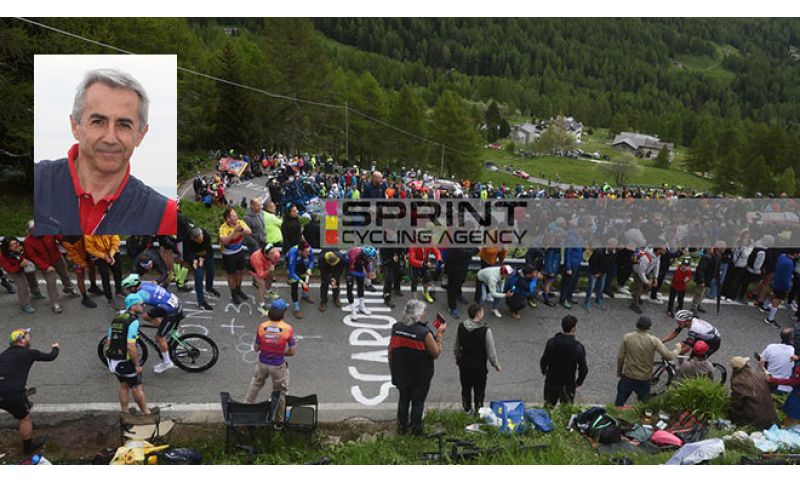
As far as I'm concerned, a Giro d'Italia with Mortirolo (twice), Gavia and Zoncolan doesn't need many comments. It speaks for itself. These are the great mountains, the mountains of myth and legend that other countries don't have, so brutal and so majestic. Finally, after years of obeying simple commercial logic, the Giro takes possession of them again and exploits them properly, as they should always be exploited, using them as trademarks, as qualities of made in Italy, exclusive and envied.
So. I would add only a hearty pat on the back to Stefano Allocchio, the new architect of the race (under the still-studying eye of new boss Guercilena), who immediately leaves his personal mark, in contrast to that of Mauro Vegni, on whom the charm, fame, and legend of certain brands made little impression—his criteria were different, more purely technical and economic, but with the inevitable effect of flattening and confusing everything a bit, essentially squandering a heritage of history and prestige, of originality and charm, in favor of more impersonal Giros.
To put it another way: if I had to design the Giro, I would every time set as fixed and non-negotiable points Mortirolo, Gavia, Zoncolan, perhaps Colle delle Finestre, then everything else to follow, with a thousand possibilities for variation and compensation in terms of difficulty. But it's understood that the Giro must be that, the word alone should suffice, like when we say Tourmalet, Mont Ventoux, Alpe d'Huez, without even needing to add the name of the race.
That said, having put Allocchio on a pedestal, something must be said about the choice of 50 kilometers of time trial, 19.6 with the climb from Sulmona towards Campo di Giove and 37.6 on the flat from Monza to Milan: that it may be an inviting bonus—as fishermen would say: chumming the waters—for Evenepoel is undeniable, just as it's equally undeniable that perhaps it won't matter at all. We're in the full era of Tour first and everything else after, certainly it won't change in 2027, so before saying this Giro is designed for Remco I'd wait to see it in action.
It's understood that with the new trends (see Tour) 57 kilometers of time trial are not a scandal; as far as I'm concerned it exceeds my preferred dosage by 10-15 kilometers, so we're there, in the right quantity, without being invasive and unbalanced in favor of specialists who then just manage to defend themselves on the climbs.
What's nice about this Giro is that even the time trial specialist won't get anything handed to him in the third week, when it comes to navigating where eagles dare, with the concrete possibility of inflicting (and recovering) massive time gaps. The new know-it-alls have been saying for a while now that it's not the big climbs that decide races anymore, but rather the nervous and unpredictable stages. Perhaps. But aside from the fact that the Giro includes those too, it's understood that the wear and tear of certain distances and altitudes nonetheless leave heavy marks, not to mention what I consider the decisive element of unmatched spectacle on the mythical climbs. To win back a certain semi-informed audience you can't say look what a nice nervous little stage, full of twists and turns, all eating and drinking, you just have to say today there's the Mortirolo: it's possible that even the distracted and the uninitiated, even just by hearsay, will take another look at the Giro.
The rest is, as always, history, geopolitics, popular culture. Three velodromes, one Cima for Coppi and one for Bartali, this time especially a tribute to Michele Scarponi. Only blemish, unforgivable: the southernmost point is Naples. That is, the South isn't included. But this has all the appearance of being a fault, more than Allocchio's, of the accountant in administration.

 1


 1


 1
1
11
11
2
2
3
3
2
2



 |
 |
||
 |
 |
|
|
 |
|
||



 Ritratti
 Oscar
 Albi d'Oro


