

















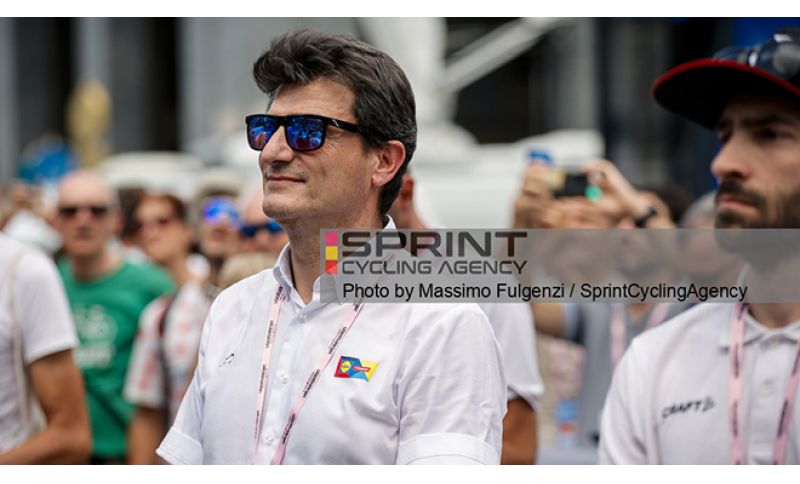
There are interviews that tell of an appointment and others that, if read carefully, already begin to outline a method. The words spoken by Luca Guercilena in conversations published in recent days by La Gazzetta dello Sport and the Corriere della Sera belong, in my view, to the second category.
Because behind the inevitable curiosity aroused by the new director of the Giro d'Italia and the cycling division of RCS Sport emerges a vision that attempts to shift the debate from the terrain of individual editions to that, far more complex, of the position that the pink race will need to occupy in world cycling in the coming years.
Perhaps the most important phrase is also one of the simplest: "We must not go hunting for big names, we must propose a race that attracts them". Within these few words lies a substantial change in perspective. The problem is not convincing Pogacar, Vingegaard or the champion of the moment to choose the Giro every year. The problem is building a Giro in which choosing to participate becomes convenient, prestigious and technically coherent with the planning of a great rider and his team. It is a distinction that may seem subtle, but it completely changes the way to approach the issue of attractiveness.
On this topic, in recent months, I had the opportunity to discuss with Guercilena through some analytical work dedicated precisely to the ability of the pink race to enter stably into the strategic decisions of teams. The reasoning was based on data, the quality of start lists, the calendar, the sporting and commercial value of races, participation costs and recovery times. Finding today some of those themes brought back into the concrete experience of someone who has directed one of the most important WorldTour teams for years represents, for those who conduct research applied to cycling, a source of genuine satisfaction. Not because ideas should have an owner, but because research truly makes sense when it emerges from tables and manages, perhaps even only in part, to feed into a decision.
Guercilena then speaks of a "psychological subordination" to the Tour that must be overcome. This too is a decisive passage. The Tour will inevitably remain the primary commercial and media reference point of world cycling, but recognizing its strength does not mean accepting that everything else on the calendar must live by subtraction. The Giro does not need to become an Italian copy of the French race. It needs, rather, to make even more recognizable what it already possesses: extraordinary technical variety, different territories, mountains that resemble no other race, a cycling culture sedimented over more than a century of history and that unpredictability which, when governed and not random, represents one of its greatest values.
Interesting, in this sense, is also the reference to the need to make "stable, upward, the list of starters at the Giro". This is probably where the most important game is played. A great race cannot depend every year on the presence of one or two names. The overall quality of a start list, the density of top-level riders, the simultaneous presence of general classification contenders, sprinters, time trialists, stage hunters and emerging young talent build that competitive depth that allows a race to thrive even when the absolute superstar is missing.
Pogacar and Vingegaard are fundamental, Guercilena explained, but the Giro must be capable of producing spectacle even independently of them. This is exactly the leap to be made: moving from the value of the individual champion to the structural value of the race.
Then there is the calendar. Guercilena spoke of the possibility of moving the Giro slightly forward, of permanently including June 2nd, of offering greater recovery to riders coming out of the Northern campaign and, possibly, of finding more favorable weather conditions. This is a theme far more important than it may appear. For a WorldTour team the calendar is not simply a succession of races: it is a system of resource allocation. Every choice determines altitude periods, recovery, peaks of form, transfers, available riders and sponsor objectives.
If the Giro wants to become a first choice it must enter earlier into team programs, offering greater certainty and greater advance notice. Also for this reason the declared willingness to present routes earlier represents not only an organizational improvement: it is a true competitive lever.
Equally significant is the idea of building balanced courses. "Climbers, sprinters and time trialists must have their space", Guercilena said, also returning to the value of time trials and the need to avoid extreme solutions. This is a modern conception of difficulty. The Giro must remain hard, because it would lose part of its identity if it stopped being so, but hard does not necessarily mean excessive. A complete race is not one that simply accumulates meters of elevation gain; it is one that forces the winner to demonstrate different abilities and, at the same time, leaves multiple forms of competition open.
And then safety, circuits, public services, sponsors, television, internationalization. Guercilena sums it all up with a phrase that deserves attention: "It's all connected". This is probably precisely the key. In contemporary cycling there is no longer a clear separation between technical value, organizational quality, media exposure and economic sustainability. A route influences the riders who will come, riders influence the audience, the audience influences sponsors, sponsors support organizational capacity and quality, and organizational quality in turn affects team choices. It is a system, not a sum of separate compartments.
For this reason Guercilena's challenge concerns not only the Giro d'Italia. It concerns the role that all of Italian cycling wants to regain. RCS has Milan-San Remo, Strade Bianche, Tirreno-Adriatico, Giro d'Italia, Lombardia, Giro Women and Giro Next Gen: a heritage that few organizers in the world can boast. The Federation, sports societies, organizers, territories and institutions in turn safeguard a tradition that cannot be considered simply a legacy to celebrate.
Italian cycling has known seasons in which it was simultaneously the sporting, industrial and cultural center of this world. We will not return to those glories by evoking them with nostalgia. We can only return to them by building a model capable of interpreting the cycling that will come. And this is perhaps the aspect that most comforts me when reading the first words of the new director of the Giro: the impression that the pink race is not considered a monument to preserve, but an organism to evolve.
For those who in recent years have tried to study its numbers, fragilities and potential, recognizing in today's debate some themes addressed together is a source of pride. But it would be a mistake to stop at personal satisfaction. True satisfaction will come only when those reasonings become results: more champions at the start, more teams that program the Giro as their primary objective, more international audience, more value for sponsors and territories and, above all, an Italian cycling once again capable of setting the agenda instead of following it.
Because bringing the Giro back to the world level it deserves means, ultimately, attempting something even more ambitious: bringing Italian cycling back to the position that its history assigns to it and that the future asks it to reclaim.

 7
7


 7
7



 Ritratti
 Oscar
Oscar Albi d'Oro

