


















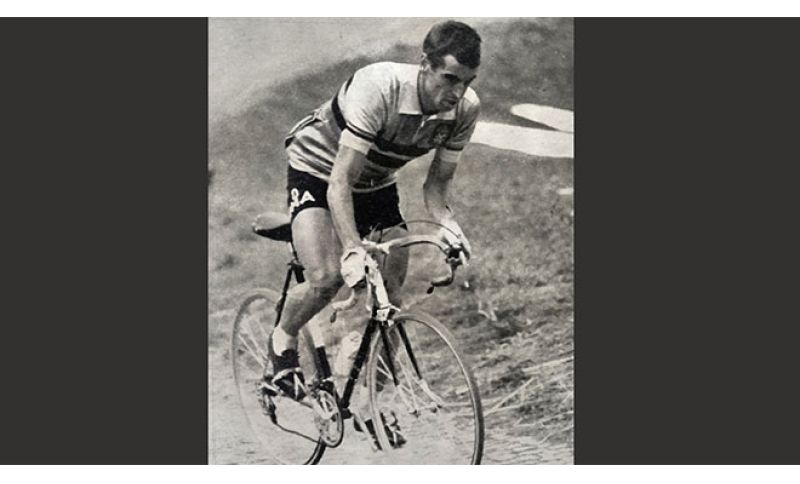
Look at those quadriceps. My father, Gigi Mele, whenever he started talking about Rik Van Looy, almost always ended up there. Not at the 37 stage wins in the grand tours. Not at the three Paris-Roubaix victories, the two World Championships, the two Flanders, the Sanremo, the Lombardia, the two Paris-Tours. It wasn't even enough to remember that this man, despite being built seemingly to dominate sprints, had finished the 1959 Giro d'Italia in fourth place.
No. Gigi always came back to those legs. To those enormous quadriceps that, in his memory, had become almost the symbol of power itself. Because he had seen Van Looy up close. Not in newspaper photographs, not in other people's stories. On the road.
From 1961 to 1964 my father raced in the same group as the Emperor of Herentals. He watched him with the admiration that a young man can have for one of the greatest champions in the world and, at the same time, with that healthy recklessness that belongs to those who ride bicycles and know that sooner or later you have to try to measure yourself against everyone.
Once, after a race, Gigi said to him: "What strength you have, Rik, congratulations. I also have legs almost as big as yours. Certainly not your kind of power."
Van Looy shook his hand. Then came the response, dry, ruthless, perfectly in the Emperor's style: "Your legs are full of shit."
Gigi burst out laughing. "Thanks Rik, you have a kind word for everyone." And they both laughed.
But that phrase, knowing my father, probably stayed there. Somewhere. Because a few months later, in the 1963 Sassari-Cagliari, Gigi would have the chance to answer him in the way a cyclist knows best: with the pedals.
The Sassari-Cagliari was one of the great Italian classics of the era. A race that Bartali loved to talk about and that had already seen immense champions win it: Fiorenzo Magni, Hugo Koblet, Miguel Poblet. And its roll of honor would welcome in the following years Rik Van Looy himself, Vittorio Adorni, Rudi Altig, Eddy Merckx, Patrick Sercu, Roger De Vlaeminck, Giuseppe Saronni and other names destined to enter cycling history.
That 1963 the race was 225 kilometers long. The first hour passed almost without incident: barely thirty kilometers. Then Gigi attacked. With him was Jean-Claude Lebaube, a Frenchman from Saint-Raphaël and teammate of Jacques Anquetil. The breakaway took shape. And for over a hundred kilometers those six men up front rode practically to the death.
Behind, Van Looy and the other champions organized the chase. The race turned into a battle. The final average would be almost 43 kilometers per hour.
Think about those numbers and try to imagine those roads. Up front they were pedaling hard. Behind, the group of the best was going at a crazy speed to close the gap. In the end they almost pulled it off: about 35 seconds behind the six leaders, Van Looy and the others arrived racing toward Cagliari. But Rik was furious. He was seething with rage from every pore.
Because in his idea of cycling, a race like the Sassari-Cagliari, with a finish that could lead to a sprint, wasn't a race to participate in. It was a race to win. And Van Looy was made that way. Classics weren't simply raced. They were won.
Gigi was pedaling up front and, the more he pedaled, the more that phrase probably came back to his head. Your legs are full of shit. That remark that could have hurt him had instead become a formidable motivation. A kind of private challenge that Gigi carried inside without needing to tell anyone about it.
But ahead was Cagliari. There was the Amsicora. There was that dirt track on which legends had already won. And Gigi wanted to be there. He wanted to win. For a rider like him it would have been an enormous achievement.
The breakaway, however, had had a price. When the moment came to pay it, the legs presented the bill. Gigi had spent a lot to keep that breakaway alive and to fuel every change. His generosity had been his strength and, precisely at the end, it would become his limit.
Up front remained Battista Babini and Antonio Suárez, winner of the 1959 Vuelta. Babini won. It would be his only professional victory. Gigi arrived third. And behind, 35 seconds back, came the group of the best. With Van Looy.
The Emperor had chased to the end. But the sprint that, in his head, should have been almost a formality, wouldn't happen. Gigi had lost the chance to win right in the final kilometers, when the effort accumulated in the breakaway had presented him with the bill.
Yet, while still trying to catch his breath and almost with the shyness of someone who knows they've brushed against something great, he saw Van Looy arrive. The Belgian reached him still on his bike. He looked at him. And he said: "I thought you'd win today. You almost got me."
A pat on the shoulder. The usual grin. And off, to rejoin his teammates.
For Gigi that phrase meant a lot. Not because Van Looy had finally recognized a rival at his level. That wasn't it. It was the recognition, from a champion of champions, of a race ridden with courage, of a breakaway conducted to the end, of an opportunity that the group of the best had to chase for over a hundred kilometers. And especially because it came from Rik Van Looy.
That evening my father understood something else too. That opportunity wouldn't come back. That breakaway. That day. That race. That finish line. Everything had happened just once.
And perhaps that's precisely what makes certain memories so persistent: not the victory you've conquered, but the one you had truly in your legs for an afternoon.
The following year would bring another great opportunity, and with it a bitterness that Gigi would carry with him until his final pedal strokes: that of Milan, at the 1964 Giro d'Italia. But that's another story.
The 1963 Sassari-Cagliari remains there. On the dirt of the Amsicora. In Gigi's third place. In the unrepeatable victory of Battista Babini. In the six men of the breakaway capable of forcing the group of champions into a mad chase. And in that Van Looy who, arriving 35 seconds back, still had the rage of someone convinced that race should have been his.
And then those words. "I thought you'd win today. You almost got me."
I think that Gigi, after hearing them, would have even wanted to thank him. Because maybe, without that remark months earlier about his legs, he wouldn't have pedaled with such ferocity.
Van Looy had told him that his legs contained only shit. That day Gigi proved to him that, at least for 225 kilometers, inside those legs there was also something very different: the desperate desire to try.
And perhaps, in the end, that's precisely what a champion leaves with those who challenged him without being able to truly beat him: the desire to try again.




 Ritratti
 Oscar
Oscar Albi d'Oro


Se sei giá nostro utente esegui il login altrimenti registrati.