
















Wrong format? Wrong choice of influencer? Wrong tone used? Perhaps all of this, perhaps something else, but one thing is certain: the case of Erola Jons has shaken the Vuelta and prompted organizers to reconsider their choice and set limits on the Iberian influencer's communication. Let's reconstruct what happened.
THE CHOICE. With the intention of capturing the attention of young people and a new market segment, the Vuelta organizers hired influencer Erola Jons to cover the race, with three million followers to her credit, who has built her fortune by catching unsuspecting men off guard and embarrassing them with her provocative clothing and double-entendre questions.
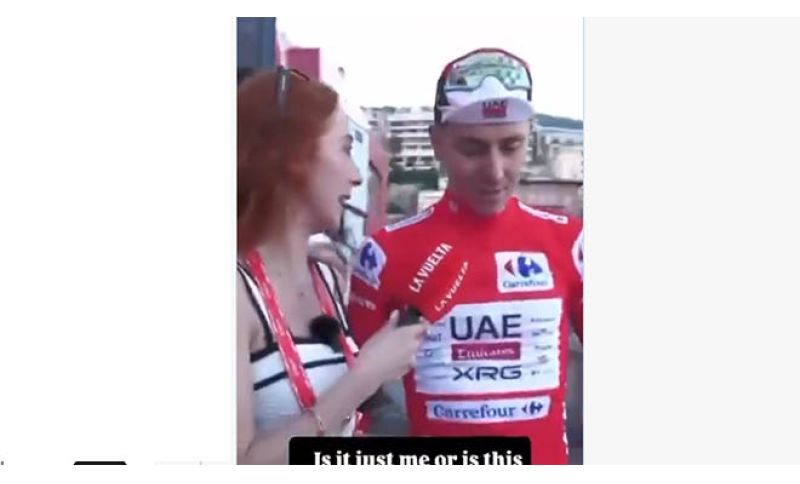
THE DEBUT. Jons' first day at the Vuelta is what sparked the scandal: the girl—far from stupid, she holds a degree in Economics and Management—chased Pogacar while he was pedaling on the rollers at the end of the time trial and while preparing to take the podium to wear the red jersey. To try to get the Slovenian's attention, she resorted to squeals and shrieks, and when she finally had him by her side, she surprised him with questions like "Why do you hyperventilate every time you see me?", or "Great Pogachitar, take me for a ride too" (a vuelta, in Spanish).
THE REACTION. On YouTube, the images had relative success, just 4,000 views, but on social media the reaction to Jons' reports was decidedly stronger, and the influencer was bombarded with criticism.
In particular, very harsh was the stance taken by Laura Meseguer, a Spanish journalist who has been an appreciated face of Eurosport for years: "Many women have spent years fighting to expand our space in a sport dominated by men, so that we are treated with respect and have the same opportunities as everyone else. It is a serious mistake to hire someone who doesn't know the sport at all, whose content will be based on this series of sexist comments from which we women have been trying to free ourselves for decades!!! It is a lack of respect towards us, towards the female professionals who work here and, above all, towards the cyclists. No one should be forced to be treated as an object, neither women nor men".
Spanish television also pointed the finger at Jons: on TVE, Carlos de Andrés involved his female journalist colleagues who felt offended after years of fighting to carve out a space for themselves in a traditionally male sport. And he closed by commenting: "I hope the organization also reacts to all this and realizes that perhaps it wasn't the best idea they could have had. I would never dream of going up to Pogacar and telling him: 'Come on, Pogachitar'. We're talking about one of the most important figures in world sport. It's not like some random guy passing by and me trying to make a joke. I didn't know this girl and I hope it doesn't occur to her to do other foolish things like that".
THE DECISION. Faced with such an uproar, which ultimately ended up putting the girl in the spotlight more than the Vuelta itself, the Vuelta organizers made a sort of U-turn: Jons will remain in the caravan until the end of the race but will not have access to the mixed zone, team buses, or checkpoints where she could interact directly with cyclists during the competition.
As for the content she publishes, the Vuelta has officially asked Erola Jons to adapt the tone and style of her posts to the context of a high-level sporting event. It's hard to understand this choice—it's like asking—the example is obviously paradoxical—a cyclist to run a marathon; it makes no sense even if he has the endurance...
The Vuelta organizers have made it known that they agree that the incident has opened a debate on feminism. Their position is based on the fact that Erola, as a woman, has every right to have her space and convey her message within the race.

 17
17


 17
17



 Ritratti
 Oscar
Oscar Albi d'Oro

