
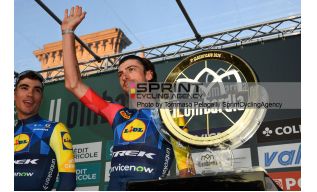





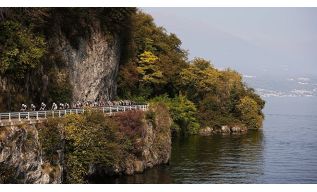

















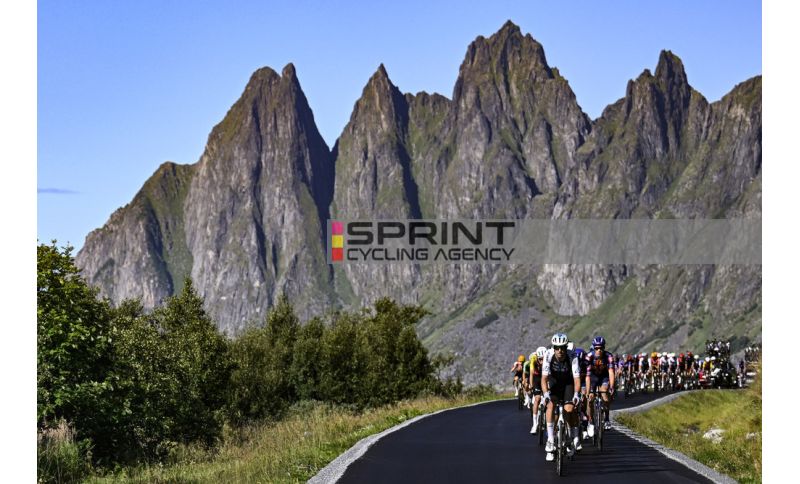
It will once again be a feast for the eyes that enthusiasts, both on site and from home, will be able to experience during the Arctic Race of Norway 2026. Scheduled from Thursday, August 13 to Sunday, August 16, the short Norwegian stage race (which has become even more the flagship event and the only professional race in the entire country following the cancellation of the Tour of Norway) will once again take place in a landscape of incredible splendor that, combined with the battle that riders will express on the road, will make the event absolutely thrilling and spectacular.
The setting chosen for the thirteenth edition of the Scandinavian .Pro category race will be almost entirely that of Nordland County which, after serving as the backdrop last year to the victory achieved by Corbin Strong ahead of Tom Pidcock and Christian Scaroni, has been selected again to create another intriguing chapter of the event organized by A.S.O.
Unlike what happened in 2025, however, this year the riders will battle for the "midnight sun" yellow jersey along the winding (and at times steep) stretches of the Vesterålen archipelago, one of the most renowned and appreciated tourist destinations in the entire nation. It is here, alongside the grand finale that will instead unfold on mainland Norway, that athletes will find themselves pedaling for 698.9 kilometers (the highest figure since the 2017 edition) and 6,737 meters of total elevation gain, numbers that are the result of four stages that will equally call upon sprinters and general classification contenders.
In the first two days of racing, indeed, we should witness two sprint finishes given the very limited altitude difficulties and not too close to the finish line. In the Evenes-Myre stage of 181.9 kilometers, the three short second-category mountain passes (the last of which is 26 kilometers from the finish) should do little more than tickle the legs of the sprinters who, supported by their teams, will have favorable terrain to control the situation and set up the probable final sprint. The next day, in the Bø i Vesterålen-Andenes stage, the second of the two Mountain Grand Prix (that of Storvatnet) will be positioned no less than 123 kilometers from the finish and therefore, 24 hours later, the partial success should again be a matter for the sprinters unless, facing the many jagged kilometers along the coast, the wind intervenes to shake up the cards and open up outcomes different from the one that appears most obvious on paper.
Having left the island of Andøya for that of Hadseløya (also known for hosting the Arctic Run marathon), it will be up to the puncheurs and the big names in the race to take center stage in the two stages that will decide the general classification. The first, that of 146.5 kilometers starting from Stokmarknes, will likely be the most anticipated because it will conclude at the top of the climb, that of Storheia, known as the Norwegian Mont Ventoux: the ascent, a true wall of 3.5 kilometers at 11.8% average gradient, was tackled for the first and only time in 2019 (victory by Odd Christian Eiking in what was also then the third stage on the program) and has everything to significantly direct the contest for first place in the standings.
To define this conclusively, however, exactly as happened seven years ago, will be the fourth and final stage starting from Sortland and finishing in Narvik which, unlike the 2019 edition, will not conclude with a circuit to be repeated three times but rather with an uphill finish (3.9 kilometers at 6.2% the detail of the final climb) toward the site that, in 2029, will host the Alpine Skiing World Championships. It will be here, in the locality that has twice in the past brought down the curtain on the Arctic Race of Norway and that after seven years returns to host the race, that the new winner of the world's most northerly professional race will be known, an event that, with its mix of steep climbs, breathtaking panoramas and the warmth of its joyful public, is certain to enchant those who follow it this year as well.
August 13: Evenes-Myre (181.9 kilometers, 1,628 meters of elevation gain)
August 14: Bø i Vesterålen-Andenes (180 kilometers, 1,161 meters of elevation gain)
August 15: Stokmarknes-Storheia Summit (Melbu) (146.5 kilometers, 1,731 meters of elevation gain)
August 16: Sortland-Narvik (190.5 kilometers, 2,217 meters of elevation gain)



 1
1
 1
2
2
1
2
2

 Ritratti
 Oscar
Oscar Albi d'Oro


Se sei giá nostro utente esegui il login altrimenti registrati.