















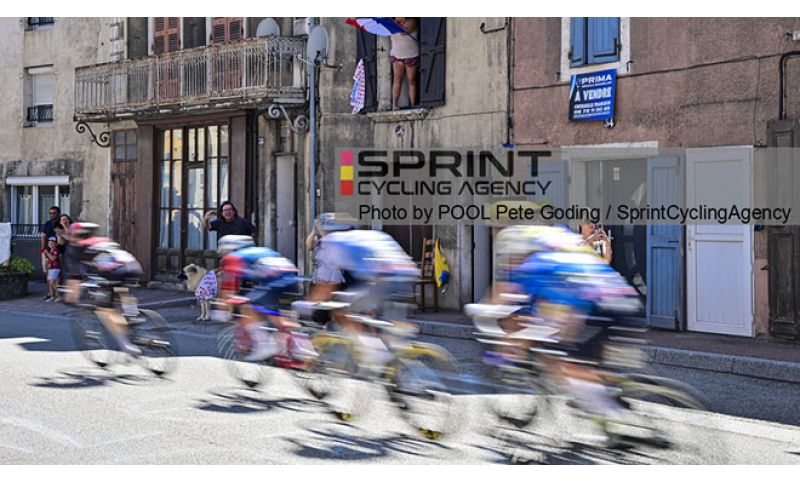
The fight against doping at the Tour de France never stops, not even when cyclists are sleeping. It was the French newspaper Le Parisien that reconstructed the behind-the-scenes details of checks carried out during nighttime hours, a publication that for years has consistently followed and investigated matters related to anti-doping at the Grand Boucle. In the past, the French newspaper has published numerous investigations on the subject and, in this edition of the Tour de France, it is closely following the work of investigators and technicians from the International Testing Agency (ITA), engaged in a testing campaign that would have involved almost all riders in the race.
The choice to conduct tests in the dead of night is not random. At the center of attention is a practice known for years by anti-doping experts: microdosing. This involves the administration of very small quantities of prohibited substances, sufficient to produce physiological benefits if taken continuously, but decidedly more difficult to detect during normal checks.
In an update yesterday evening on this case, the French newspaper wanted to share with readers what it learned from some anti-doping experts.
«For EPO, we're talking about a standard dose of about 40 units per kilogram three times a week, while a microdose can be 20 or even 10 units per kilogram - explains to Le Parisien Michel Audran, former director of the anti-doping laboratory at Châtenay-Malabry - The effect is less evident immediately, but by prolonging the treatment over time, you can obtain similar results».
Professor Jean-Claude Alvarez, a toxicology specialist at Garches Hospital, also confirms that the phenomenon is well known to those in the field.
«Not all substances work with microdosing - he observes - Products like ostarine would not have appreciable effects, while hormones like EPO or growth hormone are particularly suited to this type of use».
The real advantage for those who might choose this illicit practice is represented by the difficulty of detection. «The only advantage of microdosing is that it is much more difficult to detect during an anti-doping check», Alvarez emphasizes. It is no coincidence that scientific studies have shown how small repeated administrations of EPO can also escape the biological passport, the tool that monitors athletes' blood parameters over time.
Some substances have extremely short residence times in the body. IGF-1, growth hormone naturally produced by the liver and involved in recovery processes, can be eliminated within a few hours. A characteristic that makes the timing of the check absolutely crucial.
For this reason, Michel Audran explains further, it is necessary to intervene as quickly as possible. «These substances must be detected as close as possible to the moment they are injected into the body. Otherwise, they drop too rapidly below the detection threshold and it's too late to prove anything».
This is precisely the reason that would have led ITA inspectors to conduct checks even during the night, catching athletes in their hotels.
According to Le Parisien's reconstruction, among the riders subjected to these tests were also Tadej Pogacar and Jonas Vingegaard, woken in the early morning hours in the midst of the difficult Alpine weekend. A situation that would have caused discontent among their respective teams, UAE Team Emirates-XRG and Visma-Lease a Bike, concerned above all with the recovery of their leaders during the decisive phase of the race.
The Union Cycliste Internationale defended without hesitation the work of the International Testing Agency, reiterating its full support for the ITA in using all means at its disposal to carry out its mission as effectively as possible.
But the most significant statement comes from Jonathan Vaughters, former American professional, former teammate of Lance Armstrong and today manager of EF Education-EasyPost. His words explain better than any analysis why nighttime checks represent today one of the most effective tools in the fight against doping.
«Conducting checks at two in the morning is one of the most effective ways to combat microdosing of EPO, growth hormone and testosterone», says Vaughters.
Then comes a reflection destined to spark discussion, because it is pronounced by someone who lived from within one of the darkest eras of cycling.
«If the UCI had checked us at two in the morning in 2001, we would all have been banned and we would have spared this sport twenty-five years of anti-doping checks».
A statement that weighs like a collective confession and offers an important key to understanding the evolution of the fight against doping. Today, ITA investigators seek to anticipate the strategies of those who might attempt to circumvent checks, intervening precisely during the hours considered most sensitive for microdosing.

 8
8


 8
8


 3
3
8
8
10
10
6
6
1
1
3
3
8
8
10
10
6
6
1
1

 Ritratti
 Oscar
Oscar Albi d'Oro

