
















There are mountains that are not simply climbs. They are places of memory, pages of history that the Tour de France continues to turn year after year. Orcières-Merlette is one of these. Today the Grande Boucle will return to the Alpine locality with the eighteenth stage, 185.2 kilometers from Voiron and 3,807 meters of elevation gain, the first act of the decisive three days in the Alps that will culminate with the double appointment on Alpe d'Huez. The yellow jersey is currently on the shoulders of Tadej Pogacar, with a lead of 4'32" over Remco Evenepoel, 6'51" over Isaac Del Toro, 7'11" over Paul Seixas and 9'22" over Juan Ayuso.
But when we talk about Orcières-Merlette, our thoughts inevitably turn to July 8, 1971, the day when even Eddy Merckx seemed human, forced to yield to that climb that had put him in question.
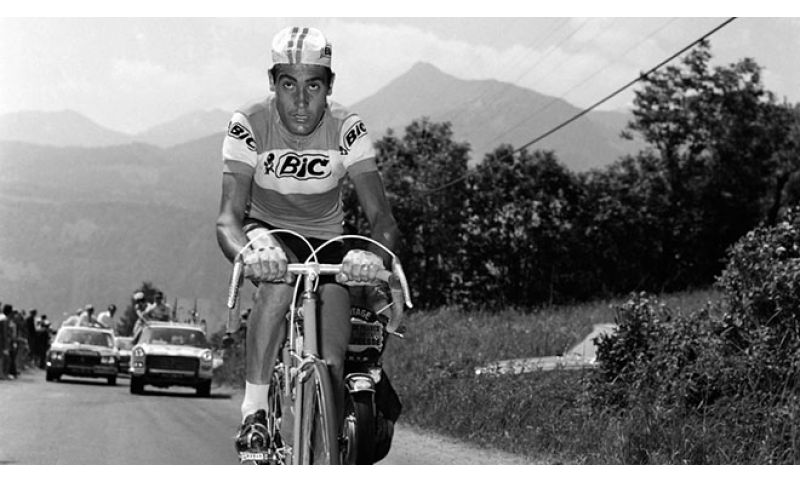
That was the day the Cannibal went into crisis. Merckx arrived at the eleventh stage from Grenoble to Orcières-Merlette wearing the yellow jersey and with the aura of an unbeatable rider. He had already won two Tours de France and seemed destined to dominate the 1971 edition as well. But that day he found Luis Ocaña in his path. The Spanish climber, an extraordinary mountain specialist and one of the few capable of challenging the Cannibal in the high mountains, decided to attack from very far out. On the Col du Noyer, a full 77 kilometers from the finish, he launched a solo attack without looking back. It was a memorable ride. Merckx tried to limit the damage, but this time he failed to respond. For the first time the Cannibal appeared vulnerable, unable to answer his rival's attacks. He crossed the finish line third, with a deficit of 8'42", surrendering the yellow jersey to Ocaña himself. It was probably the hardest mountain defeat of his career.
But those who knew Eddy Merckx knew that a defeat would not go without consequences. Luciano Armani, protagonist the next day of one of the most incredible stages in Tour history, remembered that evening perfectly when he spoke to Gian Paolo Porreca, author of the book "Ask Me Who Merckx Was": «I can still see him that evening, in the hotel, on the stairs. He was grumbling about how the race had gone, so badly for him. I tried almost to console him: Come on Eddy, if you're complaining, you who have won so much, think about how much I should be complaining». The Belgian's response was almost a warning. «If you want to go in a breakaway to Marseille, be at the front at the start». It was not a joke. It was a promise. The craziest breakaway in Tour history. The next day, in the very long stage toward Marseille, Merckx transformed his anger into one of the most legendary feats in cycling. A small group up front with Merckx leading and behind him the Spanish rider in the yellow jersey who, with his entire team, tried to catch him. The pace was so impressive that the race arrived in Marseille two hours ahead of schedule. The publicity caravan had to be stopped to let the riders pass, while Mayor Gaston Defferre arrived on the podium when the race was practically already over.
After six hours of racing at over 45 kilometers per hour, the leading group fought for victory in the sprint. Everyone naturally wanted Merckx's wheel. Armani decided instead to surprise everyone and won by just ten centimeters. Merckx himself, just after crossing the finish line, asked if the victory was his, but Armani, almost embarrassed, admitted it had been him who won. It was the most important victory of the Parmesan rider's career, achieved by beating what he himself would later define as "the most enormous Merckx", a champion who, wounded in pride the day before, had attempted to overturn the Tour with an attack spanning 250 kilometers.
The great battle between Merckx and Ocaña seemed destined to continue all the way to Paris. Instead, fate intervened a few days later. On July 12, exactly 4 days after the Orcières-Merlette stage, during the descent of the Col de Menté in the Pyrenees, in pouring rain, Ocaña crashed badly. Several riders went down and the Spanish rider was forced to retire. Merckx, who would have preferred to win by beating his great rival on the road, found himself back in the yellow jersey (though he did not wear it that day, out of respect for his rival) and conquered his third of five Tours de France in Paris.
The return to Orcières-Merlette, fifty-five years after that historic feat by Ocaña, will be another page in the long history of the Tour and a new rider will be carried in triumph, like a victorious hero who at Orcières-Merlette will have accomplished another feat. The finish is located at 1,825 meters of elevation, at the end of a 7.1-kilometer climb with an average gradient of 6.7%, twelve hairpin turns in the last six kilometers and peaks of 8%. Time bonuses of 10, 6 and 4 seconds will be at stake. For Pogacar it could be another opportunity to consolidate his leadership. For Evenepoel, Del Toro, Seixas and Ayuso, it will be one of the first real tests of the final week.
But whatever happens, Orcières-Merlette will forever remain the place where the Cannibal experienced one of the most painful defeats of his career and, just twenty-four hours later, gave rise to one of the most extraordinary demonstrations of pride that cycling has ever known. Because great champions are measured not only by their victories, but above all by the strength with which they react to defeats. And that 1971 Tour transformed Merckx into an even greater legend.

 4
4


 4
4


 1
1
1
1
4
4
2
2
1
1
1
1
4
4
2
2

 Ritratti
 Oscar
Oscar Albi d'Oro

